
Request your free, three-month trial to Tabletalk magazine. You’ll receive the print issue monthly and gain immediate digital access to decades of archives. This trial is risk-free. No credit card required.
Try Tabletalk NowAlready receive Tabletalk magazine every month?
Verify your email address to gain unlimited access.
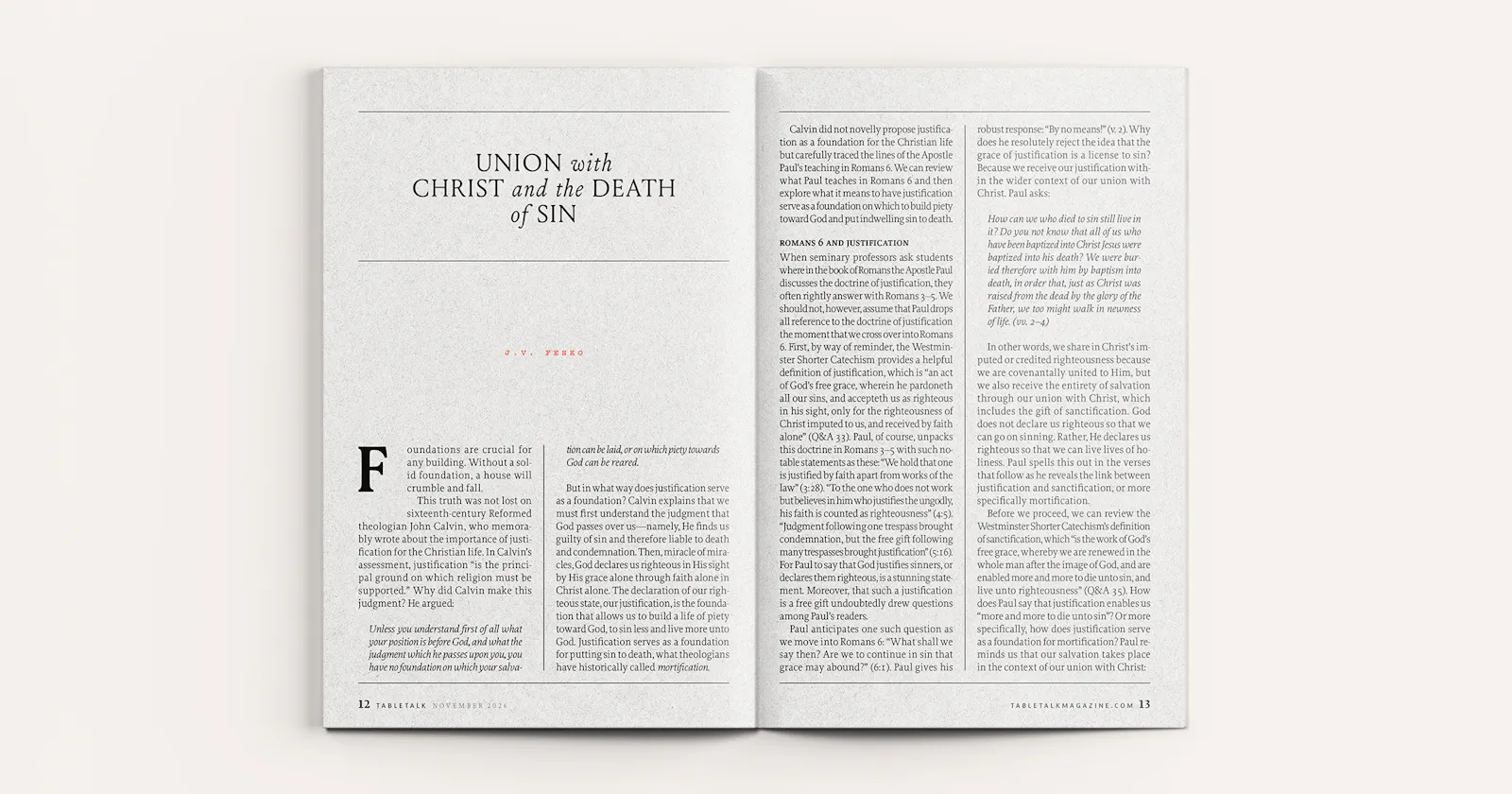
Foundations are crucial for any building. Without a solid foundation, a house will crumble and fall.
This truth was not lost on sixteenth-century Reformed theologian John Calvin, who memorably wrote about the importance of justification for the Christian life. In Calvin’s assessment, justification “is the principal ground on which religion must be supported.” Why did Calvin make this judgment? He argued:
Unless you understand first of all what your position is before God, and what the judgment which he passes upon you, you have no foundation on which your salvation can be laid, or on which piety towards God can be reared.
But in what way does justification serve as a foundation? Calvin explains that we must first understand the judgment that God passes over us—namely, He finds us guilty of sin and therefore liable to death and condemnation. Then, miracle of miracles, God declares us righteous in His sight by His grace alone through faith alone in Christ alone. The declaration of our righteous state, our justification, is the foundation that allows us to build a life of piety toward God, to sin less and live more unto God. Justification serves as a foundation for putting sin to death, what theologians have historically called mortification.
Calvin did not novelly propose justification as a foundation for the Christian life but carefully traced the lines of the Apostle Paul’s teaching in Romans 6. We can review what Paul teaches in Romans 6 and then explore what it means to have justification serve as a foundation on which to build piety toward God and put indwelling sin to death.
romans 6 and justification
When seminary professors ask students where in the book of Romans the Apostle Paul discusses the doctrine of justification, they often rightly answer with Romans 3–5. We should not, however, assume that Paul drops all reference to the doctrine of justification the moment that we cross over into Romans 6. First, by way of reminder, the Westminster Shorter Catechism provides a helpful definition of justification, which is “an act of God’s free grace, wherein he pardoneth all our sins, and accepteth us as righteous in his sight, only for the righteousness of Christ imputed to us, and received by faith alone” (Q&A 33). Paul, of course, unpacks this doctrine in Romans 3–5 with such notable statements as these: “We hold that one is justified by faith apart from works of the law” (3:28). “To the one who does not work but believes in him who justifies the ungodly, his faith is counted as righteousness” (4:5). “Judgment following one trespass brought condemnation, but the free gift following many trespasses brought justification” (5:16). For Paul to say that God justifies sinners, or declares them righteous, is a stunning statement. Moreover, that such a justification is a free gift undoubtedly drew questions among Paul’s readers.
Paul anticipates one such question as we move into Romans 6: “What shall we say then? Are we to continue in sin that grace may abound?” (6:1). Paul gives his robust response: “By no means!” (v. 2). Why does he resolutely reject the idea that the grace of justification is a license to sin? Because we receive our justification within the wider context of our union with Christ. Paul asks:
How can we who died to sin still live in it? Do you not know that all of us who have been baptized into Christ Jesus were baptized into his death? We were buried therefore with him by baptism into death, in order that, just as Christ was raised from the dead by the glory of the Father, we too might walk in newness of life. (vv. 2–4)
In other words, we share in Christ’s imputed or credited righteousness because we are covenantally united to Him, but we also receive the entirety of salvation through our union with Christ, which includes the gift of sanctification. God does not declare us righteous so that we can go on sinning. Rather, He declares us righteous so that we can live lives of holiness. Paul spells this out in the verses that follow as he reveals the link between justification and sanctification, or more specifically mortification.
Before we proceed, we can review the Westminster Shorter Catechism’s definition of sanctification, which “is the work of God’s free grace, whereby we are renewed in the whole man after the image of God, and are enabled more and more to die unto sin, and live unto righteousness” (Q&A 35). How does Paul say that justification enables us “more and more to die unto sin”? Or more specifically, how does justification serve as a foundation for mortification? Paul reminds us that our salvation takes place in the context of our union with Christ:
For if we have been united with him in a death like his, we shall certainly be united with him in a resurrection like his. We know that our old man was crucified with him in order that the body of sin might be brought to nothing, so that we would no longer be enslaved to sin. (6:5–6, author’s translation)
Notice that our death to sin and the newness of resurrection life both come through union with Christ. In our union with Christ, we receive what Calvin called the “twofold grace” of justification and sanctification. How do they work in concert to provide both the foundation for and the power of mortification?
The Apostle Paul provides the answer: “One who has died has been set free from sin” (Rom. 6:7). Literally, Paul’s Greek says that “one who has died has been justified from sin.” What does it mean to be justified from sin? In his commentary on this verse, Calvin explains that it means to be “freed from the bond of a charge” or to be “absolved by the sentence of a judge.” Imagine standing before a judge, knowing without a shadow of a doubt that you are guilty of great crimes. Yet when the judge looks down from his bench as you stand shackled and in dirty prisoner’s garb, he says the words, “I declare you righteous!” You are not merely innocent of wrongdoing, but he declares that you are in full conformity to the entirety of the law. This little illustration helps us understand what our justification through faith in Christ grants us. We are freed from the guilt of sin; we are justified from it. And yet, what does Paul mean when he writes, “One who has died has been justified from sin”? Does death alone instantaneously qualify a person to be justified from sin? No.
Within the wider context of chapter 6, only those who are in union with Christ receive the legal verdict of “righteous,” and only those who are united to Christ therefore die with Him. Christ’s death becomes our death, and thus through His redemptive work and our justification, God gives us a foundation for the Christian life. In his Romans commentary, the great nineteenth-century Princeton Seminary professor Charles Hodge paraphrases Paul’s point like this:
For he that is dead with Christ is thereby justified, and free from the punishment of sin; he is thus reconciled to God; and as reconciliation and communion with God are the true sources of holiness, he is also freed from sin.
Our justification provides the legal foundation that clears the way for Christ’s indwelling presence, a union that fuels our sanctification and mortification. In his Systematic Theology, a little-known work written in Dutch, Princeton Seminary biblical theologian Geerhardus Vos puts it this way: “The justifying acts serve as the foundation upon which the regenerational acts of God rest. Although (for instance) justification follows the new birth in time, nevertheless, the former is the foundation for the latter.” What does this all mean? What does it mean for the Christian life and the mortification of sin when Paul writes that “one who has died has been justified from sin”? What does it mean when Calvin, Hodge, and Vos explain that justification serves as a foundation for sanctification?
union with christ and mortification
We can answer these questions with several other questions and one vital and important answer. Why do we fight against temptation and sin? Do we fight it so that we can become united to Christ or because we are already united to Him? Or, more simply stated, do we fight sin in order to be saved or because we are already saved? The answer that Paul gives is that we have been justified from sin and therefore we should not let sin reign in us (Rom. 6:12). Paul writes, “For sin will have no dominion over you, since you are not under law but under grace” (v. 14). That is, because we are united to Christ, our Savior has sole lordship over us. The legal claims of sin have been nullified through our justification. This is why Hodge says that since we are justified, “reconciliation and communion with God are the true sources of holiness.” In other words, God, our Judge, has declared us righteous, which means that we are free from the dominion of sin and can now live lives of holiness unto God. But we do not merely receive the grace of justification for the entry point of the Christian life and then propel ourselves forward in the mortification of sin under our own moral steam.
Throughout the history of the church, various theologians have proposed different paths to greater mortification, or dying unto sin. Some, such as the medieval theologian Thomas à Kempis in his well-known book The Imitation of Christ, have stated that we look to Christ within and imitate His conduct. Others, such as the nineteenth-century revivalist Charles Finney, have claimed that you put sin to death by trying harder. You must pull yourself up by your moral bootstraps. Grit your teeth and say no to sin. If God gives us His law, then surely we are able to obey it. Another view entirely states that we need not make any effort at obedience whatsoever; we are saved regardless.
As common as these errors might be, Paul will have nothing to do with them because they fail to root mortification in our union with Christ. To put this in terms of Christ’s parable of the Vine and the branches, only when we are in union with Christ does the life-giving sap of the power of the Holy Spirit of the Vine flow into the branches and give us the desire to flee from sin and put it to death: “Whoever abides in me and I in him, he it is that bears much fruit, for apart from me you can do nothing” (John 15:5).
conclusion
Not only, then, must we receive the Spirit of Christ through faith alone, but we must rest in His power for our mortification. Only Christ can change our desires. Only Christ can remove our attraction to sin and make the beauty of His holiness more appealing. Only Christ can give us the resolve to take up our crosses and follow Him. Sin is powerful, and alone we will succumb to its ferocious might. God’s grace in Christ through the Spirit is blessedly more powerful than sin. And given the foundation of justification, even if we do sin, not even our sin can separate us from the sanctifying power of Christ’s Spirit. Christ will have the victory over our sin. Thus, we must pursue Christ’s power through the means of grace: Word, sacraments, and prayer. Only through our union with Christ will we then put to death the sin that remains in us. Rest not in your own power but in Christ’s grace to overcome the sins with which you struggle.