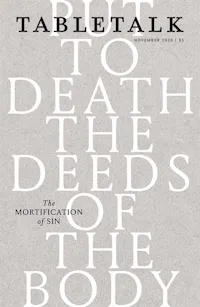

Request your free, three-month trial to Tabletalk magazine. You’ll receive the print issue monthly and gain immediate digital access to decades of archives. This trial is risk-free. No credit card required.
Try Tabletalk NowAlready receive Tabletalk magazine every month?
Verify your email address to gain unlimited access.
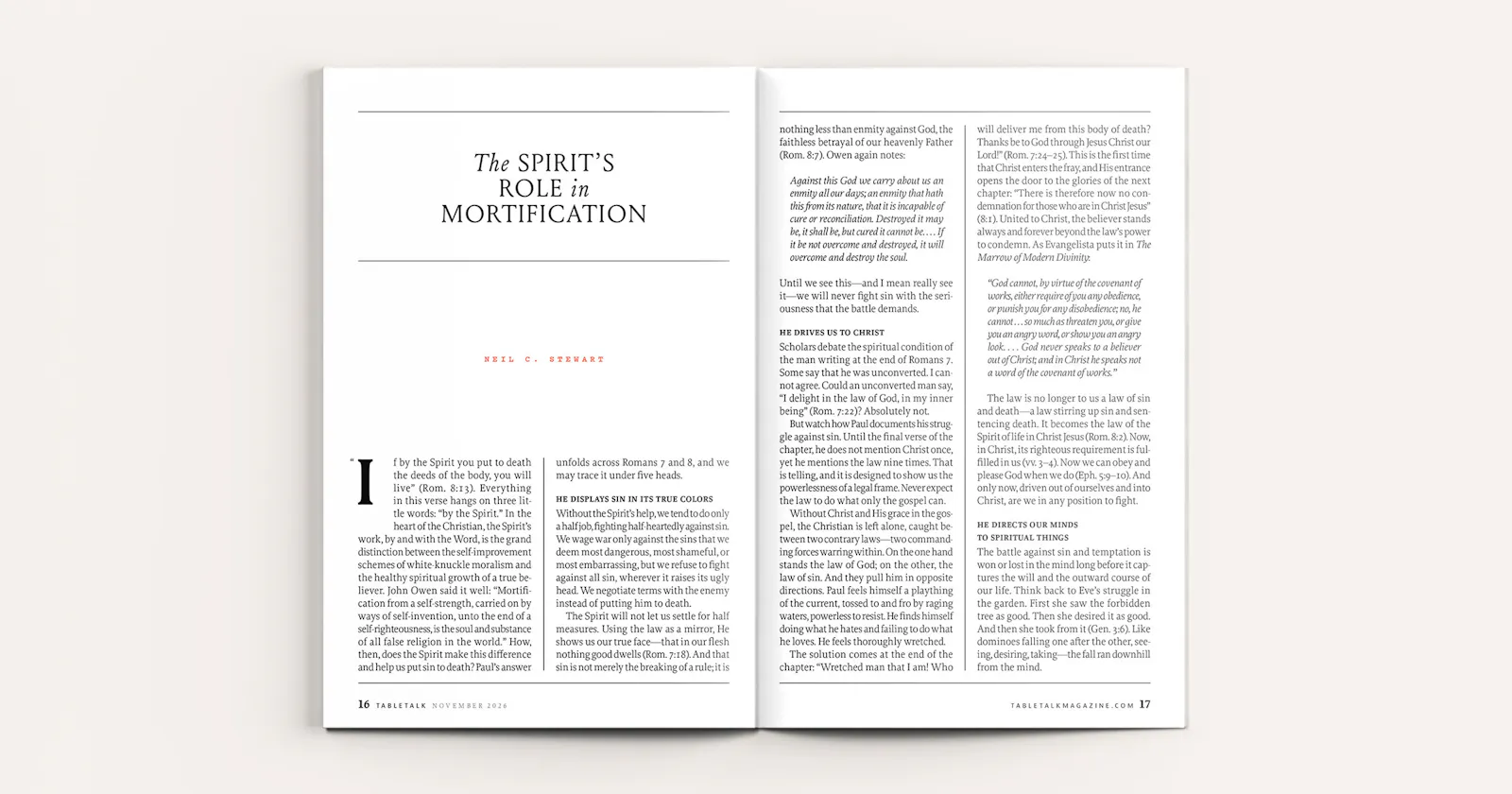
“If by the Spirit you put to death the deeds of the body, you will live” (Rom. 8:13). Everything in this verse hangs on three little words: “by the Spirit.” In the heart of the Christian, the Spirit’s work, by and with the Word, is the grand distinction between the self-improvement schemes of white-knuckle moralism and the healthy spiritual growth of a true believer. John Owen said it well: “Mortification from a self-strength, carried on by ways of self-invention, unto the end of a self-righteousness, is the soul and substance of all false religion in the world.” How, then, does the Spirit make this difference and help us put sin to death? Paul’s answer unfolds across Romans 7 and 8, and we may trace it under five heads.
he displays sin in its true colors
Without the Spirit’s help, we tend to do only a half job, fighting half-heartedly against sin. We wage war only against the sins that we deem most dangerous, most shameful, or most embarrassing, but we refuse to fight against all sin, wherever it raises its ugly head. We negotiate terms with the enemy instead of putting him to death.
The Spirit will not let us settle for half measures. Using the law as a mirror, He shows us our true face—that in our flesh nothing good dwells (Rom. 7:18). And that sin is not merely the breaking of a rule; it is nothing less than enmity against God, the faithless betrayal of our heavenly Father (Rom. 8:7). Owen again notes:
Against this God we carry about us an enmity all our days; an enmity that hath this from its nature, that it is incapable of cure or reconciliation. Destroyed it may be, it shall be, but cured it cannot be. . . . If it be not overcome and destroyed, it will overcome and destroy the soul.
Until we see this—and I mean really see it—we will never fight sin with the seriousness that the battle demands.
he drives us to christ
Scholars debate the spiritual condition of the man writing at the end of Romans 7. Some say that he was unconverted. I cannot agree. Could an unconverted man say, “I delight in the law of God, in my inner being” (Rom. 7:22)? Absolutely not.
But watch how Paul documents his struggle against sin. Until the final verse of the chapter, he does not mention Christ once, yet he mentions the law nine times. That is telling, and it is designed to show us the powerlessness of a legal frame. Never expect the law to do what only the gospel can.
Without Christ and His grace in the gospel, the Christian is left alone, caught between two contrary laws—two commanding forces warring within. On the one hand stands the law of God; on the other, the law of sin. And they pull him in opposite directions. Paul feels himself a plaything of the current, tossed to and fro by raging waters, powerless to resist. He finds himself doing what he hates and failing to do what he loves. He feels thoroughly wretched.
The solution comes at the end of the chapter: “Wretched man that I am! Who will deliver me from this body of death? Thanks be to God through Jesus Christ our Lord!” (Rom. 7:24–25). This is the first time that Christ enters the fray, and His entrance opens the door to the glories of the next chapter: “There is therefore now no condemnation for those who are in Christ Jesus” (8:1). United to Christ, the believer stands always and forever beyond the law’s power to condemn. As Evangelista puts it in The Marrow of Modern Divinity:
“God cannot, by virtue of the covenant of works, either require of you any obedience, or punish you for any disobedience; no, he cannot . . . so much as threaten you, or give you an angry word, or show you an angry look. . . . God never speaks to a believer out of Christ; and in Christ he speaks not a word of the covenant of works.”
The law is no longer to us a law of sin and death—a law stirring up sin and sentencing death. It becomes the law of the Spirit of life in Christ Jesus (Rom. 8:2). Now, in Christ, its righteous requirement is fulfilled in us (vv. 3–4). Now we can obey and please God when we do (Eph. 5:9–10). And only now, driven out of ourselves and into Christ, are we in any position to fight.
he directs our minds to spiritual things
The battle against sin and temptation is won or lost in the mind long before it captures the will and the outward course of our life. Think back to Eve’s struggle in the garden. First she saw the forbidden tree as good. Then she desired it as good. And then she took from it (Gen. 3:6). Like dominoes falling one after the other, seeing, desiring, taking—the fall ran downhill from the mind.
By an almighty current of His own, the Holy Spirit turns the mind of the believer away from the things of the flesh and toward the things of the Spirit (Rom. 8:5–6). Consider how often Scripture sets forth this principle: “Be transformed by the renewal of your mind” (Rom. 12:2); “Set your minds on things that are above, not on things that are on earth” (Col. 3:2); “Prepar[e] your minds for action” (1 Peter 1:13). This mindset sets the trajectory of a man’s whole life Godward and heavenward. As the old ditty has it:
One ship drives east and another drives west
With the selfsame winds that blow.
’Tis the set of the sails,
And not the gales,
Which tells us the way to go.
And because the Spirit of God always works by and with the Word of God, I cannot stress too much how important it is to store up God’s Word in your heart, that you might not sin against Him (Ps. 119:11). The Spirit sets the sails; the Word is the canvas He fills.
He Deals a Death Blow to Fleshly Desires and Deeds
Having conquered our minds, the Spirit goes on to conquer both our wills and our lives, enabling us to “put on the Lord Jesus Christ, and make no provision for the flesh, to gratify its desires” (Rom. 13:14). Like any carnivorous predator, the flesh grows as we feed it and withers as we starve it. This principle stands as the linchpin of what the Puritans called the mortification of sin.
But there is one additional, all-important step. It is never enough simply to stop the vice; with the Spirit’s help, we must put on the opposite virtue. We see this principle all over Paul’s writings, and especially in Ephesians 4:17–32. He begins by contrasting the emptiness of the pagan mind with the Christ-taught mind of the believer (vv. 17–21). From there, he reaches again and again for the language of putting off and putting on (vv. 22–24)—a dynamic energized by the renewal of the mind (v. 23).
Let me highlight one of his examples: “Let the thief no longer steal, but rather let him labor, doing honest work with his own hands, so that he may have something to share with anyone in need” (Eph. 4:28). Imagine a newly professing believer with light fingers. What would you say to him? You would say: “Stop that malarkey! Quit your thieving ways!” But Paul goes one step further: You must learn to labor, doing honest work with your own hands. Why? So that you will have something left over to share with anyone in need.
Do you see the contrast? The thief looks at what someone else has and thinks, “I want what he has, so I will take it.” The Christian looks beyond his own needs to the needs of others and thinks, “I will work hard—so hard that I will have enough to share with my brother and meet his needs.” Such a mindset reflects the total transformation of the man, and it is a work that only the Spirit can accomplish. Mortification, in other words, is never mere subtraction. The Spirit does not leave the house empty, swept, and put in order; He fills it with the expulsive power of a new affection and the new obedience that flows from it.
He Deals with Us as God’s Children
The final great work of the Spirit in mortification is to remind us, constantly, that we are God’s children (Rom. 8:14–17). The God whom we serve is not a demanding slave master whose only word for us is “Do or die!” Our God is our heavenly Father—the kind of Father who says: “My Son has done all for you. He has spent His life serving you; now spend yours serving Him—not in a desperate effort to earn My favor but confident that you will always have it.”
Jesus once told a story about a man with two lost sons. One was lost because he left home; the other was lost though he stayed. The Prodigal left his father’s house and wasted his father’s inheritance, and when all was spent—every last penny—he came to his senses. What thought accomplished this? It was not merely the emptiness of his condition. It was the thought of his father back home and the fullness of that old man’s heart.
You know the rest of the story. While the son was still a long way off, the old man saw him, recognized him, and ran out to meet him—something that no patriarch of that world would have been caught dead doing. But not this man. Those old legs were quickened by love, and they drove him down the road to embrace his long-lost boy.
Why did Jesus tell this story? Not merely to inform us that God is kind and compassionate enough to receive His wayward children home. He told it—as the One who knows the Father’s heart best—because He knew that we would need to hear it. And knowing that, the Father has sent the Spirit of His Son into our hearts, crying, “Abba! Father!” (Gal. 4:6), to remind us every day that we are His children—and that no matter how far we wander or how far we fall, there is always a way back to the Father’s house.
Here, then, is the Spirit’s role in mortification. He displays sin in its true colors, drives us to Christ, directs our minds to spiritual things, deals a death blow to fleshly desires and deeds, and deals with us, all the while, as God’s beloved children. In the final analysis, then, the Christian life is not a white-knuckled self-improvement scheme—like someone in the gym holding a plank to the limits of his endurance. It is a resurrection: new life, with new thoughts, new affections, and new desires, all lived in a new direction energized by the power of God’s almighty Spirit. The same Spirit who raised Jesus from the dead now dwells in you (Rom. 8:11), and He has taken up the work of helping you put sin to death—a work that He will not lay down until the day He raises your mortal body to glory. “If by the Spirit you put to death the deeds of the body, you will live” (v. 13). Thanks be to God through Jesus Christ our Lord.