
Request your free, three-month trial to Tabletalk magazine. You’ll receive the print issue monthly and gain immediate digital access to decades of archives. This trial is risk-free. No credit card required.
Try Tabletalk NowAlready receive Tabletalk magazine every month?
Verify your email address to gain unlimited access.
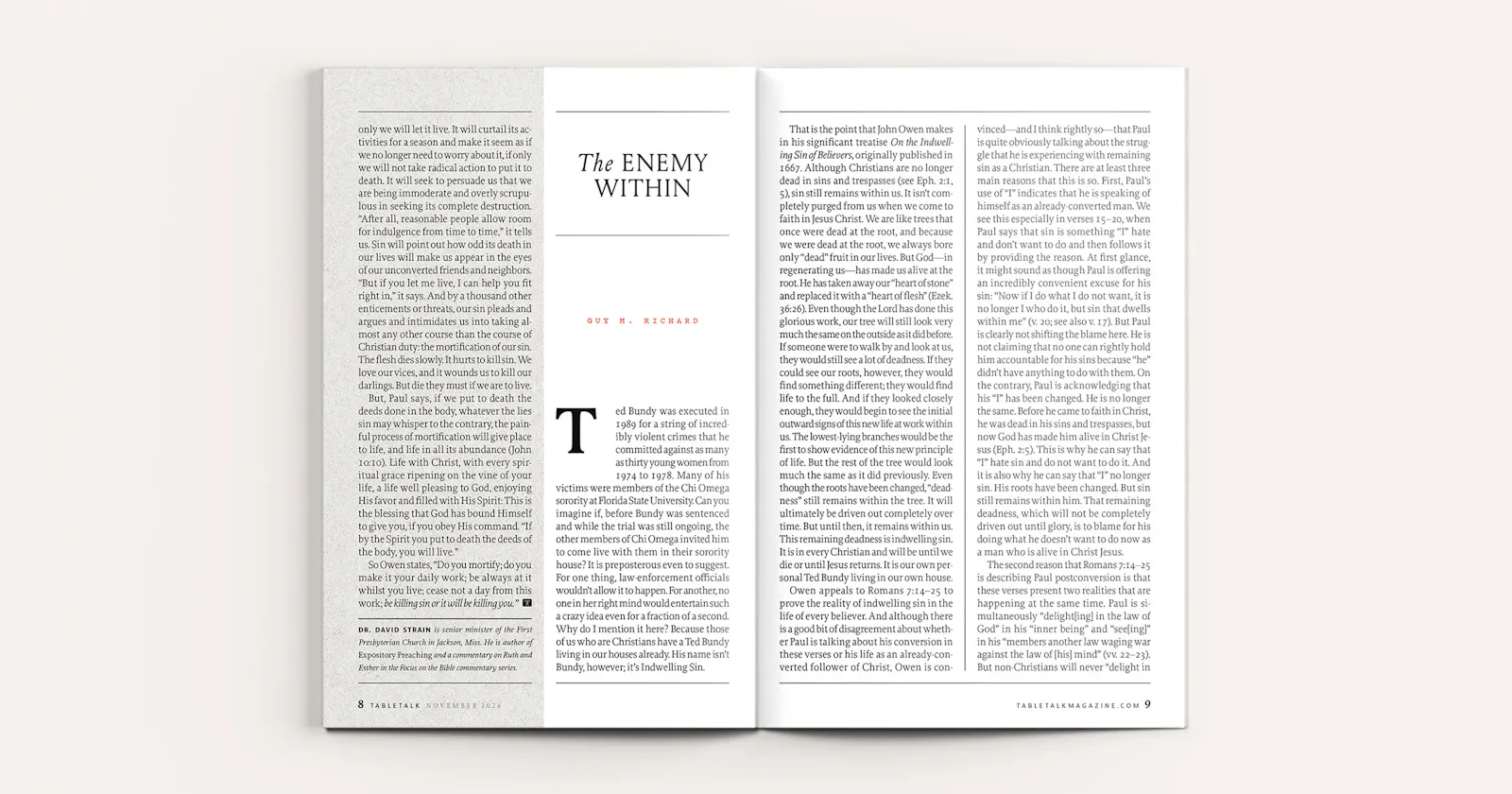
Ted Bundy was executed in 1989 for a string of incredibly violent crimes that he committed against as many as thirty young women from 1974 to 1978. Many of his victims were members of the Chi Omega sorority at Florida State University. Can you imagine if, before Bundy was sentenced and while the trial was still ongoing, the other members of Chi Omega invited him to come live with them in their sorority house? It is preposterous even to suggest. For one thing, law-enforcement officials wouldn’t allow it to happen. For another, no one in her right mind would entertain such a crazy idea even for a fraction of a second. Why do I mention it here? Because those of us who are Christians have a Ted Bundy living in our houses already. His name isn’t Bundy, however; it’s Indwelling Sin.
That is the point that John Owen makes in his significant treatise On the Indwelling Sin of Believers, originally published in 1667. Although Christians are no longer dead in sins and trespasses (see Eph. 2:1, 5), sin still remains within us. It isn’t completely purged from us when we come to faith in Jesus Christ. We are like trees that once were dead at the root, and because we were dead at the root, we always bore only “dead” fruit in our lives. But God—in regenerating us—has made us alive at the root. He has taken away our “heart of stone” and replaced it with a “heart of flesh” (Ezek. 36:26). Even though the Lord has done this glorious work, our tree will still look very much the same on the outside as it did before. If someone were to walk by and look at us, they would still see a lot of deadness. If they could see our roots, however, they would find something different; they would find life to the full. And if they looked closely enough, they would begin to see the initial outward signs of this new life at work within us. The lowest-lying branches would be the first to show evidence of this new principle of life. But the rest of the tree would look much the same as it did previously. Even though the roots have been changed, “deadness” still remains within the tree. It will ultimately be driven out completely over time. But until then, it remains within us. This remaining deadness is indwelling sin. It is in every Christian and will be until we die or until Jesus returns. It is our own personal Ted Bundy living in our own house.
Owen appeals to Romans 7:14–25 to prove the reality of indwelling sin in the life of every believer. And although there is a good bit of disagreement about whether Paul is talking about his conversion in these verses or his life as an already-converted follower of Christ, Owen is convinced—and I think rightly so—that Paul is quite obviously talking about the struggle that he is experiencing with remaining sin as a Christian. There are at least three main reasons that this is so. First, Paul’s use of “I” indicates that he is speaking of himself as an already-converted man. We see this especially in verses 15–20, when Paul says that sin is something “I” hate and don’t want to do and then follows it by providing the reason. At first glance, it might sound as though Paul is offering an incredibly convenient excuse for his sin: “Now if I do what I do not want, it is no longer I who do it, but sin that dwells within me” (v. 20; see also v. 17). But Paul is clearly not shifting the blame here. He is not claiming that no one can rightly hold him accountable for his sins because “he” didn’t have anything to do with them. On the contrary, Paul is acknowledging that his “I” has been changed. He is no longer the same. Before he came to faith in Christ, he was dead in his sins and trespasses, but now God has made him alive in Christ Jesus (Eph. 2:5). This is why he can say that “I” hate sin and do not want to do it. And it is also why he can say that “I” no longer sin. His roots have been changed. But sin still remains within him. That remaining deadness, which will not be completely driven out until glory, is to blame for his doing what he doesn’t want to do now as a man who is alive in Christ Jesus.
The second reason that Romans 7:14–25 is describing Paul postconversion is that these verses present two realities that are happening at the same time. Paul is simultaneously “delight[ing] in the law of God” in his “inner being” and “see[ing]” in his “members another law waging war against the law of [his] mind” (vv. 22–23). But non-Christians will never “delight in the law of God.” They will only and always want to sin, because, as Moses points out, “every intention of the thoughts of [their] heart[s]” is “only evil continually” (Gen. 6:5). Non-Christians are dead at the root, and dead roots can produce only “dead” fruit. The mere fact that Paul is able to say that he “delight[s] in the law of God” is proof positive that his “I” has been changed. And this new reality, according to Paul, exists side by side with “another law,” which he later calls the “law of sin” (Rom. 7:23). Paul is clearly describing the Christian life as a struggle, a battle between the new nature, which is alive in Christ, and the indwelling sin that remains within him.
The third reason is related to the second but picks up on the language that Paul is using in regard to the “law of sin” (Rom. 7:23). Paul plainly states that the “law of sin” is “making me captive.” In other words, he isn’t sinning willingly. He has been “made captive” by this “law of sin” that remains within him, and he is operating under the influence of its power. This doesn’t mean that Paul isn’t accountable for his sins; he most certainly is. He isn’t denying the voluntary nature of all our actions, even our sins: We all sin because we want to. Paul isn’t repudiating that. He is again indicating that his “I” has been changed. Non-Christians don’t need to be “made captive” to sin. They sin gladly, with, as we saw previously, “every intention of the thoughts of [their] heart[s]” (Gen. 6:5). They don’t need to be persuaded or enticed to sin. They run headlong into it to such a degree that even their righteous deeds are sinful (Isa. 64:6)—in motive, intention, and purpose, if not in action. Paul, therefore, is evidently talking from the vantage point of one already converted.
What this means is that Romans 7:14–25 is describing the experience of someone who is already a follower of Christ. It portrays the Christian life as a battle that takes place within every believer between the new nature, which is alive to Christ at the root, and the “deadness” that remains after conversion. Paul calls this deadness a “law of sin” (v. 23), which indicates, as Owen helpfully points out, that it exercises real power in our lives, as every law does, to beckon, impel, urge, and entice behavior in keeping with it. Paul doesn’t call it a “temporary suggestion.” It is not like bad advice that has no real strength to move us to do something. It is a law, and it is a law “in” believers. It is, as Paul says in speaking of himself, “in my members.”
But what kind of power is it that Paul laments as still being in his members even after his conversion? It is a law of sin. In other words, it is a law of unrighteousness, ungodliness, and lawlessness (Rom. 1:18; 1 John 3:4), or, if we borrow R.C. Sproul’s well-known definition of sin as “cosmic treason,” it is a law of treason and rebellion against God. The power that remains within us as Christians, according to Paul, is a power that is working against God at every point. It wants exactly the opposite of what He wants. It is at war with Him, and it is beckoning and impelling us to follow it rather than God. This means that there is an enemy living within us; its name is Indwelling Sin. And it is far more destructive than any murderer we might encounter, because it seeks to destroy both body and soul.
How, then, do we resist the charms and enticements of this law that lives within us? How do we fight this enemy of God that remains in our houses? We need, first, to prepare ourselves for battle. It is easy for us to think that the real battle is “out there” and to lull ourselves into a false sense of security. But when we realize what kind of power is at work within us and what that power is aiming at, we should be jolted into a state of constant vigilance. The Christian life must be lived at high alert because the enemy is in our midst and is continually on the attack.
Second, we need to devote ourselves to prayer, to meditation on Scripture, and to fellowship with other believers. Since the “law of sin” within us seeks to draw us away from communion with God, the best way to fight its influence in our lives is to be intentional about spending time with God in prayer, and not just with our lips but with all our heart, soul, mind, and strength (Mark 12:30) as well. When we meditate on God’s Word, we especially ought to focus on His great love for us in Christ and His many kindnesses to us every day, because the kindness of God “is meant to lead [us] to repentance” (Rom. 2:4). Christian fellowship in particular ought to encourage us to love God more and to hate our sins more. This is achievable through being in corporate worship, small groups, or one-on-one time together. But it is also realized through good Christian biographies that allow us to get up close and personal with believers who have already fought the good fight, finished the race, and kept the faith (2 Tim. 4:7).
Third, we need to take heed in regard to our desires, because, as Owen argues, the affections are the “principal seat” of indwelling sin in every Christian. The law of sin wages war within us chiefly by “entangling” the affections and “drawing them” into battle against the rest of the soul. We must, therefore, train our minds to recognize sinful desires as they arise within us, so that we can try to extinguish them at their first spark and not after they have become a raging inferno. More than this, however, we need to strive to fill our affections with “whatever is true, whatever is honorable, whatever is just, whatever is pure, whatever is lovely, whatever is commendable” and “worthy of praise” (Phil. 4:8). The more that our desires are fixed on these things, the less of a beachhead indwelling sin will have to mount its assault on our souls.
The cross of Christ frees us up to engage in this battle against indwelling sin with joy and hope, because we know that Jesus has triumphed over sin once and for all. The enemy within us has received the death penalty and is even now awaiting execution. There is no possibility of pardon; no eleventh-hour stay will be granted. All who believe in Jesus Christ will most assuredly come out on top. We will be delivered from the “law of sin” completely and finally. And that is why Paul ends Romans 7 by declaring so movingly in verse 25, “Thanks be to God through Jesus Christ our Lord!”