

Request your free, three-month trial to Tabletalk magazine. You’ll receive the print issue monthly and gain immediate digital access to decades of archives. This trial is risk-free. No credit card required.
Try Tabletalk NowAlready receive Tabletalk magazine every month?
Verify your email address to gain unlimited access.
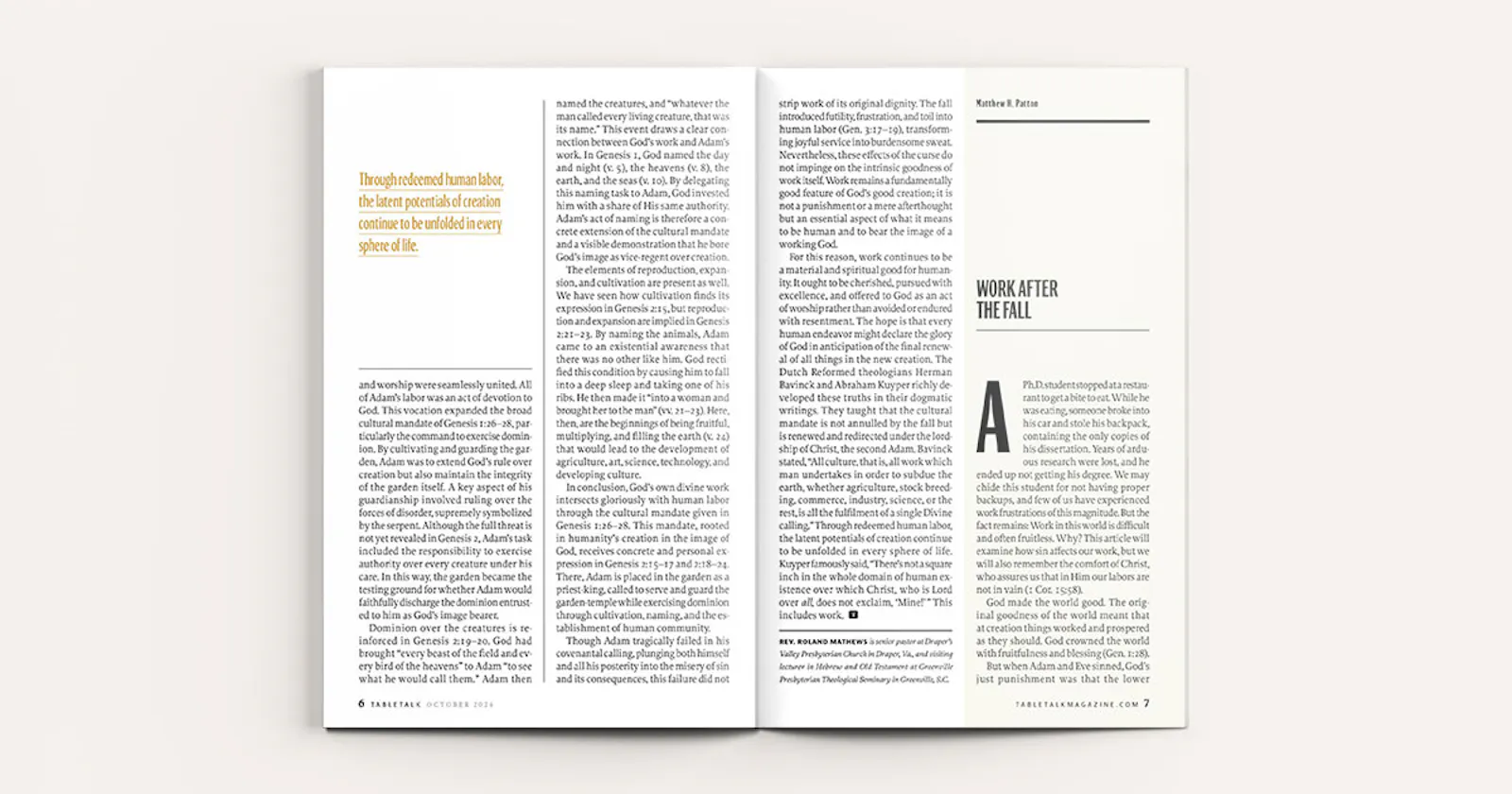
A Ph.D. student stopped at a restaurant to get a bite to eat. While he was eating, someone broke into his car and stole his backpack, containing the only copies of his dissertation. Years of arduous research were lost, and he ended up not getting his degree. We may chide this student for not having proper backups, and few of us have experienced work frustrations of this magnitude. But the fact remains: Work in this world is difficult and often fruitless. Why? This article will examine how sin affects our work, but we will also remember the comfort of Christ, who assures us that in Him our labors are not in vain (1 Cor. 15:58).
God made the world good. The original goodness of the world meant that at creation things worked and prospered as they should. God crowned the world with fruitfulness and blessing (Gen. 1:28).
But when Adam and Eve sinned, God’s just punishment was that the lower creation would rebel against them: “Cursed is the ground because of you” (Gen. 3:17). This is eye-for-eye justice (see Ex. 21:24). Adam and Eve would feel the pain of their realm’s rebelling against them, even as they had rebelled against God.
The difficulty of work
The fall introduced three dimensions of brokenness into our labors. First, it introduced difficulty. There was no longer the joyful labor of tending a garden that always responded delightfully to Adam’s touch, for things are different after the fall. “By the sweat of your face you shall eat bread” (Gen. 3:19), and “in pain you shall eat of [the ground] all the days of your life” (v. 17). Weeds grow more easily than useful plants. A huge building project fails because of a mudslide. Rusty bolts refuse to budge. Our bodies give way under the strain. And somehow, it’s always easier for the guy on the instructional video than for you to do the same task.
I once worked as a computer programmer. As part of my job, I needed to estimate how long a task would take in order to provide a proposal to the customer. I learned from my consistently low estimates that deep down I did not believe in the fall. I did not expect the many unexpected problems that would come.
Difficulty also comes from working with other sinners. Coworkers will be deliberately lazy and mediocre so that they are not given more work. People will fail and then accuse you of being at fault. People will make a promise but then quit and leave you in the lurch. Then there are much graver evils: slavery, human trafficking, and exploitation of every kind.
Amid all these trials, there is the grief of knowing, deep down, that living in this good world is not supposed to be this hard. Our God did not make labor to be onerous, but that is what it has become because of our sin. “What has a man from all the toil and striving of heart with which he toils beneath the sun? For all his days are full of sorrow, and his work is a vexation. Even in the night his heart does not rest. This also is vanity” (Eccl. 2:22–23).
Temptations in work
The second aspect of our work’s brokenness is that we are prone to sin in it. Our work is supposed to be a joyful offering of our strength and gifts to God (Rom. 12:1; Col. 3:23). One of my former coworkers posted on her office door, “This is my offering.” It was her joy to offer her work to King Jesus. But since the fall, our work has become an avenue for sin.
Some work is inherently sinful. Prostitution and the sex industry destroy families and souls. Scammers employ people to swindle the credulous. Some marketing companies make a fortune propagating lies.
Other work is not inherently sinful, but we do it in a sinful way. There are many ways that our sin inserts itself into our work, but here are a few.
1. Prayerlessness. We say, “I am rich, I have prospered, and I need nothing,” not realizing that we are “wretched, pitiable, poor, blind, and naked” (Rev. 3:17). How often have we begun our labors without asking for God’s help? In not asking God to prosper our labor, we have acted as though “the might of my hand [has] gotten me this wealth” (Deut. 8:17). We have not recognized that every fruitful day’s labor is a gift from God (1 Cor. 4:7).
2. Greed. “The love of money is a root of all kinds of evils” (1 Tim. 6:10). Because of our lust for money, we use cheap materials that will fall apart quickly or cheap ingredients that are less healthy. Waste and pollution devastate God’s beautiful world. We put the bottom line ahead of people’s safety. We persuade people to buy things that they do not need. Instead of an honest transaction in which both sides benefit, we actively try to manipulate others to give us more of their money.
3. Pride. As God’s image bearers, we are to show forth His excellence in our work. People are to see our good works and glorify our heavenly Father (Matt. 5:16). Instead, we twist our work to be about us. We hunger to “make a name for ourselves” (Gen. 11:4). We long for our neighbors to envy us (Eccl. 4:4). Our choice of a career is more about what will exalt our status among others than about what would most honor God with our gifts (1 Peter 4:10–11).
4. Workaholism. Why did God command us to rest one day out of seven (Ex. 20:8–11)? He knew that we would be tempted to work ceaselessly, as though everything depended on us. He knew that we would be tempted to find our significance in our work instead of in Him. He knew that we would be tempted to sacrifice our relationships with Him and our families in order to be the best. And He knew that we would drive the people placed under us in the same way.
5. Laziness. Some people care too much about work. Others care too little. We make lame excuses (Prov. 22:13) and do everything we can to put off work (6:9). As employees, we care nothing for the customer or the well-being of the business we work for, as long as we get paid. In our entitled mindset, we think it is better if others serve us instead of vice versa. We forget that it is better to give than to receive (Acts 20:35). We consider our needs as more important than those of others (see Phil. 2:3–4).
At the heart of these sin patterns is idolatry. Instead of offering our labors to our triune Creator, we offer ourselves to money, comfort, or status. Our energies, gifts, and accomplishments rob God of glory instead of giving glory to Him.
The futility of work
The third and final area in which sin ruins our work is its futility and fruitlessness. At the end of years of toil, we die. “By the sweat of your face you shall eat bread, till you return to the ground, for out of it you were taken; for you are dust, and to dust you shall return” (Gen. 3:19). No matter how much status, pleasure, or wealth we accumulate, we will go to the grave as naked as when we were born (Job 1:21; Ps. 49:17; Eccl. 5:15).
But we feel the futility of our labors long before we die. A young couple buys a home and spends extensive time, money, and energy renovating it. Before they get to enjoy it, they must move and sell it. The new owner, desiring a bigger house, levels the old building to build another. Or consider the college graduate, whose parents and teachers have invested thousands of hours and hundreds of thousands of dollars in her education, only for her to be disabled in a car wreck after graduation and unable to work for the rest of her days. Or consider the intelligent boy who has tremendous promise, but who, because of his poverty or the oppression of others, can never cultivate his gifts and does menial work all his days.
The Preacher in Ecclesiastes 1–2 discovered this vanity and shows it from several angles. Our labors will not be remembered just a few years from now (1:11: “There is no remembrance of former things”). The wisest man will die and be forgotten just like the fool (2:16: “Of the wise as of the fool there is no enduring remembrance, seeing that in the days to come all will have been long forgotten”). Even if we achieve the “ideal life” of unending pleasure, it will still disappoint (2:11: “All was vanity and a striving after wind”). Even if we accumulate great wealth and build great institutions or estates, these things will often fall into the hands of fools (2:18–19: “I hated all my toil in which I toil under the sun, seeing that I must leave it to the man who will come after me, and who knows whether he will be wise or a fool?”).
The modern world has discovered a new kind of futility: the factory worker who does the same inane task for hours on end, day after day. He never sees the fruit of his labor. He never sees the connection between his hard work and the blessing of others. He has no understanding of how his labor fits into a larger, grand vision. He is degraded by such mindless work, as if he were not capable of so much more. And many such laborers must continue with no end in sight, for it is the only way to provide for themselves and their families.
Grace for workers
Sin reaches its corrupting fingers deep into our work. Since the fall, work has been exceedingly difficult, rife with temptation, and—when viewed from the perspective of our lives on earth—frustratingly futile. When we consider these consequences, we must conclude that the Lord has been just. Our sin warranted all these things. The wages of sin truly is death.
But thankfully, sin is not the whole story. Even amid these consequences, we see God’s grace. It is true that people must often wrest produce from the ground, fighting off thorns and thistles (Gen. 3:18). But amid all this toil, the land still yields bread to undeserving sinners. Many people still have enough to eat in this broken world. Because all people share in this grace to some degree, we call it common grace.
But special grace is the true answer to sin’s destruction of our work. The Lord Jesus came to reverse the curse on our work. Far as the curse is found, so far does His grace come with its healing power for all who believe in Him. Consider the three sections above: Jesus gives us joy amid the difficulty of our work (Phil. 4:12–13), His Spirit gives us the power to overcome temptations at work (Rom. 8:13), and His resurrection assures us that our labors are not ultimately futile (1 Cor. 15:58). One day in the new creation, we will enter our rest and enjoy a world untainted by sin.
In the meantime, remember the dignity of your work. Don’t be surprised by how difficult and fruitless it is and by how many temptations you must battle in the midst of work—you labor in a fallen world. Though it is difficult and sometimes fruitless, you have the privilege of picturing our great God, who worked six days to create this beautiful world and who sent His Son to redeem us. Through Christ, your labor can bring God great glory.