

Request your free, three-month trial to Tabletalk magazine. You’ll receive the print issue monthly and gain immediate digital access to decades of archives. This trial is risk-free. No credit card required.
Try Tabletalk NowAlready receive Tabletalk magazine every month?
Verify your email address to gain unlimited access.
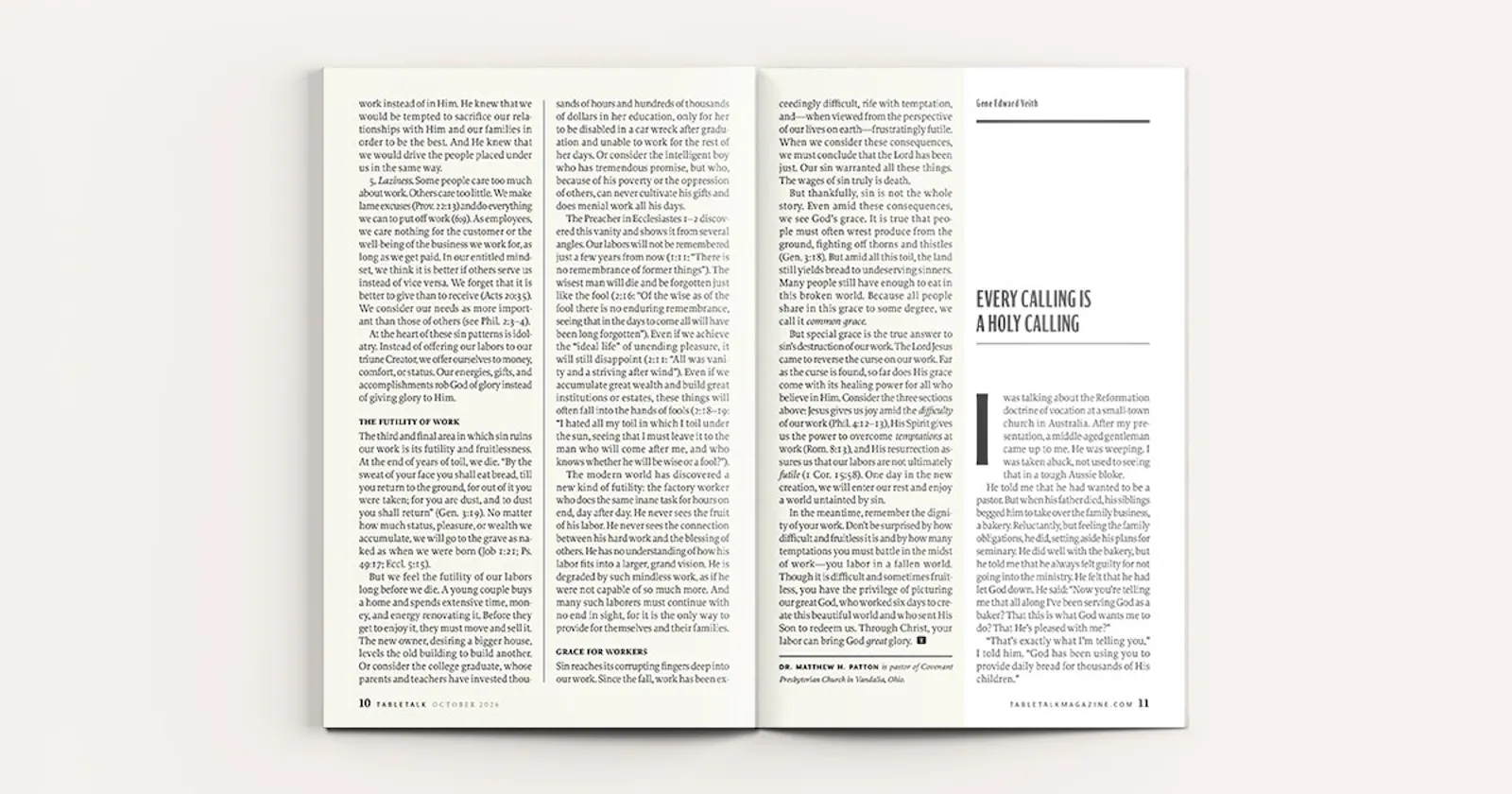
I was talking about the Reformation doctrine of vocation at a small-town church in Australia. After my presentation, a middle-aged gentleman came up to me. He was weeping. I was taken aback, not used to seeing that in a tough Aussie bloke.
He told me that he had wanted to be a pastor. But when his father died, his siblings begged him to take over the family business, a bakery. Reluctantly, but feeling the family obligations, he did, setting aside his plans for seminary. He did well with the bakery, but he told me that he always felt guilty for not going into the ministry. He felt that he had let God down. He said: “Now you’re telling me that all along I’ve been serving God as a baker? That this is what God wants me to do? That He’s pleased with me?”
“That’s exactly what I’m telling you,” I told him. “God has been using you to provide daily bread for thousands of His children.”
In medieval Roman Catholicism, if you really wanted to be holy, you would take on the so-called religious life, becoming a priest, a monk, or a nun. This was described as following the “Way of Perfection.” It involved entering a “holy order” that required setting yourself apart from ordinary life in the world by taking vows of celibacy, poverty, and obedience.
Of course, there was still a need for marriage, parenthood, and participating in the economy. Laypeople had an important role. They could be saved by following the Ten Commandments. This was called the “Way of the Commandments.” But this was not nearly so perfect or holy as what the “religious” did. They claimed to follow the more strenuous ethic of the Sermon on the Mount. They spent all their waking moments in prayer, worship, and other spiritual disciplines. Those who occupied this higher tier of Christianity were said to have a “vocation,” a calling from God.
The Reformation repudiated these distinctions, but even Protestants sometimes fall back into that Roman Catholic mindset. Evangelicals have often valued the call to be a pastor or a missionary over more “secular” occupations. I once heard a successful businessman say that the significance of his work is to earn money so that he can give to ministries that spread the gospel. It is definitely commendable to give generously to God’s church, but running his business is a holy calling in itself.
For the Reformers, all Christians have been called by God; therefore, all Christians have vocations. To call means to address someone with a voice, and God has called all Christians by His voice—that is to say, His Word. “He called you through our gospel,” the Apostle Paul wrote, “so that you may obtain the glory of our Lord Jesus Christ” (2 Thess. 2:14). By means of the word of the gospel, the Holy Spirit creates faith in our hearts. That calling from God is the foundation of the Christian life. “And those whom he predestined he also called, and those whom he called he also justified, and those whom he justified he also glorified” (Rom. 8:30).
Furthermore, God calls us to the life that He has prepared for us. “Only let each person lead the life that the Lord has assigned to him, and to which God has called him” (1 Cor. 7:17). The Lord “has assigned” each of us a “life,” whereupon He calls us to that life.
The life that God assigns to us includes far more than just “a job.” In the context of the 1 Corinthians verse, Paul is discussing marriage and singleness, Jew and gentile, and slaves and masters. Hence, the verse addresses what Martin Luther would describe as the “estates” that God has ordained for human life: the church (by virtue of the gospel), the state, and the family (marriage, singleness, parenthood), which in turn includes the economic order (slaves and masters, workers and employers) by which the family supports itself. We have callings—that is to say, vocations—in each of these estates.
The vows required by the Roman Catholic Way of Perfection approach to holiness fly in the face of God’s design: The vow of celibacy rejects marriage, but marriage is holy because it is God Himself who “join[s] together” a man and a woman (Matt. 19:6). That vow also rejects parenthood, but being a father or mother is holy and is given special honor in the commandments of God the Father (Ex. 20:12), “from whom every family [or “all fatherhood”] in heaven and on earth is named” (Eph. 3:15). Poverty as a vow (rather than an involuntary privation) rejects participation in the economic order, but the various kinds of human labor are holy because God gave man dominion over the earth (Gen. 1:26–28) and placed him in the garden “to work it and keep it” (2:15). The vow of obedience, as practiced in the Middle Ages, meant that those in religious orders were subject only to their church superiors and the canon laws of the church rather than to secular authorities. But earthly governments are established by God as His instruments of justice (Rom. 13:1–7), so they too are holy.
Another way of recognizing the holiness of all vocations is to realize that God Himself is working through us as we carry out our callings. Vocation has to do with God’s providence, how He cares for and governs His creation. Though He can work directly, He has chosen, for the most part, to give His gifts by working through human beings. Thus, He gives us this day our daily bread by means of farmers, millers, bakers, shopkeepers, and cooks. He protects us by means of lawful magistrates. He creates and nurtures new human beings by means of fathers and mothers. He brings healing by means of physicians, nurses, and pharmacists. He proclaims His gospel, teaches His Word, and gives spiritual care by means of pastors. God’s activity through these different tasks makes them holy.
According to Luther, the purpose of every vocation (marriage, parenthood, your work, your business, government authorities, pastors, etc.) is to love and serve your neighbors, and specifically the neighbors that the vocation brings into your life (spouse, children, coworkers, customers, citizens, members of your congregation, etc.). When you love and serve them, God’s love is working through you. When we use our position only for ourselves—demanding that our neighbor serve us, exploiting our neighbor, or harming our neighbor—we are putting ourselves into conflict with God, sinning in and against our vocation. For that we must repent. But the Christian life is all about loving God and loving our neighbors (Matt. 22:37–40).
“This is love, not that we have loved God but that he loved us and sent his Son to be the propitiation for our sins,” the Apostle John wrote. And “if God so loved us, we also ought to love one another” (1 John 4:10–11). We do this in the ordinary vocations of our lives—in our families, our workplaces, our communities, and our churches.
Vocation is also at the heart of the Reformation doctrine of the priesthood of all believers. This doctrine does not mean, as it is often taken, that all believers get to be pastors or that believers do not need pastors. Rather, it means almost the opposite of that. Believers do not have to be pastors to be priests. And Christians who grasp how God works through them in their royal priesthood will especially appreciate how God works through their pastors.
All believers are priests because, through their faith in Christ and the presence of the Holy Spirit, they can do what the priests of the Old Testament could do. All believers have access to God through Jesus Christ. All believers may handle holy things, such as God’s Word. All believers may be intercessors, pleading on behalf of others in their prayers.
But the main activity of a priest was sacrificing. Only a priest was authorized to slaughter the sacrificial lambs and other animals, as King Saul learned to his downfall (1 Sam. 13:8–14).
Today, Roman Catholics call their ministers priests because they believe that in celebrating the Mass—that is, their version of the Lord’s Supper—they are offering up an “unbloody” sacrifice of Christ for the living and the dead. The Reformers strongly denied that the Mass is a sacrifice, insisting that Christ offered Himself as a sacrifice for sin “once for all” (Heb. 7:27), so that the sacrifice of animals—which pointed ahead to His sacrifice—is no longer needed, nor must He be sacrificed continually. Now, Christ alone is our Priest, who sacrificed Himself for us and who continues to intercede for us (Heb. 7–9).
For this reason, most Protestants do not usually use the title priest, preferring pastor (shepherd), minister (servant), elder (leader), or preacher (for the task of proclaiming God’s Word). Anglicans and some European Lutherans still use priest, but they construe the word differently, pointing out that the word derives from the Latin word presbyter—that is, elder. Medieval Roman Catholics did use this Latin term, along with the Latin word sacerdos, for the sacrificial (sacerdotal) role of the priest.
And yet, even though Christ is the Great High Priest and we no longer need to offer up sacrifices to atone for our sins (that having been accomplished once for all time on the cross), a priesthood remains. And sacrifices of a very different nature are still called for. All of God’s people in all of God’s callings share this priesthood. The sacrifices they offer, however, are not for the forgiveness of sin. Rather, they are sacrifices of vocation.
The Bible describes this new priesthood and these new sacrifices: “You yourselves like living stones are being built up as a spiritual house, to be a holy priesthood, to offer spiritual sacrifices acceptable to God through Jesus Christ” (1 Peter 2:5). “Present your bodies as a living sacrifice, holy and acceptable to God, which is your spiritual worship” (Rom. 12:1). “The one who offers thanksgiving as his sacrifice glorifies me; to one who orders his way rightly I will show the salvation of God!” (Ps. 50:23).
Thus, when factory workers, farmers, business executives, office workers, or pastors come home exhausted from a hard day at work, worn out from making a living for their families and serving their neighbors, they have presented their bodies as a living sacrifice. When a husband is thankful for his wife, or a mother is thankful for her children, or a worker is grateful for a job well done, or a pastor is thankful for his congregation, they are offering up the sacrifice of thanksgiving. Laymen and pastors alike, in their very different vocations, are all exercising their holy priesthood.
There is one other dimension of the sacrifices offered by the priesthood of all believers that we must take to heart. Jesus Himself described what it would look like to follow Him: “If anyone would come after me, let him deny himself and take up his cross daily and follow me” (Luke 9:23). The cross is an instrument of torment, so we rightly take this verse to refer to the sufferings of life.
But the cross is also an instrument of sacrifice. When Jesus calls His followers to deny themselves, He is calling them to sacrifice themselves for others. And when He tells us to do this “daily,” He must be referring not only to the major trials and tribulations but to the kinds of things that happen every day. Jesus here is giving us a profound description of love—denying oneself for the good of someone else—and the sacrifices of vocation. These are typically very small—far from the magnitude of what Jesus did on His cross—and often not painful at all. But going to work when you would rather sleep in, spending time with your children when you would rather be doing something else, going the extra mile for a customer, putting up with difficult members of your congregation—these are the daily acts of self-denial and cross-bearing that are to be found in every vocation. And because we bear these little crosses in the course of following Christ, they are all holy.