
Request your free, three-month trial to Tabletalk magazine. You’ll receive the print issue monthly and gain immediate digital access to decades of archives. This trial is risk-free. No credit card required.
Try Tabletalk NowAlready receive Tabletalk magazine every month?
Verify your email address to gain unlimited access.
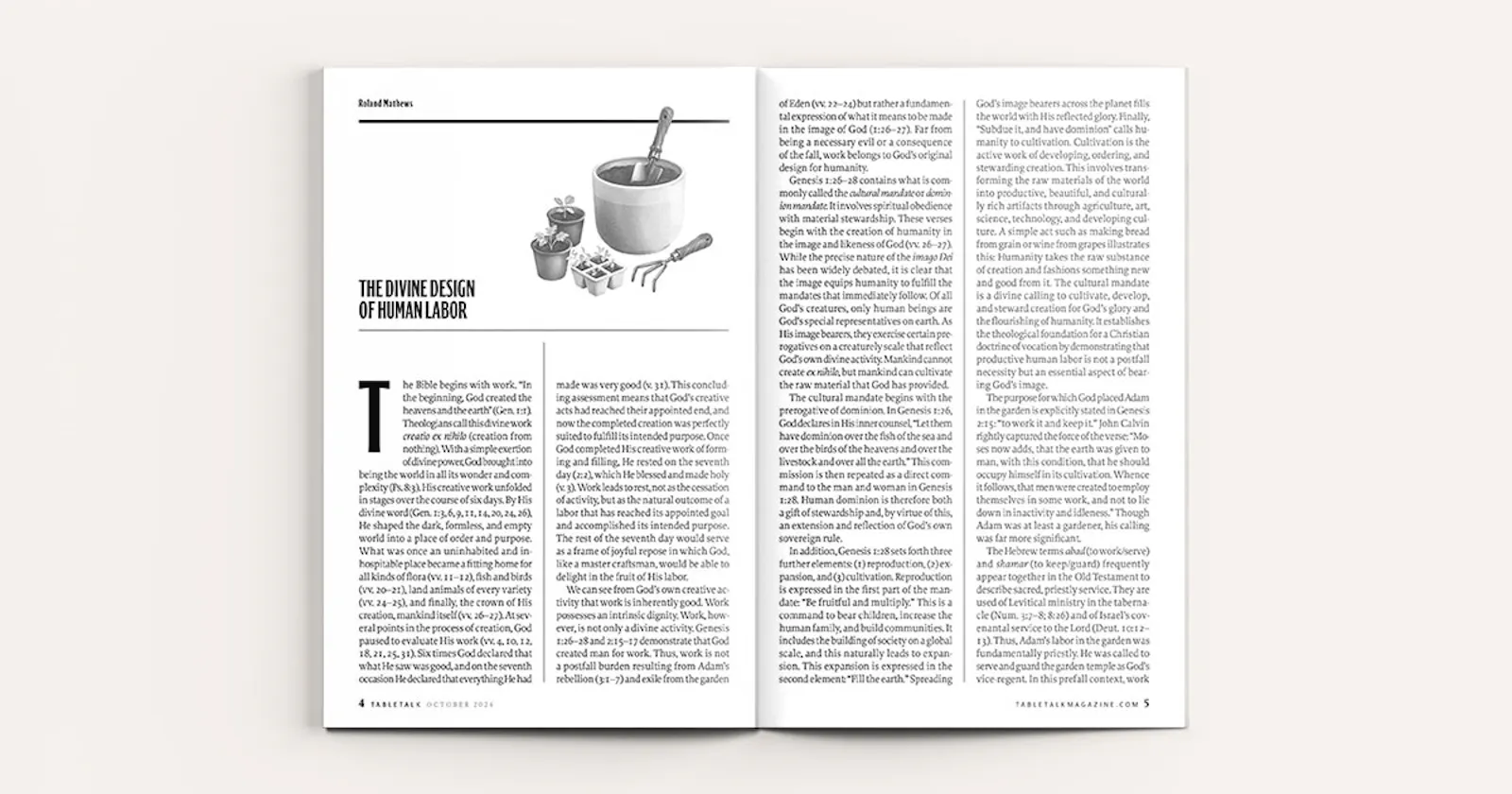
The Bible begins with work. “In the beginning, God created the heavens and the earth” (Gen. 1:1). Theologians call this divine work creatio ex nihilo (creation from nothing). With a simple exertion of divine power, God brought into being the world in all its wonder and complexity (Ps. 8:3). His creative work unfolded in stages over the course of six days. By His divine word (Gen. 1:3, 6, 9, 11, 14, 20, 24, 26), He shaped the dark, formless, and empty world into a place of order and purpose. What was once an uninhabited and inhospitable place became a fitting home for all kinds of flora (vv. 11–12), fish and birds (vv. 20–21), land animals of every variety (vv. 24–25), and finally, the crown of His creation, mankind itself (vv. 26–27). At several points in the process of creation, God paused to evaluate His work (vv. 4, 10, 12, 18, 21, 25, 31). Six times God declared that what He saw was good, and on the seventh occasion He declared that everything He had made was very good (v. 31). This concluding assessment means that God’s creative acts had reached their appointed end, and now the completed creation was perfectly suited to fulfill its intended purpose. Once God completed His creative work of forming and filling, He rested on the seventh day (2:2), which He blessed and made holy (v. 3). Work leads to rest, not as the cessation of activity, but as the natural outcome of a labor that has reached its appointed goal and accomplished its intended purpose. The rest of the seventh day would serve as a frame of joyful repose in which God, like a master craftsman, would be able to delight in the fruit of His labor.
We can see from God’s own creative activity that work is inherently good. Work possesses an intrinsic dignity. Work, however, is not only a divine activity. Genesis 1:26–28 and 2:15–17 demonstrate that God created man for work. Thus, work is not a postfall burden resulting from Adam’s rebellion (3:1–7) and exile from the garden of Eden (vv. 22–24) but rather a fundamental expression of what it means to be made in the image of God (1:26–27). Far from being a necessary evil or a consequence of the fall, work belongs to God’s original design for humanity.
Genesis 1:26–28 contains what is commonly called the cultural mandate or dominion mandate. It involves spiritual obedience with material stewardship. These verses begin with the creation of humanity in the image and likeness of God (vv. 26–27). While the precise nature of the imago Dei has been widely debated, it is clear that the image equips humanity to fulfill the mandates that immediately follow. Of all God’s creatures, only human beings are God’s special representatives on earth. As His image bearers, they exercise certain prerogatives on a creaturely scale that reflect God’s own divine activity. Mankind cannot create ex nihilo, but mankind can cultivate the raw material that God has provided.
The cultural mandate begins with the prerogative of dominion. In Genesis 1:26, God declares in His inner counsel, “Let them have dominion over the fish of the sea and over the birds of the heavens and over the livestock and over all the earth.” This commission is then repeated as a direct command to the man and woman in Genesis 1:28. Human dominion is therefore both a gift of stewardship and, by virtue of this, an extension and reflection of God’s own sovereign rule.
In addition, Genesis 1:28 sets forth three further elements: (1) reproduction, (2) expansion, and (3) cultivation. Reproduction is expressed in the first part of the mandate: “Be fruitful and multiply.” This is a command to bear children, increase the human family, and build communities. It includes the building of society on a global scale, and this naturally leads to expansion. This expansion is expressed in the second element: “Fill the earth.” Spreading God’s image bearers across the planet fills the world with His reflected glory. Finally, “Subdue it, and have dominion” calls humanity to cultivation. Cultivation is the active work of developing, ordering, and stewarding creation. This involves transforming the raw materials of the world into productive, beautiful, and culturally rich artifacts through agriculture, art, science, technology, and developing culture. A simple act such as making bread from grain or wine from grapes illustrates this: Humanity takes the raw substance of creation and fashions something new and good from it. The cultural mandate is a divine calling to cultivate, develop, and steward creation for God’s glory and the flourishing of humanity. It establishes the theological foundation for a Christian doctrine of vocation by demonstrating that productive human labor is not a postfall necessity but an essential aspect of bearing God’s image.
The purpose for which God placed Adam in the garden is explicitly stated in Genesis 2:15: “to work it and keep it.” John Calvin rightly captured the force of the verse: “Moses now adds, that the earth was given to man, with this condition, that he should occupy himself in its cultivation. Whence it follows, that men were created to employ themselves in some work, and not to lie down in inactivity and idleness.” Though Adam was at least a gardener, his calling was far more significant.
The Hebrew terms abad (to work/serve) and shamar (to keep/guard) frequently appear together in the Old Testament to describe sacred, priestly service. They are used of Levitical ministry in the tabernacle (Num. 3:7–8; 8:26) and of Israel’s covenantal service to the Lord (Deut. 10:12–13). Thus, Adam’s labor in the garden was fundamentally priestly. He was called to serve and guard the garden-temple as God’s vice-regent. In this prefall context, work and worship were seamlessly united. All of Adam’s labor was an act of devotion to God. This vocation expanded the broad cultural mandate of Genesis 1:26–28, particularly the command to exercise dominion. By cultivating and guarding the garden, Adam was to extend God’s rule over creation but also maintain the integrity of the garden itself. A key aspect of his guardianship involved ruling over the forces of disorder, supremely symbolized by the serpent. Although the full threat is not yet revealed in Genesis 2, Adam’s task included the responsibility to exercise authority over every creature under his care. In this way, the garden became the testing ground for whether Adam would faithfully discharge the dominion entrusted to him as God’s image bearer.
Dominion over the creatures is reinforced in Genesis 2:19–20. God had brought “every beast of the field and every bird of the heavens” to Adam “to see what he would call them.” Adam then named the creatures, and “whatever the man called every living creature, that was its name.” This event draws a clear connection between God’s work and Adam’s work. In Genesis 1, God named the day and night (v. 5), the heavens (v. 8), the earth, and the seas (v. 10). By delegating this naming task to Adam, God invested him with a share of His same authority. Adam’s act of naming is therefore a concrete extension of the cultural mandate and a visible demonstration that he bore God’s image as vice-regent over creation.
The elements of reproduction, expansion, and cultivation are present as well. We have seen how cultivation finds its expression in Genesis 2:15, but reproduction and expansion are implied in Genesis 2:21–23. By naming the animals, Adam came to an existential awareness that there was no other like him. God rectified this condition by causing him to fall into a deep sleep and taking one of his ribs. He then made it “into a woman and brought her to the man” (vv. 21–23). Here, then, are the beginnings of being fruitful, multiplying, and filling the earth (v. 24) that would lead to the development of agriculture, art, science, technology, and developing culture.
In conclusion, God’s own divine work intersects gloriously with human labor through the cultural mandate given in Genesis 1:26–28. This mandate, rooted in humanity’s creation in the image of God, receives concrete and personal expression in Genesis 2:15–17 and 2:18–24. There, Adam is placed in the garden as a priest-king, called to serve and guard the garden-temple while exercising dominion through cultivation, naming, and the establishment of human community.
Though Adam tragically failed in his covenantal calling, plunging both himself and all his posterity into the misery of sin and its consequences, this failure did not strip work of its original dignity. The fall introduced futility, frustration, and toil into human labor (Gen. 3:17–19), transforming joyful service into burdensome sweat. Nevertheless, these effects of the curse do not impinge on the intrinsic goodness of work itself. Work remains a fundamentally good feature of God’s good creation; it is not a punishment or a mere afterthought but an essential aspect of what it means to be human and to bear the image of a working God.
For this reason, work continues to be a material and spiritual good for humanity. It ought to be cherished, pursued with excellence, and offered to God as an act of worship rather than avoided or endured with resentment. The hope is that every human endeavor might declare the glory of God in anticipation of the final renewal of all things in the new creation. The Dutch Reformed theologians Herman Bavinck and Abraham Kuyper richly developed these truths in their dogmatic writings. They taught that the cultural mandate is not annulled by the fall but is renewed and redirected under the lordship of Christ, the second Adam. Bavinck stated, “All culture, that is, all work which man undertakes in order to subdue the earth, whether agriculture, stock breeding, commerce, industry, science, or the rest, is all the fulfilment of a single Divine calling.” Through redeemed human labor, the latent potentials of creation continue to be unfolded in every sphere of life. Kuyper famously said, “There’s not a square inch in the whole domain of human existence over which Christ, who is Lord over all, does not exclaim, ‘Mine!’” This includes work.