

Request your free, three-month trial to Tabletalk magazine. You’ll receive the print issue monthly and gain immediate digital access to decades of archives. This trial is risk-free. No credit card required.
Try Tabletalk NowAlready receive Tabletalk magazine every month?
Verify your email address to gain unlimited access.
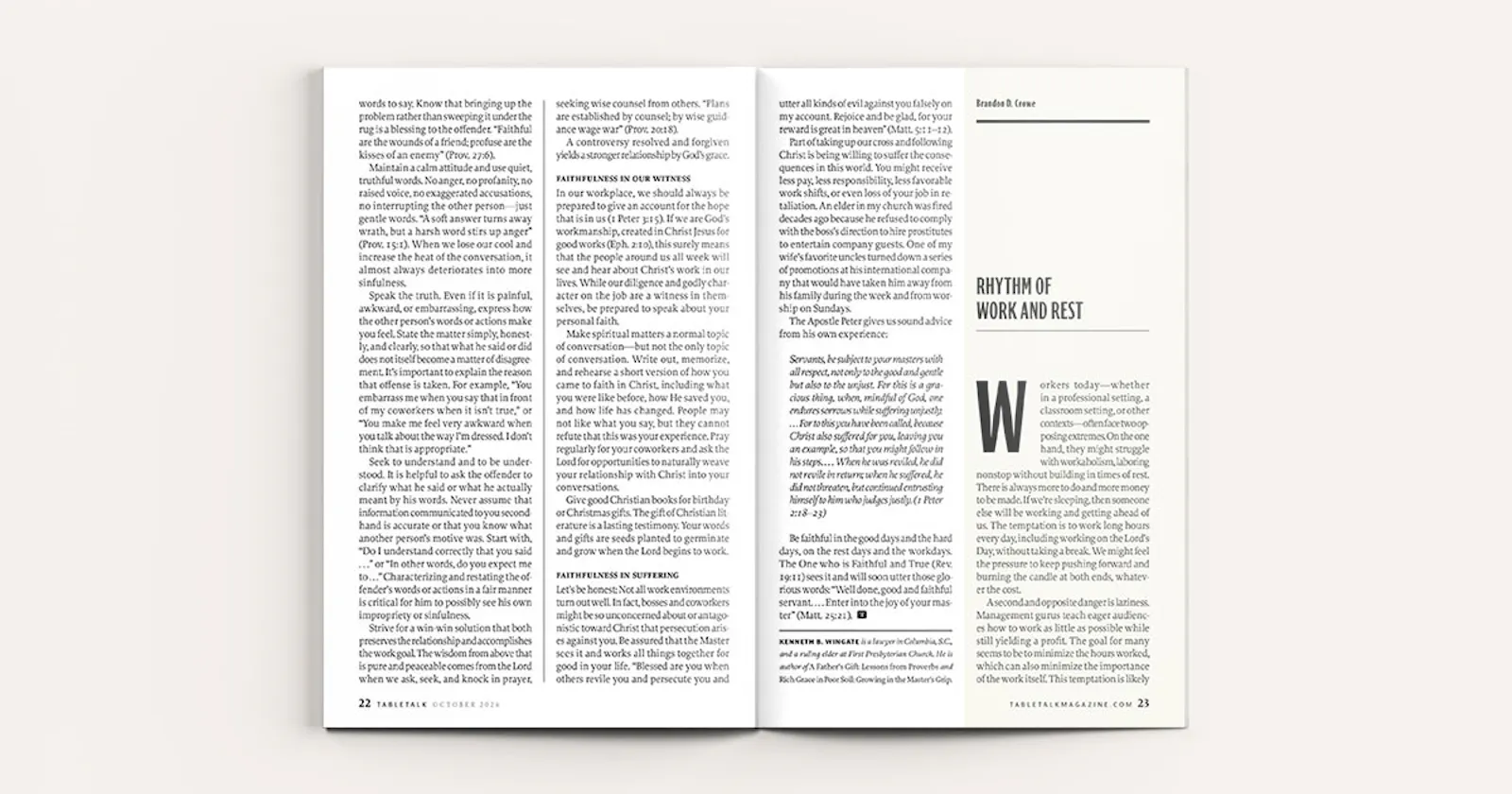
Workers today—whether in a professional setting, a classroom setting, or other contexts—often face two opposing extremes. On the one hand, they might struggle with workaholism, laboring nonstop without building in times of rest. There is always more to do and more money to be made. If we’re sleeping, then someone else will be working and getting ahead of us. The temptation is to work long hours every day, including working on the Lord’s Day, without taking a break. We might feel the pressure to keep pushing forward and burning the candle at both ends, whatever the cost.
A second and opposite danger is laziness. Management gurus teach eager audiences how to work as little as possible while still yielding a profit. The goal for many seems to be to minimize the hours worked, which can also minimize the importance of the work itself. This temptation is likely only increasing in an age of artificial intelligence that calls out with the siren song of automation. The possibility is offered to us that we can produce the same outcomes without having to put in the same amount of effort. Work should be easy so that we can focus on our own pleasure.
These are real struggles in today’s world. And yet they’re not entirely new. Scripture addresses both workaholism and laziness, warning us to avoid both these extremes, which are out of step with biblical teaching. Instead, Scripture offers us a better way.
The Biblical Answer
The Bible teaches us that work is good and that we must consistently cease from our work and focus our minds on heavenly things. The pattern of work plus rest is built into the structure of creation: six days to work and one day to rest. This creational pattern is emphasized in the Ten Commandments in Exodus 20:8–11. We are to work six days, but the seventh is a Sabbath of rest to the Lord our God (vv. 8–10). The reason for the command to keep the Sabbath is explained in verse 11: In six days the Lord made heaven and earth, but He rested on the seventh day. That seventh day of rest is a pattern for us as well. We are to work six days but rest one day in seven. Since this pattern of six plus one is rooted in creation, it is just as binding today as it was in the beginning.
The Bible teaches that men and women are created for work; work was part of God’s created order even before the fall into sin (Gen. 1:28–31). Work is therefore good and should be embraced. We should work as unto the Lord and not for selfish purposes (Col. 3:23). We are to apply ourselves as those made in God’s image to exercising benevolent dominion over God’s creation. This also means working for things that accord with the righteousness that characterizes the kingdom of God (2 Peter 3:11–13). We must also resist depersonalizing and automating those aspects of work that can be rightly fulfilled only by those made in God’s image.
The pattern of creation instructs us not only that work is good but also that work is not all there is to life. Resting for one day out of seven reminds us that we are finite. Only God’s works last forever. No matter how successful we are, our works will not last. This is a key feature of the teaching of Ecclesiastes (see, for example, Eccl. 1:11; 2:16; 2:21–22; 3:14).
Practically, the wisdom of resting one day out of seven also keeps us from burnout. I remember thinking, when I was younger and trying to figure out the secrets of highly productive individuals, that they must not be operating on much sleep. Maybe that is true for some people, but few can thrive without sufficient sleep for long periods of time. Because we are all finite, we all need sleep. Only God does not sleep (Ps. 121:4). No one is able to get around the reality that we all, as finite creatures, need sufficient rest.
Applying the Principles Today
What, then, does living according to the six-plus-one principle look like? To begin, we must obey the fourth commandment and rest from our daily labors on the Lord’s Day. In the Old Testament, the seventh day was the day of rest. But since Jesus has risen from the dead, the Sabbath is now on Sunday (Westminster Confession of Faith 21.7). The Westminster Standards explain that on the Lord’s Day, we are to rest from worldly employments and focus on corporate and personal worship (see Westminster Larger Catechism 117). Our goal is not to accumulate a list of nonbiblical rules; Jesus responded to this tendency during His own ministry. Instead, a balanced view considers broadly the works of necessity and mercy as appropriate on the Lord’s Day (WLC 117). This follows the pattern of the ministry of Christ, in which He engaged in works of necessity and mercy on the Sabbath. For example, He defended His disciples’ lawfully eating grain (Mark 2:23–28, a work of necessity), and Jesus healed a man with a withered hand on the Sabbath (3:1–6, a work of mercy).
Resting from our normal labors on the Lord’s Day should also point ahead to the future heavenly rest that is held out to believers (see Heb. 4:6–11). Our weekly rhythm of work and rest not only reflects back on the beginning of God’s created order, but it also anticipates our coming heavenly rest, when we will cease from our earthly labors. That possibility is held out to us because of the work of Christ, whose resurrection ensures that none of our labors are in vain (1 Cor. 15:58).