

Request your free, three-month trial to Tabletalk magazine. You’ll receive the print issue monthly and gain immediate digital access to decades of archives. This trial is risk-free. No credit card required.
Try Tabletalk NowAlready receive Tabletalk magazine every month?
Verify your email address to gain unlimited access.
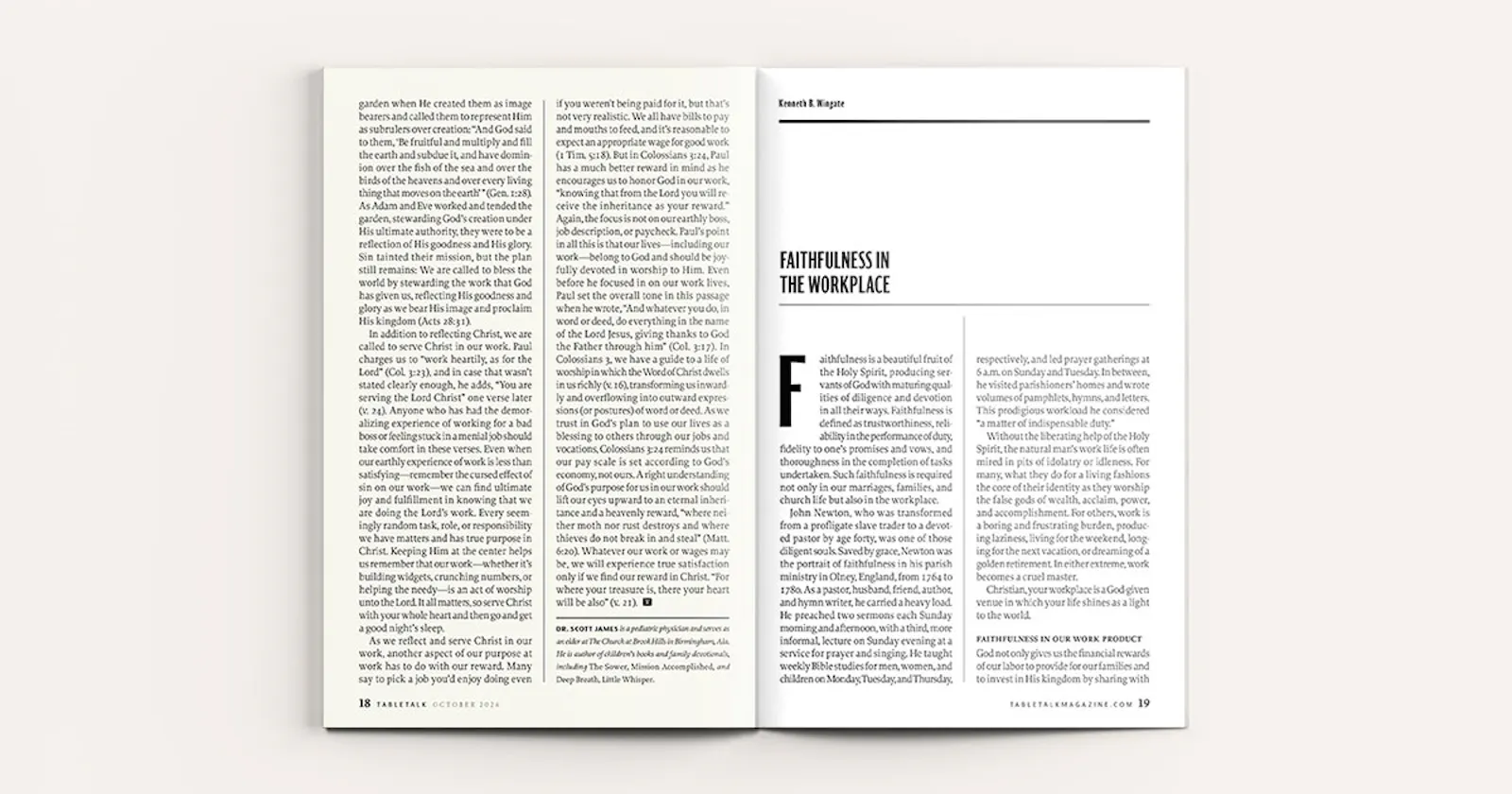
Faithfulness is a beautiful fruit of the Holy Spirit, producing servants of God with maturing qualities of diligence and devotion in all their ways. Faithfulness is defined as trustworthiness, reliability in the performance of duty, fidelity to one’s promises and vows, and thoroughness in the completion of tasks undertaken. Such faithfulness is required not only in our marriages, families, and church life but also in the workplace.
John Newton, who was transformed from a profligate slave trader to a devoted pastor by age forty, was one of those diligent souls. Saved by grace, Newton was the portrait of faithfulness in his parish ministry in Olney, England, from 1764 to 1780. As a pastor, husband, friend, author, and hymn writer, he carried a heavy load. He preached two sermons each Sunday morning and afternoon, with a third, more informal, lecture on Sunday evening at a service for prayer and singing. He taught weekly Bible studies for men, women, and children on Monday, Tuesday, and Thursday, respectively, and led prayer gatherings at 6 a.m. on Sunday and Tuesday. In between, he visited parishioners’ homes and wrote volumes of pamphlets, hymns, and letters. This prodigious workload he considered “a matter of indispensable duty.”
Without the liberating help of the Holy Spirit, the natural man’s work life is often mired in pits of idolatry or idleness. For many, what they do for a living fashions the core of their identity as they worship the false gods of wealth, acclaim, power, and accomplishment. For others, work is a boring and frustrating burden, producing laziness, living for the weekend, longing for the next vacation, or dreaming of a golden retirement. In either extreme, work becomes a cruel master.
Christian, your workplace is a God-given venue in which your life shines as a light to the world.
Faithfulness in Our Work Product
God not only gives us the financial rewards of our labor to provide for our families and to invest in His kingdom by sharing with others, but He also uses the trials and travails of work to sanctify us. In Titus 2:1–10, the Apostle Paul declares that all believers from the oldest to the youngest are to live in a manner that accords with sound doctrine. We are to conduct ourselves with godliness, mentoring others by our words and modeling good works. Bondservants (workers employed by others) are instructed to be “submissive to their own masters.” Whether we produce goods, sell products, or provide services, we are to work honestly (“not pilfering”), quietly (“not argumentative”), diligently (“well-pleasing”), and faithfully (“showing all good faith”) in a manner that adorns the doctrine of Christ. More important than what we do is how we do it.
Newton described the character of a Christian worker this way:
As a member of society, he is just, punctual in the discharge of every relative duty, faithful to his engagements and promises, rendering to all their dues, obedient to lawful authority, and acting to all men according to the golden rule, of doing as he would be done by. His conduct is simple, devoid of artifice, and consistent, attending to every branch of duty; and in the [prayer] closet, the family, the church, and in the transactions of common life, he is the same man; for in every circumstance he serves the Lord.
A college friend of mine, who was a young Christian, graduated with a degree in mechanical engineering. His first job for a large engineering firm, however, turned out to be a disappointment for him. After a few months, he complained bitterly to an older man, who was also a believer, that his supervisor made him arrive early each morning to start the coffee and sweep the office floor. “Who does he think he is? I’m a professional, and he makes me sweep the floor!” Perhaps he expected a sympathetic ear from his listener, but instead he received a sharp rebuke. “He’s your boss, that’s who he is. Sweep that floor better than anybody ever did it before and stop grumbling. One day he’ll see that you can handle responsibility, and he’ll give it to you.”
We are called to be the same person at work that we are at church: faithful.
Faithfulness in Workplace Conflict
Conflict management is a critical skill in all aspects of life. And the workplace is no exception. In fact, the organizational hierarchy of employers and employees, supervisors and subordinates, is fertile soil for disputes and frustrations. The mix of conflicting responsibilities, work styles, and personalities with people we don’t know well or might not like can be difficult. Every day brings fresh opportunities for exercising the ministry of reconciliation to both God and man.
Lawyer and author Ken Sande defines conflict as “a difference in opinion or purpose that frustrates someone’s goals or desires.” Such conflict might result from poor communication, differences in goals or values, competition over limited resources of time or money, or sinful attitudes and habits that lead to sinful words and actions.
The key principle for believers to embrace is that “conflict always provides an opportunity to glorify God,” Sande writes. By trusting God, obeying Him, and acknowledging Him in the resolution of disputes, we apply biblical truth to everyday situations. Our Father will help us, as He promises: “Trust in the Lord with all your heart, and do not lean on your own understanding. In all your ways [even in the heat of conflict] acknowledge him, and he will make straight your paths” (Prov. 3:5–6).
Minor conflicts that are out of character for a coworker may be ignored and forgiven. Again, Proverbs teaches us, “Good sense makes one slow to anger, and it is his glory to overlook an offense” (19:11). But if the offending behavior becomes a pattern, it must be addressed or it will fester and destroy the relationship. The following are some practical principles from God’s Word.
Before confronting the offender, examine your own heart and behavior. Ask the Lord to help you see if you have somehow contributed to the misunderstanding or conflict. Christ warns us:
“How can you say to your brother, ‘Let me take the speck out of your eye,’ when there is the log in your own eye? You hypocrite, first take the log out of your own eye, and then you will see clearly to take the speck out of your brother’s eye.” (Matt. 7:4–5)
We must confess to God first and then to the offender how our own words and attitudes might have added fuel to the fire.
Confront the issue directly and privately with the offender. It takes courage and tact to start a difficult conversation, but ask God for the opportunity to speak and the words to say. Know that bringing up the problem rather than sweeping it under the rug is a blessing to the offender. “Faithful are the wounds of a friend; profuse are the kisses of an enemy” (Prov. 27:6).
Maintain a calm attitude and use quiet, truthful words. No anger, no profanity, no raised voice, no exaggerated accusations, no interrupting the other person—just gentle words. “A soft answer turns away wrath, but a harsh word stirs up anger” (Prov. 15:1). When we lose our cool and increase the heat of the conversation, it almost always deteriorates into more sinfulness.
Speak the truth. Even if it is painful, awkward, or embarrassing, express how the other person’s words or actions make you feel. State the matter simply, honestly, and clearly, so that what he said or did does not itself become a matter of disagreement. It’s important to explain the reason that offense is taken. For example, “You embarrass me when you say that in front of my coworkers when it isn’t true,” or “You make me feel very awkward when you talk about the way I’m dressed. I don’t think that is appropriate.”
Seek to understand and to be understood. It is helpful to ask the offender to clarify what he said or what he actually meant by his words. Never assume that information communicated to you secondhand is accurate or that you know what another person’s motive was. Start with, “Do I understand correctly that you said . . .” or “In other words, do you expect me to . . .” Characterizing and restating the offender’s words or actions in a fair manner is critical for him to possibly see his own impropriety or sinfulness.
Strive for a win-win solution that both preserves the relationship and accomplishes the work goal. The wisdom from above that is pure and peaceable comes from the Lord when we ask, seek, and knock in prayer, seeking wise counsel from others. “Plans are established by counsel; by wise guidance wage war” (Prov. 20:18).
A controversy resolved and forgiven yields a stronger relationship by God’s grace.
Faithfulness in Our Witness
In our workplace, we should always be prepared to give an account for the hope that is in us (1 Peter 3:15). If we are God’s workmanship, created in Christ Jesus for good works (Eph. 2:10), this surely means that the people around us all week will see and hear about Christ’s work in our lives. While our diligence and godly character on the job are a witness in themselves, be prepared to speak about your personal faith.
Make spiritual matters a normal topic of conversation—but not the only topic of conversation. Write out, memorize, and rehearse a short version of how you came to faith in Christ, including what you were like before, how He saved you, and how life has changed. People may not like what you say, but they cannot refute that this was your experience. Pray regularly for your coworkers and ask the Lord for opportunities to naturally weave your relationship with Christ into your conversations.
Give good Christian books for birthday or Christmas gifts. The gift of Christian literature is a lasting testimony. Your words and gifts are seeds planted to germinate and grow when the Lord begins to work.
Faithfulness in Suffering
Let’s be honest: Not all work environments turn out well. In fact, bosses and coworkers might be so unconcerned about or antagonistic toward Christ that persecution arises against you. Be assured that the Master sees it and works all things together for good in your life. “Blessed are you when others revile you and persecute you and utter all kinds of evil against you falsely on my account. Rejoice and be glad, for your reward is great in heaven” (Matt. 5:11–12).
Part of taking up our cross and following Christ is being willing to suffer the consequences in this world. You might receive less pay, less responsibility, less favorable work shifts, or even loss of your job in retaliation. An elder in my church was fired decades ago because he refused to comply with the boss’s direction to hire prostitutes to entertain company guests. One of my wife’s favorite uncles turned down a series of promotions at his international company that would have taken him away from his family during the week and from worship on Sundays.
The Apostle Peter gives us sound advice from his own experience:
Servants, be subject to your masters with all respect, not only to the good and gentle but also to the unjust. For this is a gracious thing, when, mindful of God, one endures sorrows while suffering unjustly. . . . For to this you have been called, because Christ also suffered for you, leaving you an example, so that you might follow in his steps. . . . When he was reviled, he did not revile in return; when he suffered, he did not threaten, but continued entrusting himself to him who judges justly. (1 Peter 2:18–23)
Be faithful in the good days and the hard days, on the rest days and the workdays. The One who is Faithful and True (Rev. 19:11) sees it and will soon utter those glorious words: “Well done, good and faithful servant. . . . Enter into the joy of your master” (Matt. 25:21).