
September 2026
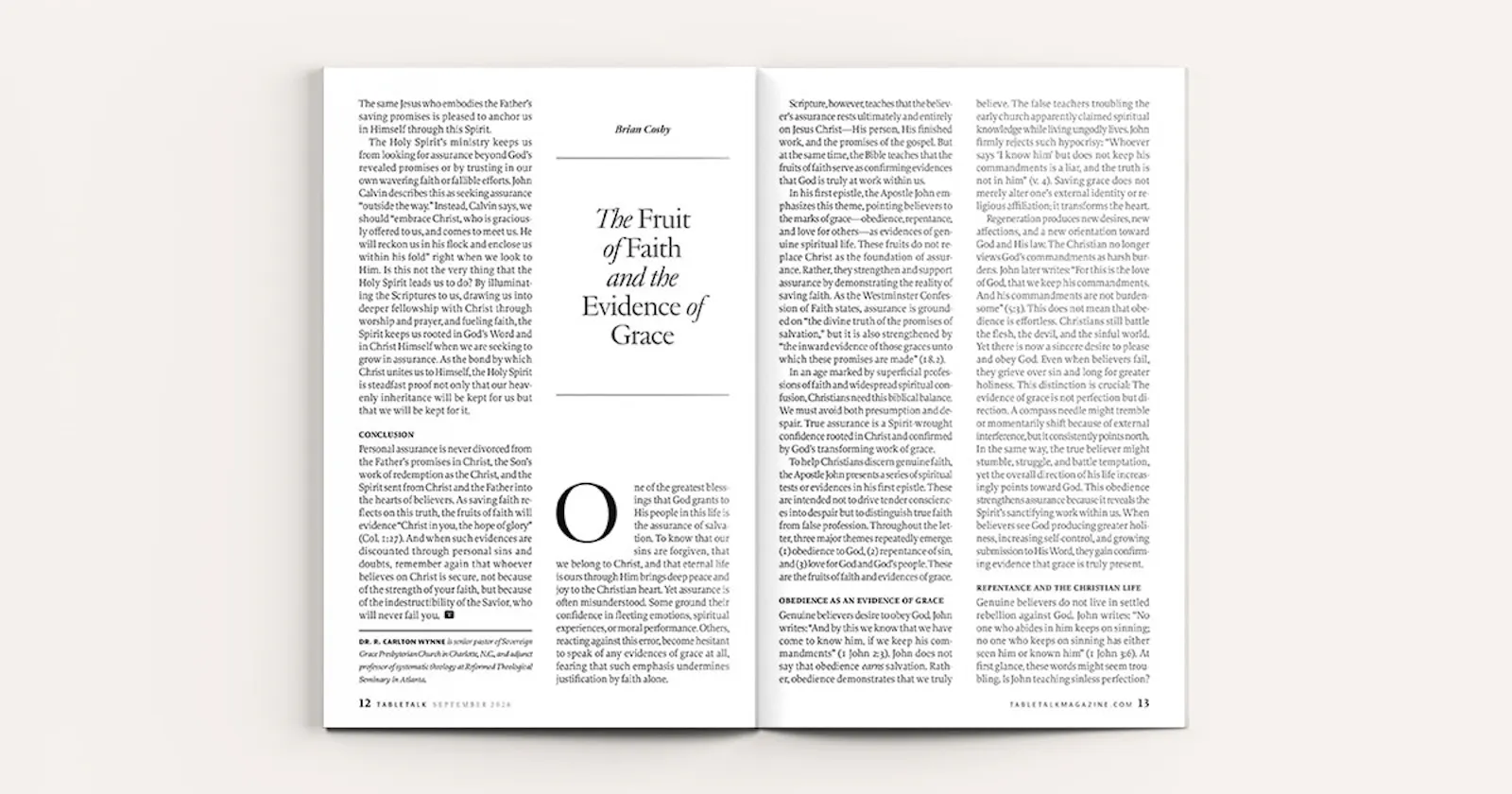
The Fruit of Faith and the Evidence of Grace
by Brian Cosby
Feature Article
September 2026

Request your free, three-month trial to Tabletalk magazine. You’ll receive the print issue monthly and gain immediate digital access to decades of archives. This trial is risk-free. No credit card required.
Try Tabletalk NowAlready receive Tabletalk magazine every month?
Verify your email address to gain unlimited access.
One of the greatest blessings that God grants to His people in this life is the assurance of salvation. To know that our sins are forgiven, that we belong to Christ, and that eternal life is ours through Him brings deep peace and joy to the Christian heart. Yet assurance is often misunderstood. Some ground their confidence in fleeting emotions, spiritual experiences, or moral performance. Others, reacting against this error, become hesitant to speak of any evidences of grace at all, fearing that such emphasis undermines justification by faith alone.
Scripture, however, teaches that the believer’s assurance rests ultimately and entirely on Jesus Christ—His person, His finished work, and the promises of the gospel. But at the same time, the Bible teaches that the fruits of faith serve as confirming evidences that God is truly at work within us.
In his first epistle, the Apostle John emphasizes this theme, pointing believers to the marks of grace—obedience, repentance, and love for others—as evidences of genuine spiritual life. These fruits do not replace Christ as the foundation of assurance. Rather, they strengthen and support assurance by demonstrating the reality of saving faith. As the Westminster Confession of Faith states, assurance is grounded on “the divine truth of the promises of salvation,” but it is also strengthened by “the inward evidence of those graces unto which these promises are made” (18.2).
In an age marked by superficial professions of faith and widespread spiritual confusion, Christians need this biblical balance. We must avoid both presumption and despair. True assurance is a Spirit-wrought confidence rooted in Christ and confirmed by God’s transforming work of grace.
To help Christians discern genuine faith, the Apostle John presents a series of spiritual tests or evidences in his first epistle. These are intended not to drive tender consciences into despair but to distinguish true faith from false profession. Throughout the letter, three major themes repeatedly emerge: (1) obedience to God, (2) repentance of sin, and (3) love for God and God’s people. These are the fruits of faith and evidences of grace.
Obedience as an Evidence of Grace
Genuine believers desire to obey God. John writes: “And by this we know that we have come to know him, if we keep his commandments” (1 John 2:3). John does not say that obedience earns salvation. Rather, obedience demonstrates that we truly believe. The false teachers troubling the early church apparently claimed spiritual knowledge while living ungodly lives. John firmly rejects such hypocrisy: “Whoever says ‘I know him’ but does not keep his commandments is a liar, and the truth is not in him” (v. 4). Saving grace does not merely alter one’s external identity or religious affiliation; it transforms the heart.
Regeneration produces new desires, new affections, and a new orientation toward God and His law. The Christian no longer views God’s commandments as harsh burdens. John later writes: “For this is the love of God, that we keep his commandments. And his commandments are not burdensome” (5:3). This does not mean that obedience is effortless. Christians still battle the flesh, the devil, and the sinful world. Yet there is now a sincere desire to please and obey God. Even when believers fail, they grieve over sin and long for greater holiness. This distinction is crucial: The evidence of grace is not perfection but direction. A compass needle might tremble or momentarily shift because of external interference, but it consistently points north. In the same way, the true believer might stumble, struggle, and battle temptation, yet the overall direction of his life increasingly points toward God. This obedience strengthens assurance because it reveals the Spirit’s sanctifying work within us. When believers see God producing greater holiness, increasing self-control, and growing submission to His Word, they gain confirming evidence that grace is truly present.
Repentance and the Christian Life
Genuine believers do not live in settled rebellion against God. John writes: “No one who abides in him keeps on sinning; no one who keeps on sinning has either seen him or known him” (1 John 3:6). At first glance, these words might seem troubling. Is John teaching sinless perfection? Clearly not, since earlier he acknowledged that believers still sin (1:8). The key lies in understanding John’s emphasis on habitual, ongoing patterns of unrepentant sin. The Christian cannot comfortably remain in rebellion against God because the seed of faith and of eternal life has been planted within him. John explains: “No one born of God makes a practice of sinning, for God’s seed abides in him” (3:9).
Repentance itself is evidence of grace. The unregenerate heart may fear consequences, but it does not truly mourn sin as an offense against God. The believer, however, experiences godly sorrow. He longs to forsake sin because he desires fellowship with the Lord. Many tender Christians struggle here. They experience ongoing battles with temptation and fear that they are not truly saved. Yet often the very grief they feel over sin is evidence of spiritual life. Dead hearts do not battle against or mourn sin. Thomas Watson once wrote, “Repentance is a grace of God’s Spirit whereby a sinner is inwardly humbled and visibly reformed.” This ongoing posture of repentance confirms the presence of genuine faith.
Love for God and His People
Perhaps no theme is more central in 1 John than love. John writes: “We know that we have passed out of death into life, because we love the brothers. Whoever does not love abides in death” (3:14). This is one of the clearest evidences of regeneration in the entire New Testament. The new birth produces love for God and God’s people.
Why is this so significant? Because Christian love is supernatural. The natural human heart is fundamentally self-centered. But genuine sacrificial love flows from God Himself: “Beloved, let us love one another, for love is from God” (4:7). The believer increasingly reflects the character of the God who first loved him—a love displayed in the giving of God’s only begotten Son. Christ’s sacrificial love becomes the pattern for Christian relationships. Believers care for one another, bear one another’s burdens, forgive one another, and seek one another’s spiritual good.
Genuine believers increasingly desire unity, reconciliation, and sacrificial care for God’s people. One of the sweetest confirmations of grace often comes through the fellowship of the church. As believers worship together, pray together, serve together, and encourage one another, they experience tangible evidence of God’s transforming work in their lives.
The Danger of False Assurance
John’s emphasis on these evidences of grace also serves another important purpose—exposing false assurance. Throughout church history, many have professed faith while lacking genuine conversion. Jesus warned, “Not everyone who says to me, ‘Lord, Lord,’ will enter the kingdom of heaven, but the one who does the will of my Father who is in heaven” (Matt. 7:21). False assurance is spiritually dangerous because it gives peace to those who remain outside Christ.
John combats this danger by showing that authentic faith produces real transformation. Saving faith bears fruit, as James writes: “So also faith by itself, if it does not have works, is dead” (2:17). Many assume that they are Christians because they prayed a prayer, walked an aisle, or grew up in church. Yet Scripture consistently teaches that regeneration changes a person’s life. The presence of obedience, repentance, and love does not save us, but their total absence reveals a spiritually dead heart. We must affirm justification by faith alone through Christ alone while also emphasizing the necessity of sanctification as evidence of genuine salvation. The God who justifies also sanctifies. As Christians grow in holiness, they increasingly experience the comforting assurance that God is truly at work within them.
Encouragement for Struggling Believers
Many sincere Christians struggle with weak assurance. They see remaining sin and fear that they are not truly saved. John’s letter provides profound encouragement for such believers.
The question is not whether your faith is perfect but whether it is real. Do you grieve over sin? Do you desire to obey Christ? Do you love God and His people? Do you keep returning to Christ for mercy? These are evidences of grace. Even weak faith unites the soul to a strong Savior. Believers should therefore not despise small beginnings. Sanctification is progressive—spiritual fruit develops gradually over time. A young tree may bear limited fruit at first, yet its life is genuine and growing.
The doctrine of assurance requires biblical balance. Our confidence before God rests entirely on Jesus Christ—His perfect life of righteousness, His atoning death, His glorious resurrection, and His unfailing promises. Nothing in ourselves can serve as the foundation of salvation. Yet Scripture also teaches that genuine faith produces visible fruit. In 1 John, obedience, repentance, and love for God’s people function as confirming evidences of grace. These marks do not replace Christ as the basis of assurance. Rather, they strengthen and support assurance by revealing the Spirit’s transforming work within us. And the fruits of faith, though imperfect in this life, serve as precious reminders that “he who began a good work in you will bring it to completion at the day of Jesus Christ” (Phil. 1:6).