

Request your free, three-month trial to Tabletalk magazine. You’ll receive the print issue monthly and gain immediate digital access to decades of archives. This trial is risk-free. No credit card required.
Try Tabletalk NowAlready receive Tabletalk magazine every month?
Verify your email address to gain unlimited access.
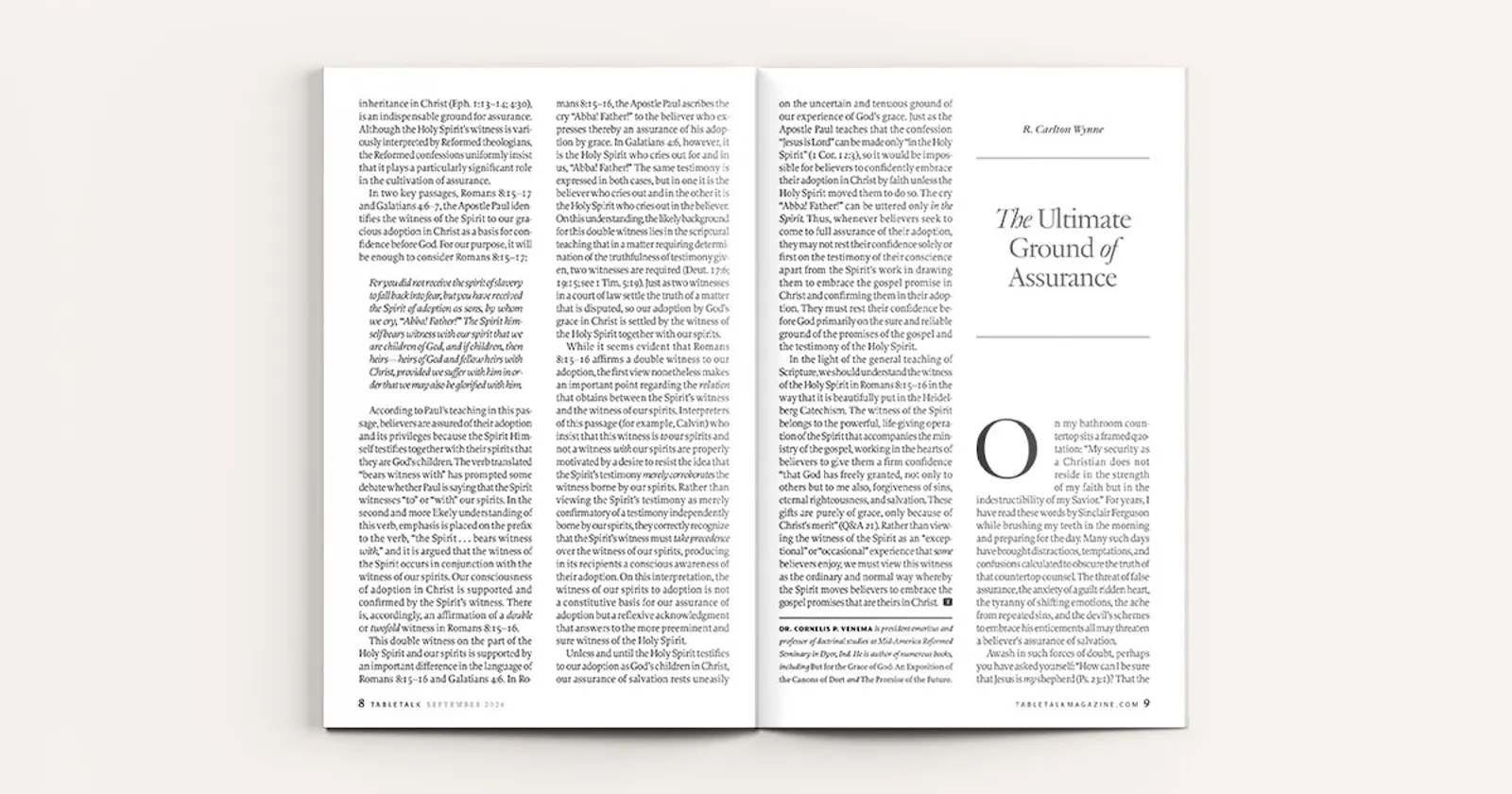
On my bathroom countertop sits a framed quotation: “My security as a Christian does not reside in the strength of my faith but in the indestructibility of my Savior.” For years, I have read these words by Sinclair Ferguson while brushing my teeth in the morning and preparing for the day. Many such days have brought distractions, temptations, and confusions calculated to obscure the truth of that countertop counsel. The threat of false assurance, the anxiety of a guilt-ridden heart, the tyranny of shifting emotions, the ache from repeated sins, and the devil’s schemes to embrace his enticements all may threaten a believer’s assurance of salvation.
Awash in such forces of doubt, perhaps you have asked yourself: “How can I be sure that Jesus is my shepherd (Ps. 23:1)? That the Lord rejoices over me (Zeph. 3:17)?” To borrow a line from the hymn writer Horatius Bonar, what can rid us of such dark unrest and set our spirits free? What is the ultimate ground of assurance of salvation for the Christian?
Secondary Vs. Primary Grounds of Assurance
The word ultimate regarding the grounds of our assurance of salvation lifts our eyes over and beyond other legitimate grounds, such as discerning one’s own repentance, growth in grace, sincere care for others, and love for God, all of which should be assuring. Westminster Confession of Faith 18.1 includes such “secondary” or “subjective” grounds of assurance when it affirms that those who “truly believe in the Lord Jesus, and love him in sincerity, endeavoring to walk in all good conscience before him, may, in this life, be certainly assured that they are in the state of grace.” Texts such as 2 Peter 1:5–8 and 1 John 2:3 rightly commend discernible fruits of a regenerated heart as proper grounds for assurance of salvation.
This article, however, aims to look beyond secondary and subjective grounds to their source—that is, to the primary and objective grounds of Christian assurance in the glorious person of the Lord Jesus Christ. At a further glance, the Christ-centered nature of assurance appears in the quote above, teaching the possibility of assurance for those who “truly believe in the Lord Jesus,” “love him in sincerity,” and endeavor “to walk in all good conscience before him.” Let us orbit around Christ and consider Him as the ultimate ground of assurance in a threefold, Trinitarian way.
The Father’s Promises in Christ
The first and most precious aspect of the ultimate ground of assurance is the saving promises of God the Father in Jesus Christ. These promises are the direct object of saving faith as they bring Christ to a sinner and a sinner to Christ. In them we find the unshakable truthfulness, undiluted love, and almighty power of the promising God. While human feelings and failures can cloud secondary and subjective indicators of salvation, God’s clear and repeated promises to save sinners through Christ outshine the evidences in our lives that we might be prone to doubt. As Paul writes, a believer can live “in hope of eternal life, which God, who never lies, promised before the ages began” (Titus 1:2). Assurance grows as we discount our suspicions of God’s truth and receive His promises as entirely true and made to us personally.
What are these promises, exactly? They include all the riches of heaven: forgiveness of sin, reconciliation with God, increasing holiness, final resurrection, an imperishable inheritance, and more. The most important thing to know, though, is that all such promises are permanently embodied in Jesus Christ as crucified and raised, “for all the promises of God find their Yes in him” (2 Cor. 1:20).
“I agree,” you say. “God’s promises are true. But I have no strength to produce the faith I need to receive them for myself!” To those who give this response, please hear this: God promises to give even the faith you need to receive Christ and the salvation He has won (see Eph. 2:8). “But my faith is weak!” you say. A weak hand may still receive a rich jewel, as the Puritan Richard Sibbes wrote. What ultimately matters is whom we believe, not how strongly we believe. And, resting in Christ, the doubting Christian discovers the second and central aspect of the ultimate ground of assurance.
The Son’s Redemption as the Christ
The Father’s saving promises are the Christian’s assurance as they are fulfilled by the Son. Put differently, the Father’s glory radiates in His promises as they shine on us through the prism of Christ and His redeeming work. For the gospel is “the promise of the life that is in Christ Jesus” (2 Tim. 1:1). The promises are purchased by Christ, performed in Christ, and received from Christ as our Redeemer and Savior. Therefore, to receive and rest in God’s promises is to receive and rest in Christ Himself. Like looking up at the night sky, the more a sinner gazes on Jesus, resting in Him, the more he will find a constellation of comfort, stability, delight, and assurance under the canopy of God’s love.
Developing this full assurance can take time. But as Westminster Confession 18.2 teaches, what God desires to give you in Christ is “not a bare conjectural and probable persuasion grounded upon a fallible hope” but “an infallible assurance of faith.” Such assurance is “infallible” not because our faith never falters but because it is anchored in a Savior who cannot fail.
Where have you failed to love the God who saved you? In the hardships you encounter? In your loneliness? In your suffering because of the fall? Jesus loved the Father through all those and more. By His perfect life, Jesus loved His God and Father as we never have, so that “by the one man’s obedience the many will be made righteous” (Rom. 5:19). Even when He endured the infinite penalty for the sins laid on Him, He clung to His Father, crying, “My God, my God, why have you forsaken me?” (Mark 15:34). His perfect death satisfied God’s justice and purchased immortality, heavenly glory, and an eternal kingdom for undeserving sinners like you and me. And by His resurrection from the dead, Jesus reigns with total authority (Matt. 28:18) and has oceans of sympathy (Heb. 4:15) for backsliding, doubting, and confused believers. As our perpetually interceding Savior, Christ is the center of every factor that contributes to assurance of salvation.
The Spirit Sent from Christ
This leads to a third dimension of Christ as the ultimate ground of assurance—namely, the testimony of the Holy Spirit. How is it that the ministry of the Spirit in the believer is a feature of Christ as the ground of assurance? It is because the Spirit is “the Spirit of Christ” (Rom. 8:9). He is Jesus’ ambassador who administers Christ’s resurrection life to us. He is “the Spirit of truth” (John 15:26) whom Father and Son have sent to bear perpetual witness to Christ in heaven. Most amazingly, the indwelling Holy Spirit is the assurance of every Christian’s full salvation. For He, the Spirit, is “the guarantee of our inheritance until we acquire possession of it, to the praise of his glory” (Eph. 1:14). The same Jesus who embodies the Father’s saving promises is pleased to anchor us in Himself through this Spirit.
The Holy Spirit’s ministry keeps us from looking for assurance beyond God’s revealed promises or by trusting in our own wavering faith or fallible efforts. John Calvin describes this as seeking assurance “outside the way.” Instead, Calvin says, we should “embrace Christ, who is graciously offered to us, and comes to meet us. He will reckon us in his flock and enclose us within his fold” right when we look to Him. Is this not the very thing that the Holy Spirit leads us to do? By illuminating the Scriptures to us, drawing us into deeper fellowship with Christ through worship and prayer, and fueling faith, the Spirit keeps us rooted in God’s Word and in Christ Himself when we are seeking to grow in assurance. As the bond by which Christ unites us to Himself, the Holy Spirit is steadfast proof not only that our heavenly inheritance will be kept for us but that we will be kept for it.
Conclusion
Personal assurance is never divorced from the Father’s promises in Christ, the Son’s work of redemption as the Christ, and the Spirit sent from Christ and the Father into the hearts of believers. As saving faith reflects on this truth, the fruits of faith will evidence “Christ in you, the hope of glory” (Col. 1:27). And when such evidences are discounted through personal sins and doubts, remember again that whoever believes on Christ is secure, not because of the strength of your faith, but because of the indestructibility of the Savior, who will never fail you.