

Request your free, three-month trial to Tabletalk magazine. You’ll receive the print issue monthly and gain immediate digital access to decades of archives. This trial is risk-free. No credit card required.
Try Tabletalk NowAlready receive Tabletalk magazine every month?
Verify your email address to gain unlimited access.
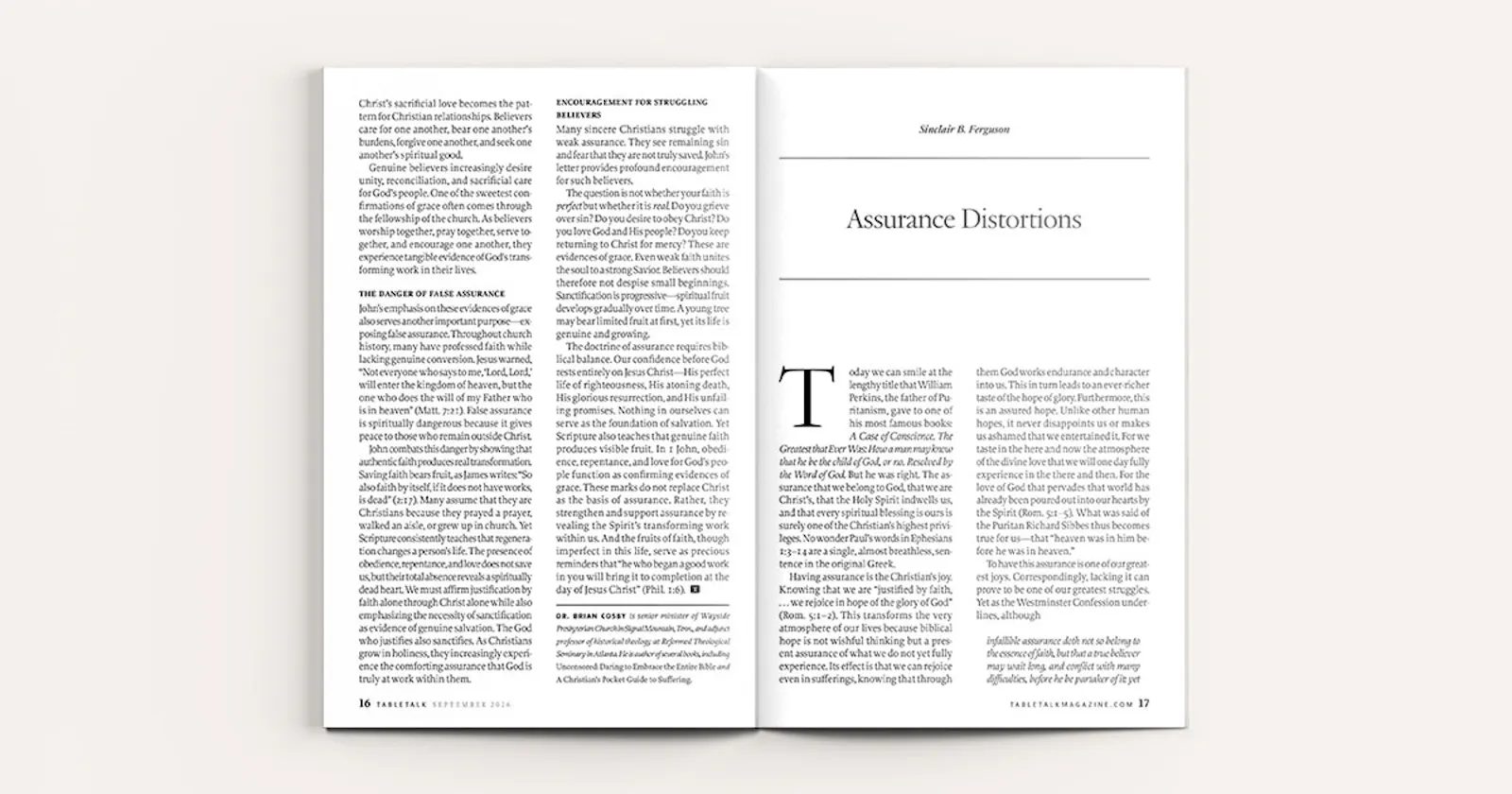
Today we can smile at the lengthy title that William Perkins, the father of Puritanism, gave to one of his most famous books: A Case of Conscience. The Greatest that Ever Was: How a man may know that he be the child of God, or no. Resolved by the Word of God. But he was right. The assurance that we belong to God, that we are Christ’s, that the Holy Spirit indwells us, and that every spiritual blessing is ours is surely one of the Christian’s highest privileges. No wonder Paul’s words in Ephesians 1:3–14 are a single, almost breathless, sentence in the original Greek.
Having assurance is the Christian’s joy. Knowing that we are “justified by faith, . . . we rejoice in hope of the glory of God” (Rom. 5:1–2). This transforms the very atmosphere of our lives because biblical hope is not wishful thinking but a present assurance of what we do not yet fully experience. Its effect is that we can rejoice even in sufferings, knowing that through them God works endurance and character into us. This in turn leads to an ever-richer taste of the hope of glory. Furthermore, this is an assured hope. Unlike other human hopes, it never disappoints us or makes us ashamed that we entertained it. For we taste in the here and now the atmosphere of the divine love that we will one day fully experience in the there and then. For the love of God that pervades that world has already been poured out into our hearts by the Spirit (Rom. 5:1–5). What was said of the Puritan Richard Sibbes thus becomes true for us—that “heaven was in him before he was in heaven.”
To have this assurance is one of our greatest joys. Correspondingly, lacking it can prove to be one of our greatest struggles. Yet as the Westminster Confession underlines, although
infallible assurance doth not so belong to the essence of faith, but that a true believer may wait long, and conflict with many difficulties, before he be partaker of it: yet being enabled by the Spirit to know the things which are freely given him of God, he may, without extraordinary revelation, in the right use of ordinary means, attain thereunto. (18.3)
The corollary of this is that distorted views of assurance entangle us in a web of spiritual danger. Such distortions are powerful weapons in Satan’s armory, hence Paul’s warning that we must not allow ourselves to be “outwitted” by him. Notice too Paul’s affirmation: “We are not ignorant of his designs” (2 Cor. 2:11). But the Apostle’s use of the first-person plural (“we”) does not necessarily imply that the same is true for everyone. For, sadly, the church’s story is punctuated by Satan’s victories. There have been many times when—to borrow John Owen’s striking phraseology—“Satan claps his hands” when he can induce either a false understanding or a false experience of assurance. In fact, he has been doing this since virtually the beginning of the Bible’s story. Genesis 3 is the primary example.
Assurance is, of course, a multidimensional reality. It involves confidence in God’s Word, in His love for us, and in His embracing us as His children. Genesis 3 traces the subtle way that Satan sought to distort each of these dimensions. His approach to Eve undermined her assurance of the veracity, reliability, and authority of God’s Word (“Did God actually say . . . ?”; v. 1). More than that, he undermined her assurance of His love for her as His child by distorting God’s kind and generous character. This lies on the surface of his words: “Did God actually say, ‘You shall not eat of any tree in the garden’?” (v. 1, emphasis added). The innuendo of miserliness is obvious, since the Lord had placed Adam and Eve in a garden abounding in delightful and delicious fruit (2:9). God had actually said, “You may surely eat of every tree of the garden, but of the tree of the knowledge of good and evil you shall not eat” (v. 16–17, emphasis added).
Struggle as she might, Eve was befuddled in her thinking. Her understanding of the grounds and means of experiencing a happy assurance of her relationship with God was immediately distorted. The rest, as we say, is history—her history, biblical history, the church’s history, and our history too. The origin of all our sins is recorded in Genesis 3. So too are the roots of every distortion of assurance.
Since assurance is a multidimensional reality, so also are the ways that it can be distorted. And when Satan dislodges us from the true path to assurance, his further strategy is to stimulate us to create our own false paths. Among these are deception, antinomianism, and legalism. We might call them self-deception, self-assurance, and self-help. They are different facets of Satan’s central aim of obscuring the centrality of our Lord Jesus Christ in both justification and assurance of salvation. Since he cannot destroy Christ’s work for us, he seeks to destroy our enjoyment of it.
self-deception
Every distortion of assurance involves an element of deception. Its most subtle form is self-deception. Despite Scripture’s warnings, we are too easily self-deceived. Think of how surveys consistently suggest that 80 to 93 percent of us believe that we are “better than average” drivers. If this self-deception can be true in relation to an acquired skill, perhaps we should not be surprised that most people consider their standing before God (and the assurance that accompanies it) as “above average.” Because of the common misconception that God’s acceptance is calibrated to a passing grade of being “average and above,” such individuals readily assume that all is well. One symptom of such self-deception is that the same individuals will cheerfully sing John Newton’s hymn “Amazing Grace!” (which in the United States has become a kind of unofficial second national anthem). Self-deceived, they fail to recognize that they are singing about a grace that is amazing (because it is undeserved and de-merited) and is saving (because we are lost), and that in singing about it, they describe themselves as “a wretch.”
Such self-deceptive assurance punctuates the Bible story. The prophets regularly excoriated their contemporaries, seeking to undeceive their facile assumption that they were acceptable to God and could therefore be assured of His blessing, since they were, after all, not like other nations. Jeremiah was told “to pluck up and to break down, to destroy and to overthrow” such self-deception. Only then could he build and plant (Jer. 1:10). It is perhaps not so surprising, then, that some of Jesus’ contemporaries thought He was Jeremiah Redivivus, or “brought back to life” (see Matt. 16:14), for they heard sermons from Him that similarly unmasked and undermined their self-deception. A prime example is the parable of the Pharisee and the tax collector—so true to life that it reads like an eyewitness account (Luke 18:9–14). We, of course, know that only one of these men “went down to his house justified.” If asked who it was, we confidently affirm, “The tax collector.” But while that is the “right” answer, it can mask the disturbing truth that we ourselves may actually more closely resemble the Pharisee—self-deceived because we are self-assured rather than grace-assured. Far from thinking and speaking of ourselves as “a wretch,” we inwardly think in terms of “better-than-average-and-deserving-of-grace.”
Nor is this self-deception a feature of the great unwashed. The various State of Theology surveys that Ligonier has commissioned make clear that the same self-deception is alive and well in many who classify themselves as evangelicals. Such self-deception involves a failure to understand that only those who see themselves as “lost” know that they need Someone to “find” them. Only those who see themselves as “wretched” will ever want a Savior.
But only those who need and have a Savior can be assured of salvation.
antinomianism
Antinomianism is a catchall category for another variety of assurance distortions. It implies theologically rejecting or morally ignoring the law of God (Greek anti, meaning “against,” and nomos, meaning “law”). As a theological term, it implies believing that the teaching of Christ and the Apostles removed the Decalogue from a commanding role in the Christian life. This involves the question of how the Old and New Testaments are related. But since almost all of the Decalogue’s injunctions are clearly expressed in one form or another in the New Testament (the Sabbath commandment usually being seen as an exception), the existential differences may be few (even if the hermeneutical divide is considerable), since the moral substance of God’s will has not changed, even if it comes to us through the lips of Christ and the Apostles rather than the lips of Moses. For many such Christians, there remains what we might call the New Testament Novemalogue (nine laws).
But antinomianism comes in other shapes and sizes. There is the kind that Paul discusses in Romans 6:1 and following—an antinomianism that holds that God’s saving grace abounds in the presence of sin (Rom. 5:20) and that our assurance of salvation will not be affected by how we live. This idea—in its more extreme forms—is well expressed in the ditty:
Free from the law, O blessed condition.
I can sin as I please, and still have remission!
It is illustrated in the kind of response that we might receive when suggesting to a friend that he is breaking the speed limit: “We are not under law, but under grace.” The local police are not likely to share this misshapen theology of “grace.” The assumption here is that where there is grace, there is divine tolerance. A similar distortion is expressed in every defense of a sinful pattern in our lives, saying, “But God loves me the way I am.” Not so. The truth is that He loves us despite the way we are and does not intend to leave us the way that He finds us. To assume otherwise distorts our understanding of grace and assurance and puts us on a path that leads to spiritual shipwreck. In sharp contrast to this distortion, the cardinal Apostolic principle is that since a Christian is united to Christ, it is impossible to have Him for justification without also having Him for sanctification. As John Calvin says more than once, this is “to tear Christ asunder since he was given us for both these ends.”
The same distortion is present in yet another form, illustrated in the experience of a minister friend of mine. After the minister conducted the funeral of a man who had shown no interest in Christ or the church, the man’s brother showed him a “decision card” that his brother had once signed, and said, “He is all right [i.e., in heaven], isn’t he?” There are, of course, high-church equivalents: “I was baptized” or “I took the sacrament”—that guarantees heaven for me, doesn’t it? Yes, it does, when saving and transforming faith is present, but not otherwise. The action without the reality it signifies can never give solid assurance.
Thankfully, we are not the final arbiter of another’s salvation. But ultimately, someone who is not actually being saved, being transformed, and growing in a desire to live in harmony with the Lord can have no real assurance that he is actually being saved, for this is what being saved looks like. Such distortions will either increase through self-deception or collapse in the face of life’s trials.
legalism
Legalism, like antinomianism, also appears in various guises. It implies that our acceptance with God, and therefore our assurance, depends to some degree on our own acts of obedience. Such legalism does not necessarily involve outright denial of our sinfulness or our need for grace, but it will always distort both by implying that some kind of addition to grace is essential. If that were true, “grace would no longer be grace” (Rom. 11:6).
This was the distortion that the early Reformers encountered. Their discovery of the gospel way of grace produced an explosion of assurance. In fact, the medieval church talked a great deal about “grace”—how we receive it and how we “cooperate” with it. Its ordo salutis involved the individual’s receiving grace at baptism and, despite failures, progressively cooperating with the “grace” of the other sacraments. The hoped-for end point of this elongated process was that faith might eventually be suffused with perfect love for God such that the individual becomes justus, “righteous,” and God can therefore count him to be righteous “by grace.”
The Reformers saw two problems here. The first was that this “grace” was in fact “grace plus my cooperation” and therefore “no longer . . . grace.” The second was that this way of salvation made it practically impossible for anyone to know that he had cooperated “enough” to qualify for justification (by “grace”). Exceptions might be made for the “saints” and those whose salvation was vouchsafed to them by supernatural means (such as an appearance of Mary). Thus, “ordinary” believers (like you and me) were denied the birthright of enjoying assurance “without extraordinary revelation, in the right use of ordinary means” (WCF 18.3).
Such teaching turned the biblical gospel upside down, for justification takes place not at the end of an elongated cooperative process but at the very beginning of the Christian life. The life of the Christian is an “already-having-been-justified life.” We are justified through faith in union with the risen Christ in His perfect, indestructible, irreversible righteousness. Since He has risen, He can never die again (see Rom. 4:23–25; 6:9).
A Latin tag summarized this “grace cooperative”: Facere quod in se est—“Do what you can.” It perhaps remains the most ordinary form of gospel distortion: “God helps those who help themselves.” The need for grace is not denied, but the explanation of how this “grace” saves is, in effect, destructive of gospel grace and assurance. The need for the Reformers to un-distort this teaching was perhaps most clearly expressed by the formidable Roman Catholic theologian-apologist Cardinal Robert Bellarmine (1542–1621) when he stated that the greatest of all Protestant heresies was assurance. He said this, of course, because the medieval system of sacramental “grace” neither offered nor encouraged assurance. Indeed, it was incapable of doing so.
This medieval distortion continues to have a Protestant form. Yes, “grace” is necessary for salvation. But while God contributes most of what is needed, we must play our part and cooperate with our own contribution. But that always produces the curse of “Have I done enough to be sure?” By contrast, the gospel tells us that we can never do enough. But its good news is that Jesus Christ has done enough for us in our place. In fact, “Jesus paid it all.” That is grace. Anything other, anything less, anything more—and “grace is no longer grace.”
True assurance, then, is found in the One in whom our faith is placed. Self-deception, antinomianism, and legalism all distort this good news because they all diverge from a proper center in Christ alone. But when we see—as Calvin noted so powerfully—that our whole salvation is found perfectly, finally, and irreversibly in Jesus Christ, “clothed with his gospel,” then we will seek no part of it, nor base our assurance of it, anywhere else than in Him, in whom all true grace and lasting assurance are to be found. Thus united to Him, we are able to sing:
Blessed assurance, Jesus is mine!
O what a foretaste of glory divine!