

Request your free, three-month trial to Tabletalk magazine. You’ll receive the print issue monthly and gain immediate digital access to decades of archives. This trial is risk-free. No credit card required.
Try Tabletalk NowAlready receive Tabletalk magazine every month?
Verify your email address to gain unlimited access.
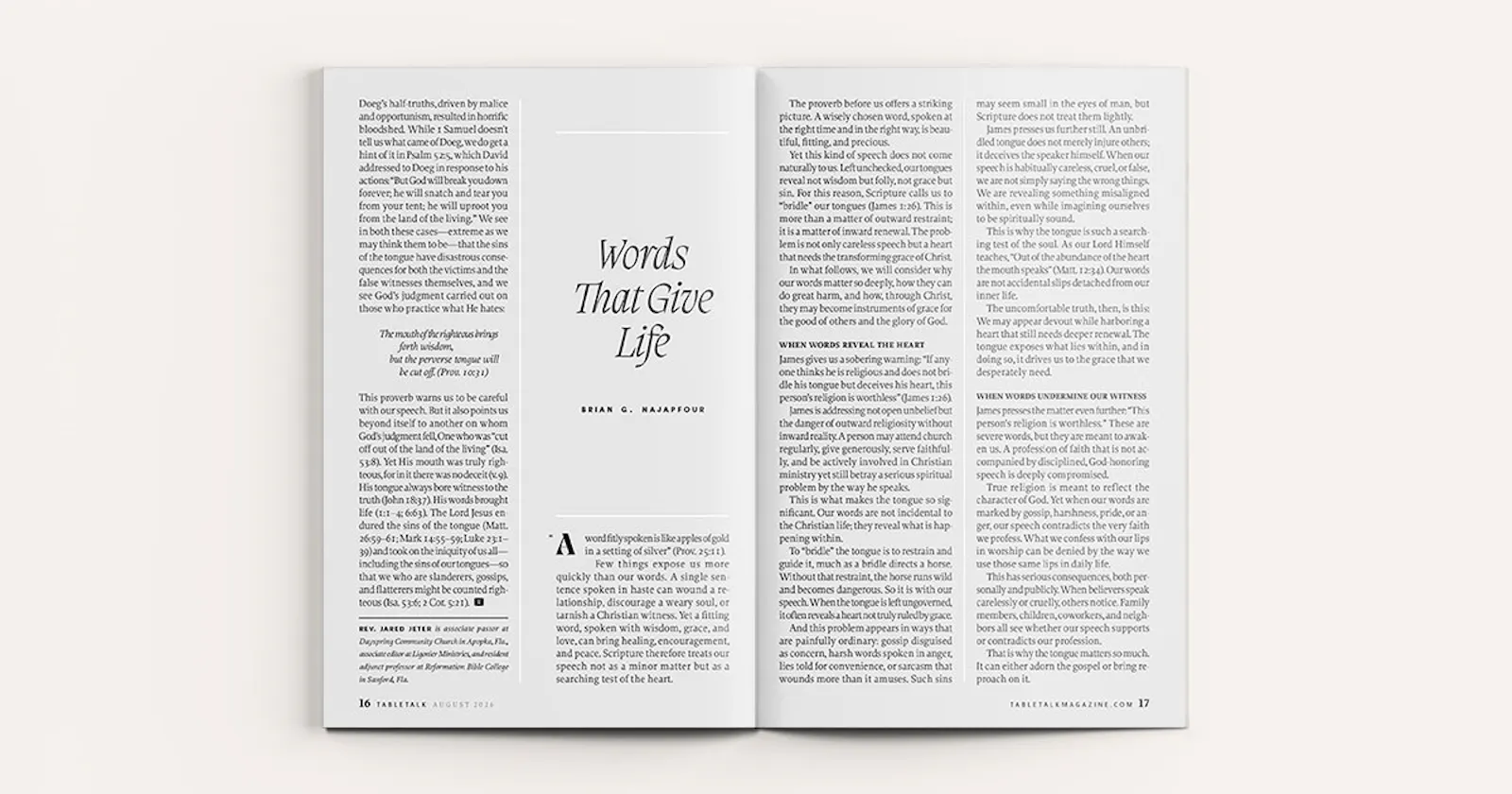
“A word fitly spoken is like apples of gold in a setting of silver” (Prov. 25:11).
Few things expose us more quickly than our words. A single sentence spoken in haste can wound a relationship, discourage a weary soul, or tarnish a Christian witness. Yet a fitting word, spoken with wisdom, grace, and love, can bring healing, encouragement, and peace. Scripture therefore treats our speech not as a minor matter but as a searching test of the heart.
The proverb before us offers a striking picture. A wisely chosen word, spoken at the right time and in the right way, is beautiful, fitting, and precious.
Yet this kind of speech does not come naturally to us. Left unchecked, our tongues reveal not wisdom but folly, not grace but sin. For this reason, Scripture calls us to “bridle” our tongues (James 1:26). This is more than a matter of outward restraint; it is a matter of inward renewal. The problem is not only careless speech but a heart that needs the transforming grace of Christ.
In what follows, we will consider why our words matter so deeply, how they can do great harm, and how, through Christ, they may become instruments of grace for the good of others and the glory of God.
when words reveal the heart
James gives us a sobering warning: “If anyone thinks he is religious and does not bridle his tongue but deceives his heart, this person’s religion is worthless” (James 1:26).
James is addressing not open unbelief but the danger of outward religiosity without inward reality. A person may attend church regularly, give generously, serve faithfully, and be actively involved in Christian ministry yet still betray a serious spiritual problem by the way he speaks.
This is what makes the tongue so significant. Our words are not incidental to the Christian life; they reveal what is happening within.
To “bridle” the tongue is to restrain and guide it, much as a bridle directs a horse. Without that restraint, the horse runs wild and becomes dangerous. So it is with our speech. When the tongue is left ungoverned, it often reveals a heart not truly ruled by grace.
And this problem appears in ways that are painfully ordinary: gossip disguised as concern, harsh words spoken in anger, lies told for convenience, or sarcasm that wounds more than it amuses. Such sins may seem small in the eyes of man, but Scripture does not treat them lightly.
James presses us further still. An unbridled tongue does not merely injure others; it deceives the speaker himself. When our speech is habitually careless, cruel, or false, we are not simply saying the wrong things. We are revealing something misaligned within, even while imagining ourselves to be spiritually sound.
This is why the tongue is such a searching test of the soul. As our Lord Himself teaches, “Out of the abundance of the heart the mouth speaks” (Matt. 12:34). Our words are not accidental slips detached from our inner life.
The uncomfortable truth, then, is this: We may appear devout while harboring a heart that still needs deeper renewal. The tongue exposes what lies within, and in doing so, it drives us to the grace that we desperately need.
when words undermine our witness
James presses the matter even further: “This person’s religion is worthless.” These are severe words, but they are meant to awaken us. A profession of faith that is not accompanied by disciplined, God-honoring speech is deeply compromised.
True religion is meant to reflect the character of God. Yet when our words are marked by gossip, harshness, pride, or anger, our speech contradicts the very faith we profess. What we confess with our lips in worship can be denied by the way we use those same lips in daily life.
This has serious consequences, both personally and publicly. When believers speak carelessly or cruelly, others notice. Family members, children, coworkers, and neighbors all see whether our speech supports or contradicts our profession.
That is why the tongue matters so much. It can either adorn the gospel or bring reproach on it.
An angry heart produces angry words. A bitter heart produces cutting remarks. A proud heart produces self-exalting speech. But a heart softened by grace increasingly produces words that are patient, truthful, and kind. Our speech, then, becomes a kind of spiritual barometer. It often reveals more about us than we intend.
This raises a searching question: Do those around us hear a “heavenly accent” in our speech? Because we are citizens of heaven, our words should reflect our identity. Just as an accent reveals where we are from, so our speech should reveal that we belong to Christ.
when words wound our own souls
The damage done by careless speech is not limited to those who hear it. Scripture warns that an ungoverned tongue also harms the speaker himself.
This is a truth that we often overlook. We readily see how sinful speech harms others, but the Bible also teaches that it carries consequences for the one who speaks it. That is why Proverbs 13:3 says, “Whoever guards his mouth preserves his life; he who opens wide his lips comes to ruin.” This is not an exaggerated warning but a sober reminder that words can become instruments of personal ruin.
An unrestrained tongue is dangerous because it is difficult to stop once set in motion. It is like riding a horse without a bridle or driving without a steering wheel. What begins as a careless word can end in broken relationships, lost trust, damaged reputations, and lingering regret.
But there is an even deeper danger. Sinful speech does not merely create external damage; it also shapes the soul. Gossip breeds more gossip. Anger fuels further anger. Deceit makes the conscience less tender. Over time, patterns of speech become patterns of character.
This is why the tongue must never be treated lightly. To indulge sinful speech is not merely to risk hurting others; it is to participate in one’s own spiritual decline. The misuse of the tongue can harden the heart, weaken the conscience, and draw us further away from the very grace that we profess to love.
For that reason, learning to govern our speech is not only an act of love toward others. It is also an act of spiritual discipline over our own souls.
speech renewed by grace
If our speech reveals the heart, then the solution must begin there. We need more than improved manners; we need renewed hearts. That is why Scripture calls us first to repentance. We must stop excusing our careless, harsh, or dishonest words and bring them honestly before God. The prayer of the psalmist should become our own: “Set a guard, O Lord, over my mouth; keep watch over the door of my lips!” (Ps. 141:3). Let us pray with the hymn writer Frances Havergal (1836–79):
Take my voice, and let me sing, always, only, for my King.
Take my lips, and let them be filled with messages from thee.
We cannot tame the tongue by sheer willpower. We need divine help. The Spirit of God must reshape not only our speech but also the desires and dispositions from which that speech flows.
Such prayer must be joined with vigilance, of course. As David says, “I will guard my ways, that I may not sin with my tongue; I will guard my mouth with a muzzle” (Ps. 39:1). Guarding the tongue requires intentional restraint and spiritual discernment. Scripture exhorts us, “Let your speech always be gracious, seasoned with salt” (Col. 4:6). Our words should therefore be gentle rather than harsh, gracious rather than critical, timely rather than impulsive, and persuasive rather than forceful. Not every thought needs to be spoken, and silence itself can sometimes be an act of wisdom, though this is very different from the cold, punishing silence that can be used to wound others. When governed by wisdom and love, speech does more than avoid harm; it becomes an instrument of edification, encouragement, and peace.
Yet ultimately, the answer to our speech problem is found in Jesus Christ. He alone used His tongue perfectly. He spoke truth without deceit, responded to insult without retaliation, and used His words to heal, teach, and comfort. But Christ is not merely our example; He is our Savior. At the cross, He bore the guilt of our sinful words, our lies, gossip, bitterness, and careless speech. Through His death, we are forgiven; through His Spirit and Word, we are renewed.
And so there is hope. By the grace of Christ, our words may increasingly become what Proverbs 25:11 celebrates: fitting, beautiful, and life-giving. A timely word that comforts the grieving, a gentle correction that restores the wandering, and an encouraging sentence that strengthens the weary are not small things. They are apples of gold in settings of silver. May our speech, then, adorn the gospel and bear the accent of heaven.