

Request your free, three-month trial to Tabletalk magazine. You’ll receive the print issue monthly and gain immediate digital access to decades of archives. This trial is risk-free. No credit card required.
Try Tabletalk NowAlready receive Tabletalk magazine every month?
Verify your email address to gain unlimited access.
Paul’s exhortation to the Ephesians to “[speak] the truth in love” (4:15) are words that are easier to print on wall decor than they are to practice. Most of us tend to swerve into one of two ditches. Some are committed to truth, but they wield it like a sledgehammer. Others are committed to love, but such love never wounds. But in God, these two are never at odds. Both these attributes—truth and love—are to be reflected in the Christian’s speech, and they are used by God to bring about maturity in His church. These words are pregnant with practical theology regarding our use of the tongue and what God intends to do in us and through us with it.
Paul says that the content of our speech is truth. In other words, with respect to the what, we speak the truth; this is nonnegotiable. The Christian does not speak untruth. Christians are not free to manipulate, flatter, exaggerate, or mislead. The Lord is the God of truth, and His people are to reflect His character in their speech. Falsehood is the way of the old man; truth is the way of the new man, which is “created after the likeness of God in true righteousness and holiness” (v. 24). Therefore, Paul says plainly, “Having put away falsehood, let each one of you speak the truth with his neighbor” (v. 25).
Yet faithful speech requires more than bare truth. The devil and his servants know truth (James 2:19). If the what of our speech is truth, then the when, where, how, and why are answered with the Apostle’s essential qualification “in love.” It is possible to speak the truth “unseasonably, or maliciously to a wrong end” (Westminster Larger Catechism 145). A word that is seasonable is a word spoken in the right season (“a word fitly spoken”; Prov. 25:11) and with the proper seasoning (“seasoned with salt”; Col. 4:6). It is also possible to pervert the truth “to a wrong meaning, or in doubtful and equivocal expressions, to the prejudice of truth or justice” (WLC 145). A loveless rebuke can be correct in substance and sinful in spirit. It is possible to say something true at the wrong time, in the wrong way, with the wrong tenor, and for the wrong object. Truth can be weaponized rather than stewarded. This is why the little phrase “in love” carries so much weight. It governs our motive (“Why do I say this?”), our manner (“How am I saying it?”), and our aim (“What do I mean this word to accomplish?”). To speak the truth in love, then, is to say what is true for the good of the other, in a manner suited to that good.
Here’s where the difficulty begins to surface. If we are speaking the truth, then sometimes we will speak a rebuke. Love does not remain silent while a brother wanders into sin. It does not silently watch doctrinal mayhem spread. Rather, love warns and admonishes. One of the lies of our modern day is that love is measured by how little discomfort we cause: “He’s such a nice guy” often simply means “He never hurts my feelings.” But Scripture teaches that sometimes the most loving word is the hardest word to say and the hardest word to hear. “Faithful are the wounds of a friend” (Prov. 27:6). If you are a friend who never wounds, are you really a friend? If we see a fellow believer entangled in sin, hardened by bitterness, drifting from the means of grace, or flirting with serious error, love speaks the truth for his good. This is the what and the why of truthful speech.
At the same time, love governs the way that correction is given. It shapes the how, the when, and the where of truthful speech. If the Christian wounds to heal and speaks to win his brother, those ends will shape the manner, timing, and setting of his words. For the manner, firmness and gentleness are friends in the mature Christian. For the timing, urgency and patience are friends in the mature Christian. For the setting, discretion and presence are friends in the mature Christian. (Love prefers, when possible, to speak difficult truths in person and privately.) These rare combinations are difficult because our hearts are still tainted by dreadful sin. The poison in our tongues runs deep. Fear keeps us silent to avoid awkwardness, tension, or rejection. Pride tells us to speak, but to do so with impatience or a secret desire to triumph or appear smart. When truth and love are joined in the heart of a man, he is courageous enough to speak truth and humble enough to speak it fittingly.
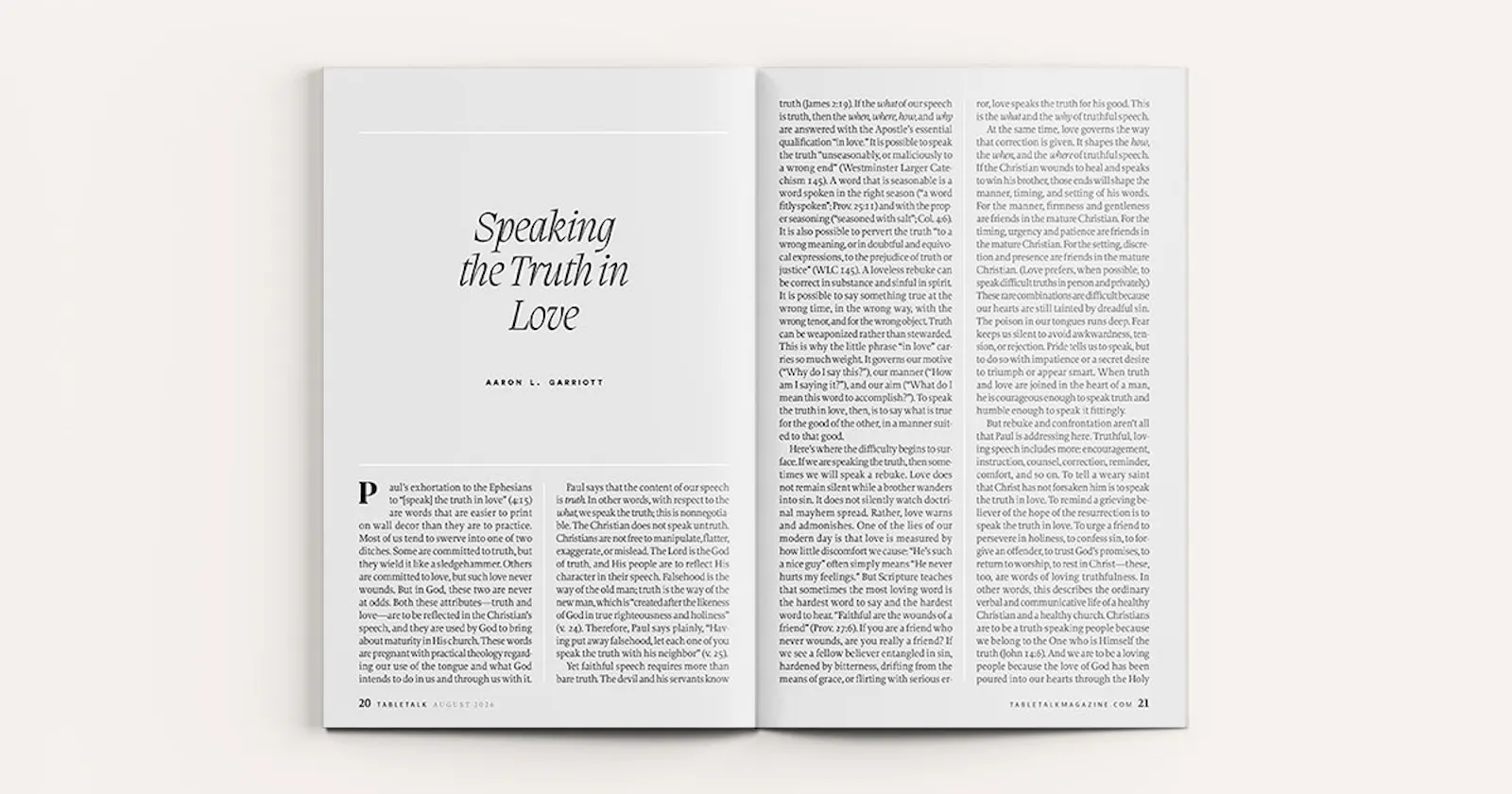
But rebuke and confrontation aren’t all that Paul is addressing here. Truthful, loving speech includes more: encouragement, instruction, counsel, correction, reminder, comfort, and so on. To tell a weary saint that Christ has not forsaken him is to speak the truth in love. To remind a grieving believer of the hope of the resurrection is to speak the truth in love. To urge a friend to persevere in holiness, to confess sin, to forgive an offender, to trust God’s promises, to return to worship, to rest in Christ—these, too, are words of loving truthfulness. In other words, this describes the ordinary verbal and communicative life of a healthy Christian and a healthy church. Christians are to be a truth-speaking people because we belong to the One who is Himself the truth (John 14:6). And we are to be a loving people because the love of God has been poured into our hearts through the Holy Spirit (Rom. 5:5). This is life in covenant on the ground. When truth and love are fused in the renewed tongue, Christ uses our words to strengthen His body unto mature manhood.
It takes more than willpower to subdue the tongue, as James warned: “No human being can tame the tongue” (James 3:8). The duty to speak the truth in love requires union and communion with Christ. Only those who have been dealt with truthfully and lovingly can begin to deal with others in that way. This is where Paul’s story is so instructive. The first words that Paul heard from the risen and ascended Lord Jesus Christ were true words spoken in love: “Saul, Saul, why are you persecuting me?” (Acts 9:4). In turn, this fire-breathing man (v. 1) had to speak truthful and loving words to many, such as Peter (Gal. 2:11–14), Barnabas (Acts 15:36–41), Euodia and Syntyche (Phil. 4:2–3), Philemon (Philem. 1:8–21), King Agrippa (Acts 26:24–29), Festus (vv. 24–25), and Timothy (1 Tim. 1:18–20; 2 Tim. 1:7–8). This pattern of spoken-to-in-love to speaking-in-love should be ours, too.
To speak the truth in love sounds simple, but it’s an otherworldly command that comes with an enormous cost. It requires prayer, humility, discernment, courage, and self-control. Sometimes it requires painful blows—delivering them and receiving them. But “speaking the truth in love” is no mere Christianese; it is one of Christ’s chosen means for building up His people.