

Request your free, three-month trial to Tabletalk magazine. You’ll receive the print issue monthly and gain immediate digital access to decades of archives. This trial is risk-free. No credit card required.
Try Tabletalk NowAlready receive Tabletalk magazine every month?
Verify your email address to gain unlimited access.
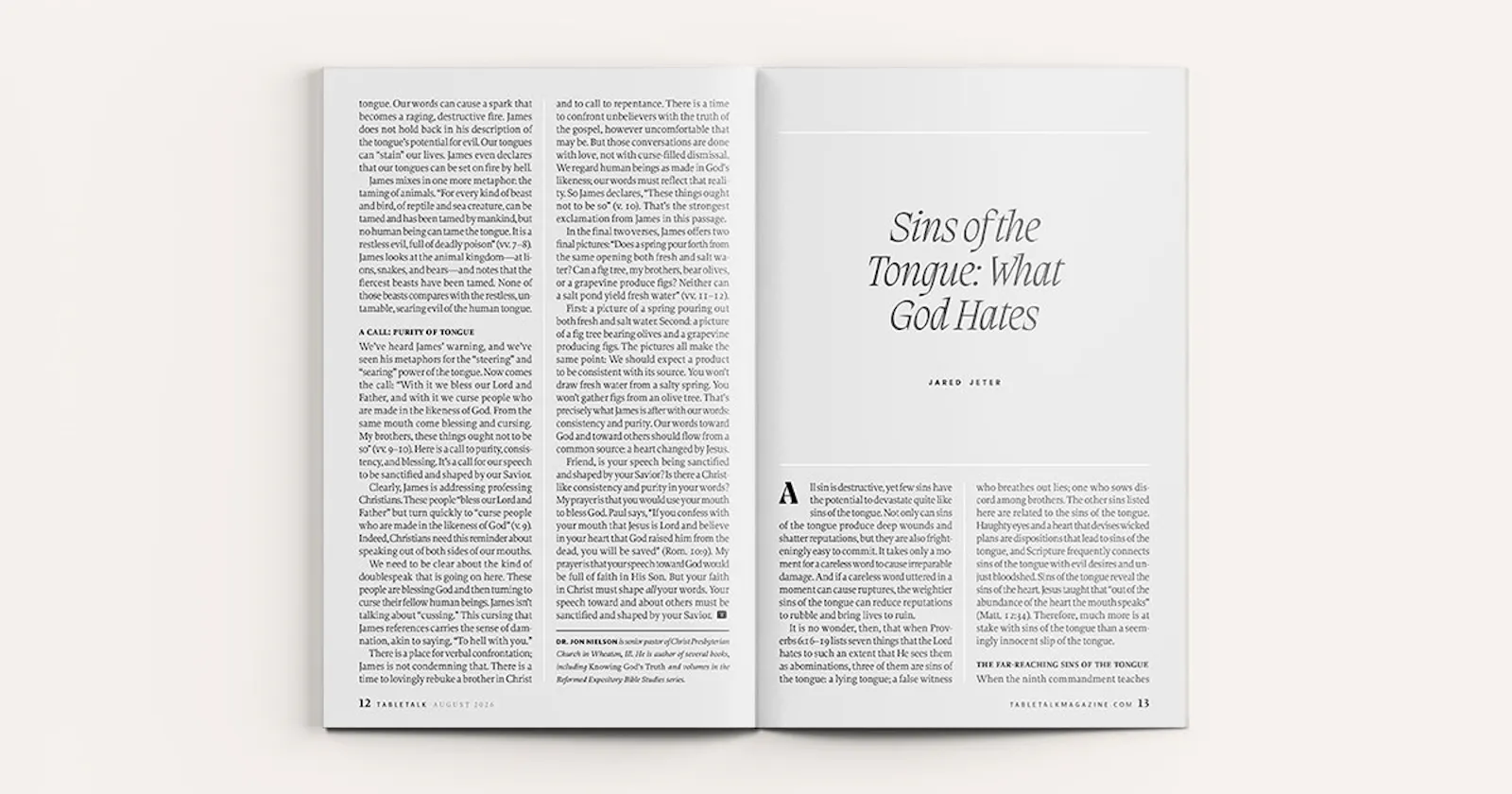
All sin is destructive, yet few sins have the potential to devastate quite like sins of the tongue. Not only can sins of the tongue produce deep wounds and shatter reputations, but they are also frighteningly easy to commit. It takes only a moment for a careless word to cause irreparable damage. And if a careless word uttered in a moment can cause ruptures, the weightier sins of the tongue can reduce reputations to rubble and bring lives to ruin.
It is no wonder, then, that when Proverbs 6:16–19 lists seven things that the Lord hates to such an extent that He sees them as abominations, three of them are sins of the tongue: a lying tongue; a false witness who breathes out lies; one who sows discord among brothers. The other sins listed here are related to the sins of the tongue. Haughty eyes and a heart that devises wicked plans are dispositions that lead to sins of the tongue, and Scripture frequently connects sins of the tongue with evil desires and unjust bloodshed. Sins of the tongue reveal the sins of the heart. Jesus taught that “out of the abundance of the heart the mouth speaks” (Matt. 12:34). Therefore, much more is at stake with sins of the tongue than a seemingly innocent slip of the tongue.
the far-reaching sins of the tongue
When the ninth commandment teaches that we are not to bear false witness against our neighbor (Ex. 20:16), it has a wide expanse of sins in view, such as slander, gossip, and flattery. Slander involves making false statements that damage a person’s reputation. Gossip bears false witness by spreading or giving ear to damaging talk behind another person’s back, whether that talk involves rumor, suspicion, or an unnecessary disclosure of faults. Flattery bears false witness in a more subtle manner: It offers praise motivated not by truth or love, but by manipulation and self-interest. These examples only begin to show how far the ninth commandment reaches.
One of the best expositions of the Ten Commandments is found in the Westminster Larger Catechism, and it is especially helpful on the ninth commandment. Along with identifying sins that we often associate with the ninth commandment, such as those mentioned above, the catechism lists the following as examples of violations of the ninth commandment (Q&A 145):
• Giving false evidence
• Wittingly pleading for an evil cause
• Calling evil good, and good evil
• Concealing the truth
• Undue silence in a just cause
• Speaking the truth unseasonably, or maliciously to a wrong end
• Aggravating smaller faults
• Unnecessary discovering of infirmities
• Receiving and countenancing evil reports
• Stopping our ears against just defense
• Evil suspicion
• Rejoicing in the disgrace and infamy of others
• Neglecting such things as are of good report
The ninth commandment is far more expansive than just lying, slandering, and gossiping. This representative list shows us how bearing false witness against our neighbor can take both outward and inward forms, and it helps us see the dangers of “a false witness who breathes out lies” and “one who sows discord among brothers” (Prov. 6:19). The ninth commandment certainly prohibits sins of the tongue, but it also gets to the center of the matter: Sins of the tongue arise from sins of the heart—valuing expediency over truth, self-interest over love, and suspicion over charity.
The Lord is “righteous in all his ways” and near to “all who call on him in truth” (Ps. 145:17–18). The antithesis of His character is the character of Satan, who Jesus testifies is “a liar and the father of lies” (John 8:44). Indeed, Satan is the prototypical false witness, since he deliberately sowed discord between the Lord and the first representatives of mankind by falsely representing the Creator Himself (Gen. 3:1–5). It is no surprise, then, that “lying lips are an abomination to the Lord” (Prov. 12:22). And just as the father of lies abhors the One who both tells the truth (John 8:45) and is the truth (14:6), so Scripture testifies that one who bears false witness despises his brother: “A lying tongue hates its victims, and a flattering mouth works ruin” (Prov. 26:28).
consequences of sins of the tongue
In 1 Kings 21, we read of Ahab, the king of the northern kingdom of Israel. He desired the vineyard of his neighbor Naboth and offered to buy it. When Naboth refused to sell, the king was vexed, and his wife, Jezebel, took notice. After she found out what had vexed the king, she hatched a plot to procure Naboth’s vineyard. Jezebel impersonated Ahab in a letter and used his seal to manipulate the elders of Naboth’s city to “set two worthless men opposite him, and . . . bring a charge against him, saying, ‘You have cursed God and the king.’ Then take him out and stone him to death” (v. 10). Jezebel’s blatant incitement to falsely accuse Naboth resulted in Naboth’s brutal death. But it also contributed to her own destruction, that of her husband, and that of her progeny (vv. 17–29; 2 Kings 9:21–37).
If the consequences of slander are illustrated by Jezebel, the consequences of more subtle sins of the tongue are illustrated through David and Doeg the Edomite, King Saul’s chief herdsman. Right on the heels of Saul’s early attempts to kill David, David goes to Ahimelech the priest. Ahimelech trembles at David’s presence and questions why he has come alone (1 Sam. 21:1). David hides the truth from Ahimelech, saying that he has received a charge from King Saul (v. 2). Ahimelech then gives David holy bread (v. 6) and Goliath’s sword (vv. 8–9), and David flees to Gath (v. 10). Yet in verse 7, we hear that one of Saul’s servants, Doeg the Edomite, “was there that day, detained before the Lord,” and witnessed their interaction.
Shortly thereafter, Saul accuses his servants of conspiring against him (22:6–8). Seizing the opportunity presented by Saul’s accusation, Doeg reports, “I saw the son of Jesse coming to Nob, to Ahimelech the son of Ahitub, and he inquired of the Lord for him and gave him provisions and gave him the sword of Goliath the Philistine” (vv. 9–10). Doeg reports some of the truth, but leaves out Ahimelech’s trembling and questioning of David, as well as David’s own deception of Ahimelech. Doeg misconstrues Ahimelech’s intentions and reports only part of the truth for malicious and selfish ends.
In response to Doeg’s testimony, Saul summons Ahimelech and all the other priests at Nob, questions them, and orders their execution. Doeg himself strikes down eighty-five priests, followed by the slaughter of the entire city of Nob, including women, children, infants, and livestock (vv. 11–19). Doeg’s half-truths, driven by malice and opportunism, resulted in horrific bloodshed. While 1 Samuel doesn’t tell us what came of Doeg, we do get a hint of it in Psalm 52:5, which David addressed to Doeg in response to his actions: “But God will break you down forever; he will snatch and tear you from your tent; he will uproot you from the land of the living.” We see in both these cases—extreme as we may think them to be—that the sins of the tongue have disastrous consequences for both the victims and the false witnesses themselves, and we see God’s judgment carried out on those who practice what He hates:
The mouth of the righteous brings forth wisdom,
but the perverse tongue will be cut off. (Prov. 10:31)
This proverb warns us to be careful with our speech. But it also points us beyond itself to another on whom God’s judgment fell, One who was “cut off out of the land of the living” (Isa. 53:8). Yet His mouth was truly righteous, for in it there was no deceit (v. 9). His tongue always bore witness to the truth (John 18:37). His words brought life (1:1–4; 6:63). The Lord Jesus endured the sins of the tongue (Matt. 26:59–61; Mark 14:55–59; Luke 23:1–39) and took on the iniquity of us all—including the sins of our tongues—so that we who are slanderers, gossips, and flatterers might be counted righteous (Isa. 53:6; 2 Cor. 5:21).