

Request your free, three-month trial to Tabletalk magazine. You’ll receive the print issue monthly and gain immediate digital access to decades of archives. This trial is risk-free. No credit card required.
Try Tabletalk NowAlready receive Tabletalk magazine every month?
Verify your email address to gain unlimited access.
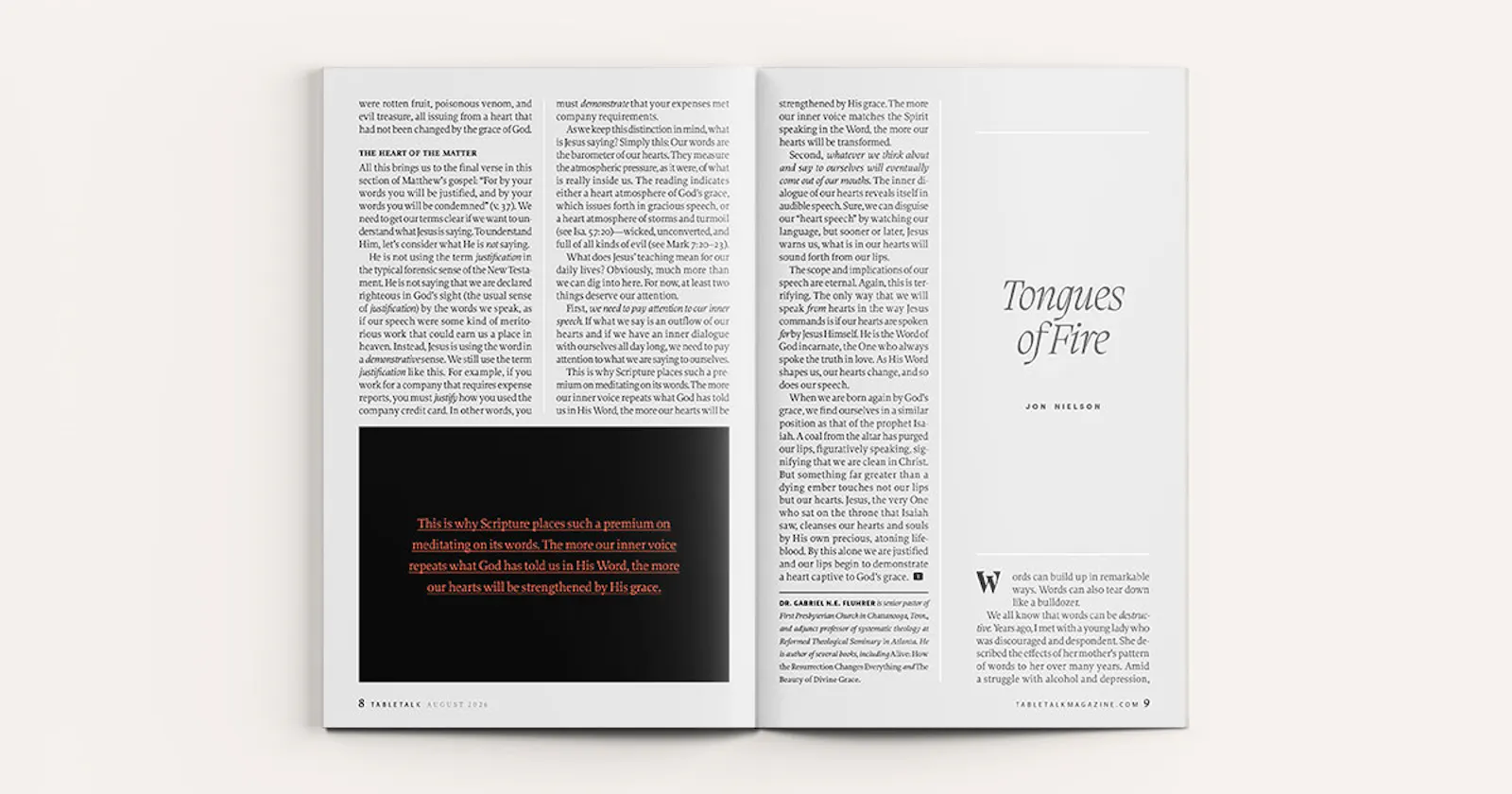
Words can build up in remarkable ways. Words can also tear down like a bulldozer.
We all know that words can be destructive. Years ago, I met with a young lady who was discouraged and despondent. She described the effects of her mother’s pattern of words to her over many years. Amid a struggle with alcohol and depression, this young woman’s mother had taken her pain out on her daughter—heaping on her a verbal pile of criticism, anger, and disappointment. There was no physical abuse, but the steady onslaught of cruel and critical words had proved destructive.
But words can be constructive. The summer before my freshman year at Wheaton College, I was in the gym most days working on my basketball game. I was struggling with confidence as I prepared to make the jump from high school to college. Another student-athlete and I started working out with a former professional player who was in town just for that summer. During our gym workouts, he was constantly yelling at me. The gist of his screaming was: “You’re better than that. You can do this.” He’d yell at me: “You’ll play here at Wheaton. You’ll be the starting point guard. You’ll be an all-conference player!” And I started to believe him. My confidence grew. I got better that summer. His words were constructive.
Our words, whether destructive or constructive, are immensely powerful. Our speech is a powerful tool. And here is James’ main point in this passage: Our speech—powerful as it is—must be shaped by our Savior.
a warning for teachers
Before James homes in on the tongue, he offers a general warning for those who teach in the context of the church: “Not many of you should become teachers, my brothers, for you know that we who teach will be judged with greater strictness. For we all stumble in many ways” (3:1–2). The implication is not that there is a different salvation standard for spiritual leaders than for other people; Christians are saved by grace, through faith in Jesus, and all who reject Christ will face eternal judgment. But James’ words echo much of what Jesus says about the weight of responsibility for leaders and for those who wield spiritual influence.
Jesus says: “To whom much was given, . . . much will be required” (Luke 12:48). Jesus reserves some of His harshest rebukes in the Gospels for the Jewish teachers of the law who lead God’s people astray into legalism and obsession with human traditions.
There is a weight that one should consider before taking on the mantle of a teacher of God’s Word. It’s a privilege, but it’s also dangerous, according to James. We will be judged with greater strictness because of the spiritual influence that we have as teachers of God’s Word.
pictures of the tongue’s power
James points, first, to the “steering power” of the tongue:
And if anyone does not stumble in what he says, he is a perfect man, able also to bridle his whole body. If we put bits into the mouths of horses so that they obey us, we guide their whole bodies as well. Look at the ships also: though they are so large and are driven by strong winds, they are guided by a very small rudder wherever the will of the pilot directs. So also the tongue is a small member, yet it boasts of great things. (James 3:2–5)
James says that someone’s successfully exercising power over his tongue is an indication of his “bridling” the entire body. He even says that if we don’t stumble in what we say, we’re essentially perfect. Indeed, our speech is often the most difficult aspect of our sanctification. That’s why James says it so strongly: If you’re perfect with your mouth, he can assume that you’re perfect in other areas of spiritual growth. The implication, of course, is that none of us is perfect with our speech.
James then offers an illustration from the “bits” of “horses.” We put tiny bits into the mouths of these giant beasts, and we can control their entire bodies. James marvels: “Isn’t that amazing? You can put a tiny metal bit in the mouth of this powerful animal and tell it where to go!” It pinches the horse’s tongue—and it steers the entire body.
James’ second illustration is a ship’s rudder. He calls us to consider massive ships on the sea—and the fact that they are steered by a “very small rudder.” He’s making the same point as with the horse: A little bit steers a big horse; a little rudder steers a big ship. That’s James’ point about the human tongue. It is so small, and yet it “boasts” of great things. To put it in different words: Your tongue has power that is disproportionate to its size.
Note James’ point here about the “steering power” of the tongue—the way that the tongue can guide, lead, and steer even things much bigger than itself. In other words, these two pictures (the horse and the ship) are positive pictures. Horses and ships accomplish good purposes; they move people and accomplish important work.
Follower of Christ, don’t miss this. Your tongue has power that is disproportionate to its size. It can be used for God’s good purposes. You can encourage someone in the Lord. You can lift a brother’s or sister’s spirits. You can point someone to Jesus, simply with a word.
But the tongue, according to James, has “searing power” as well as “steering power.” He continues:
How great a forest is set ablaze by such a small fire! And the tongue is a fire, a world of unrighteousness. The tongue is set among our members, staining the whole body, setting on fire the entire course of life, and set on fire by hell. (vv. 5–6)
It’s hard to miss the main image here: fire. James pictures the searing heat of our speech and the blazing burns left by the tongue. Our words can cause a spark that becomes a raging, destructive fire. James does not hold back in his description of the tongue’s potential for evil. Our tongues can “stain” our lives. James even declares that our tongues can be set on fire by hell.
James mixes in one more metaphor: the taming of animals. “For every kind of beast and bird, of reptile and sea creature, can be tamed and has been tamed by mankind, but no human being can tame the tongue. It is a restless evil, full of deadly poison” (vv. 7–8). James looks at the animal kingdom—at lions, snakes, and bears—and notes that the fiercest beasts have been tamed. None of those beasts compares with the restless, untamable, searing evil of the human tongue.
a call: purity of tongue
We’ve heard James’ warning, and we’ve seen his metaphors for the “steering” and “searing” power of the tongue. Now comes the call: “With it we bless our Lord and Father, and with it we curse people who are made in the likeness of God. From the same mouth come blessing and cursing. My brothers, these things ought not to be so” (vv. 9–10). Here is a call to purity, consistency, and blessing. It’s a call for our speech to be sanctified and shaped by our Savior.
Clearly, James is addressing professing Christians. These people “bless our Lord and Father” but turn quickly to “curse people who are made in the likeness of God” (v. 9). Indeed, Christians need this reminder about speaking out of both sides of our mouths.
We need to be clear about the kind of doublespeak that is going on here. These people are blessing God and then turning to curse their fellow human beings. James isn’t talking about “cussing.” This cursing that James references carries the sense of damnation, akin to saying, “To hell with you.”
There is a place for verbal confrontation; James is not condemning that. There is a time to lovingly rebuke a brother in Christ and to call to repentance. There is a time to confront unbelievers with the truth of the gospel, however uncomfortable that may be. But those conversations are done with love, not with curse-filled dismissal. We regard human beings as made in God’s likeness; our words must reflect that reality. So James declares, “These things ought not to be so” (v. 10). That’s the strongest exclamation from James in this passage.
In the final two verses, James offers two final pictures: “Does a spring pour forth from the same opening both fresh and salt water? Can a fig tree, my brothers, bear olives, or a grapevine produce figs? Neither can a salt pond yield fresh water” (vv. 11–12).
First: a picture of a spring pouring out both fresh and salt water. Second: a picture of a fig tree bearing olives and a grapevine producing figs. The pictures all make the same point: We should expect a product to be consistent with its source. You won’t draw fresh water from a salty spring. You won’t gather figs from an olive tree. That’s precisely what James is after with our words: consistency and purity. Our words toward God and toward others should flow from a common source: a heart changed by Jesus.
Friend, is your speech being sanctified and shaped by your Savior? Is there a Christlike consistency and purity in your words? My prayer is that you would use your mouth to bless God. Paul says, “If you confess with your mouth that Jesus is Lord and believe in your heart that God raised him from the dead, you will be saved” (Rom. 10:9). My prayer is that your speech toward God would be full of faith in His Son. But your faith in Christ must shape all your words. Your speech toward and about others must be sanctified and shaped by your Savior.