

Request your free, three-month trial to Tabletalk magazine. You’ll receive the print issue monthly and gain immediate digital access to decades of archives. This trial is risk-free. No credit card required.
Try Tabletalk NowAlready receive Tabletalk magazine every month?
Verify your email address to gain unlimited access.
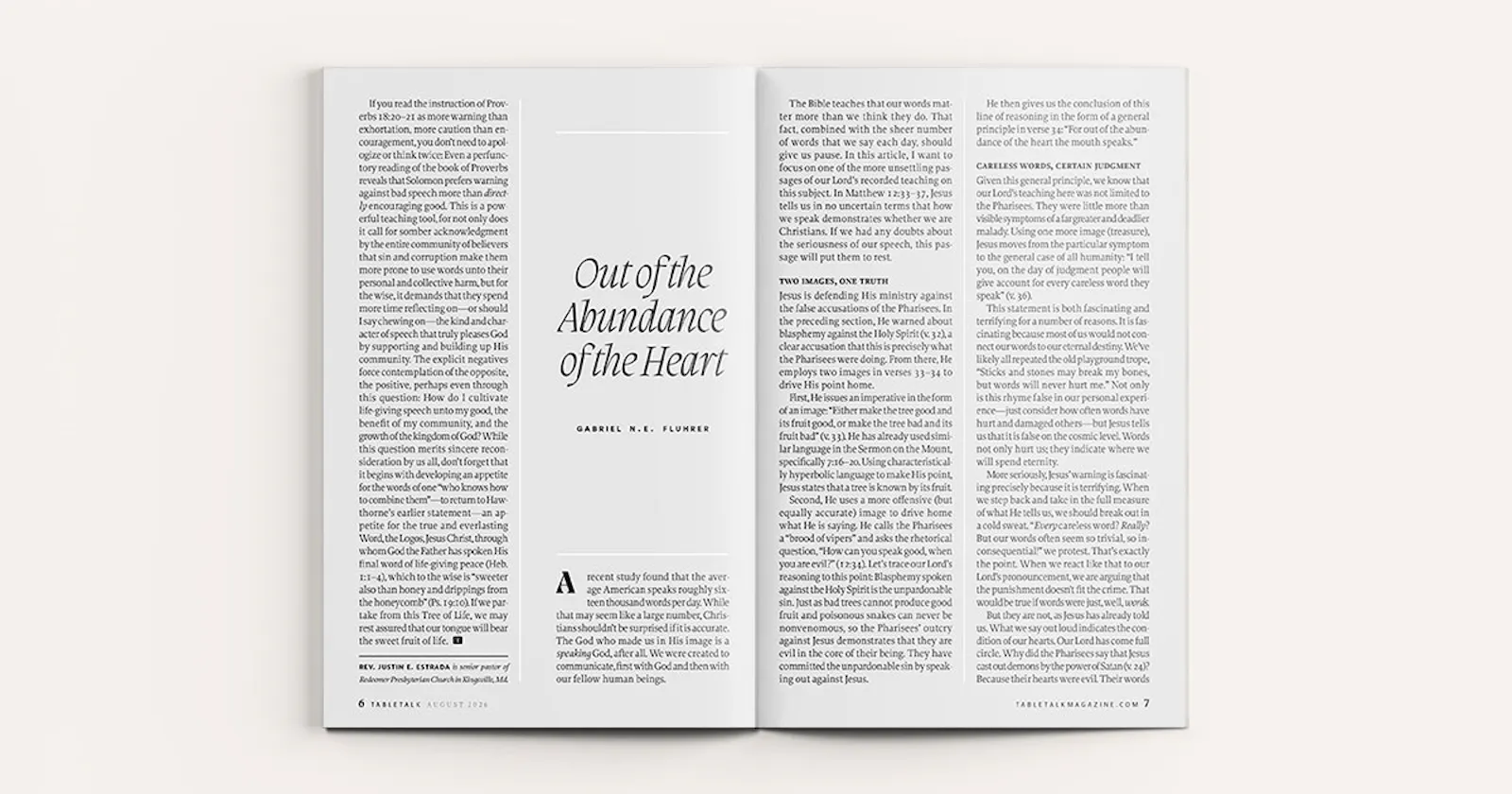
A recent study found that the average American speaks roughly sixteen thousand words per day. While that may seem like a large number, Christians shouldn’t be surprised if it is accurate. The God who made us in His image is a speaking God, after all. We were created to communicate, first with God and then with our fellow human beings.
The Bible teaches that our words matter more than we think they do. That fact, combined with the sheer number of words that we say each day, should give us pause. In this article, I want to focus on one of the more unsettling passages of our Lord’s recorded teaching on this subject. In Matthew 12:33–37, Jesus tells us in no uncertain terms that how we speak demonstrates whether we are Christians. If we had any doubts about the seriousness of our speech, this passage will put them to rest.
two images, one truth
Jesus is defending His ministry against the false accusations of the Pharisees. In the preceding section, He warned about blasphemy against the Holy Spirit (v. 32), a clear accusation that this is precisely what the Pharisees were doing. From there, He employs two images in verses 33–34 to drive His point home.
First, He issues an imperative in the form of an image: “Either make the tree good and its fruit good, or make the tree bad and its fruit bad” (v. 33). He has already used similar language in the Sermon on the Mount, specifically 7:16–20. Using characteristically hyperbolic language to make His point, Jesus states that a tree is known by its fruit.
Second, He uses a more offensive (but equally accurate) image to drive home what He is saying. He calls the Pharisees a “brood of vipers” and asks the rhetorical question, “How can you speak good, when you are evil?” (12:34). Let’s trace our Lord’s reasoning to this point: Blasphemy spoken against the Holy Spirit is the unpardonable sin. Just as bad trees cannot produce good fruit and poisonous snakes can never be nonvenomous, so the Pharisees’ outcry against Jesus demonstrates that they are evil in the core of their being. They have committed the unpardonable sin by speaking out against Jesus.
He then gives us the conclusion of this line of reasoning in the form of a general principle in verse 34: “For out of the abundance of the heart the mouth speaks.”
careless words, certain judgment
Given this general principle, we know that our Lord’s teaching here was not limited to the Pharisees. They were little more than visible symptoms of a far greater and deadlier malady. Using one more image (treasure), Jesus moves from the particular symptom to the general case of all humanity: “I tell you, on the day of judgment people will give account for every careless word they speak” (v. 36).
This statement is both fascinating and terrifying for a number of reasons. It is fascinating because most of us would not connect our words to our eternal destiny. We’ve likely all repeated the old playground trope, “Sticks and stones may break my bones, but words will never hurt me.” Not only is this rhyme false in our personal experience—just consider how often words have hurt and damaged others—but Jesus tells us that it is false on the cosmic level. Words not only hurt us; they indicate where we will spend eternity.
More seriously, Jesus’ warning is fascinating precisely because it is terrifying. When we step back and take in the full measure of what He tells us, we should break out in a cold sweat. “Every careless word? Really? But our words often seem so trivial, so inconsequential!” we protest. That’s exactly the point. When we react like that to our Lord’s pronouncement, we are arguing that the punishment doesn’t fit the crime. That would be true if words were just, well, words.
But they are not, as Jesus has already told us. What we say out loud indicates the condition of our hearts. Our Lord has come full circle. Why did the Pharisees say that Jesus cast out demons by the power of Satan (v. 24)? Because their hearts were evil. Their words were rotten fruit, poisonous venom, and evil treasure, all issuing from a heart that had not been changed by the grace of God.
the heart of the matter
All this brings us to the final verse in this section of Matthew’s gospel: “For by your words you will be justified, and by your words you will be condemned” (v. 37). We need to get our terms clear if we want to understand what Jesus is saying. To understand Him, let’s consider what He is not saying.
He is not using the term justification in the typical forensic sense of the New Testament. He is not saying that we are declared righteous in God’s sight (the usual sense of justification) by the words we speak, as if our speech were some kind of meritorious work that could earn us a place in heaven. Instead, Jesus is using the word in a demonstrative sense. We still use the term justification like this. For example, if you work for a company that requires expense reports, you must justify how you used the company credit card. In other words, you must demonstrate that your expenses met company requirements.
As we keep this distinction in mind, what is Jesus saying? Simply this: Our words are the barometer of our hearts. They measure the atmospheric pressure, as it were, of what is really inside us. The reading indicates either a heart atmosphere of God’s grace, which issues forth in gracious speech, or a heart atmosphere of storms and turmoil (see Isa. 57:20)—wicked, unconverted, and full of all kinds of evil (see Mark 7:20–23).
What does Jesus’ teaching mean for our daily lives? Obviously, much more than we can dig into here. For now, at least two things deserve our attention.
First, we need to pay attention to our inner speech. If what we say is an outflow of our hearts and if we have an inner dialogue with ourselves all day long, we need to pay attention to what we are saying to ourselves.
This is why Scripture places such a premium on meditating on its words. The more our inner voice repeats what God has told us in His Word, the more our hearts will be strengthened by His grace. The more our inner voice matches the Spirit speaking in the Word, the more our hearts will be transformed.
Second, whatever we think about and say to ourselves will eventually come out of our mouths. The inner dialogue of our hearts reveals itself in audible speech. Sure, we can disguise our “heart speech” by watching our language, but sooner or later, Jesus warns us, what is in our hearts will sound forth from our lips.
The scope and implications of our speech are eternal. Again, this is terrifying. The only way that we will speak from hearts in the way Jesus commands is if our hearts are spoken for by Jesus Himself. He is the Word of God incarnate, the One who always spoke the truth in love. As His Word shapes us, our hearts change, and so does our speech.
When we are born again by God’s grace, we find ourselves in a similar position as that of the prophet Isaiah. A coal from the altar has purged our lips, figuratively speaking, signifying that we are clean in Christ. But something far greater than a dying ember touches not our lips but our hearts. Jesus, the very One who sat on the throne that Isaiah saw, cleanses our hearts and souls by His own precious, atoning lifeblood. By this alone we are justified and our lips begin to demonstrate a heart captive to God’s grace.