

Request your free, three-month trial to Tabletalk magazine. You’ll receive the print issue monthly and gain immediate digital access to decades of archives. This trial is risk-free. No credit card required.
Try Tabletalk NowAlready receive Tabletalk magazine every month?
Verify your email address to gain unlimited access.
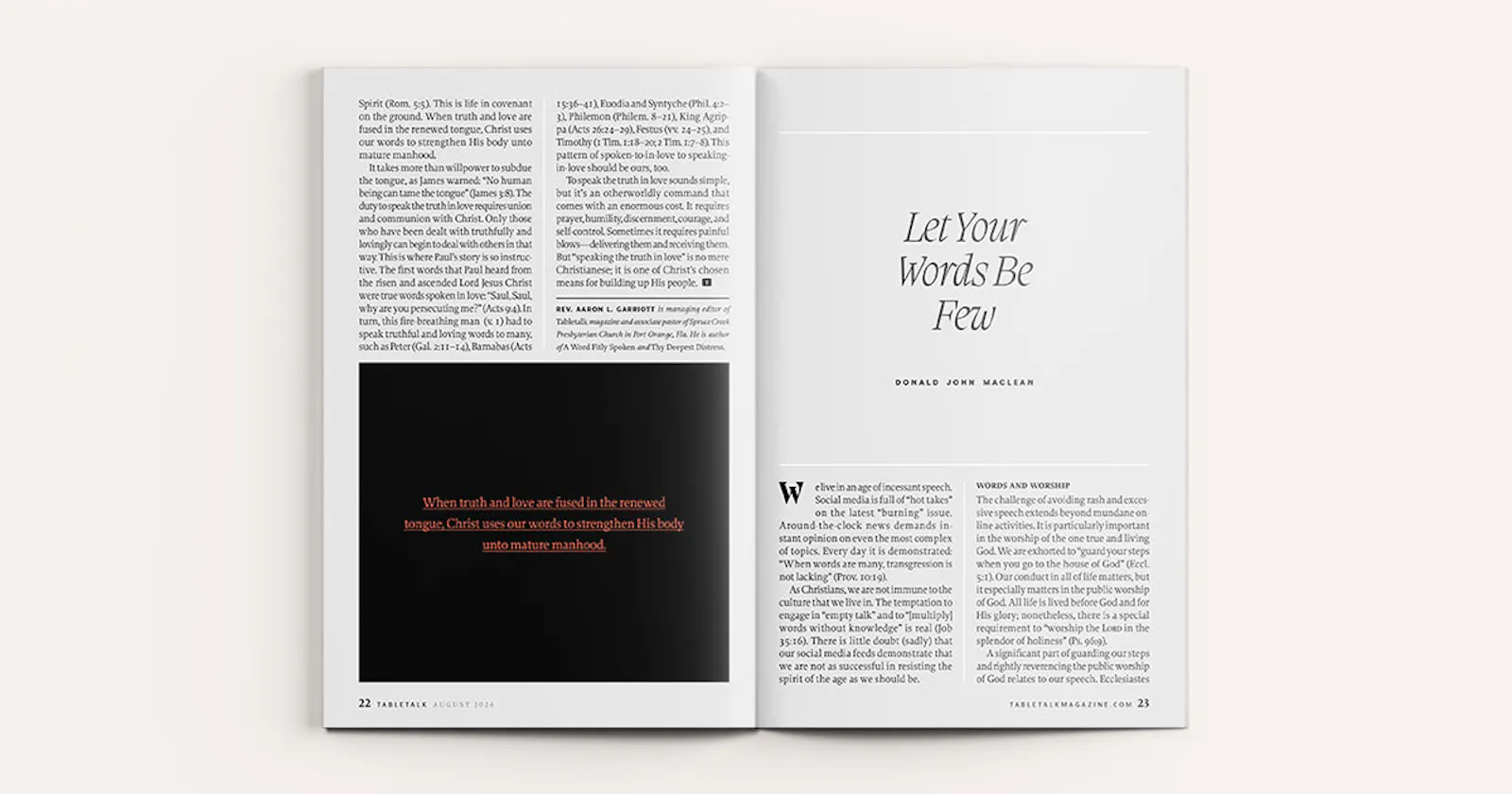
We live in an age of incessant speech. Social media is full of “hot takes” on the latest “burning” issue. Around-the-clock news demands instant opinion on even the most complex of topics. Every day it is demonstrated: “When words are many, transgression is not lacking” (Prov. 10:19).
As Christians, we are not immune to the culture that we live in. The temptation to engage in “empty talk” and to “[multiply] words without knowledge” is real (Job 35:16). There is little doubt (sadly) that our social media feeds demonstrate that we are not as successful in resisting the spirit of the age as we should be.
words and worship
The challenge of avoiding rash and excessive speech extends beyond mundane online activities. It is particularly important in the worship of the one true and living God. We are exhorted to “guard your steps when you go to the house of God” (Eccl. 5:1). Our conduct in all of life matters, but it especially matters in the public worship of God. All life is lived before God and for His glory; nonetheless, there is a special requirement to “worship the Lord in the splendor of holiness” (Ps. 96:9).
A significant part of guarding our steps and rightly reverencing the public worship of God relates to our speech. Ecclesiastes goes on to tell us that in drawing near to God, we should first aim to “listen” in case we offer “the sacrifice of fools,” and we are particularly exhorted: “Be not rash with your mouth, nor let your heart be hasty to utter a word before God. . . . Let your words be few” (Eccl. 5:1–2). Our speech in worship is to be restrained, it is to be considered, it is to be unlike the constant outpourings of social media—our words are to be “few.”
This concern for words in worship flows from an understanding of the One we are worshiping. Much today is casual and informal. Of course, worship should never be formal in the sense of losing the joy and love that children have in the familiar presence of their father. But worship is still to be pervaded with a sense that “God is in heaven and you are on earth” (v. 2). A sense of our creatureliness and the awesomeness of the triune Creator of the ends of the earth must animate our worship. This remains the case in new covenant worship. It is after teaching on the glories of the new covenant that we read, “Let us offer to God acceptable worship, with reverence and awe, for our God is a consuming fire” (Heb. 12:28–29).
But what does this practically mean for our worship? This can be made real by considering some of the elements of worship.
praise
There are few more delightful duties in worship than praise. What a joy it is to “give thanks to the Lord” because “he is good, . . . his steadfast love endures forever” (Ps. 136:1). In a sense, our praising God should be unrestrained: “I have told the glad news of deliverance in the great congregation; behold, I have not restrained my lips” (Ps. 40:9). Our souls should be stirred up and our hearts overflow in the praises of our triune God.
But this does not mean that all and any words of praise are suitable. Our words of praise must be sincere (Isa. 29:13), but they must also be fitting. So David prays, “O Lord, open my lips, and my mouth will declare your praise” (Ps. 51:15). We are sinners; we need the Lord to give us the ability and the words to praise His name. Only then will our praise be God-glorifying. And God Himself has given us a pattern of praise in His Word—the Psalter. There is no better model for understanding and expressing fitting praise than God’s inspired book of praise.
prayer
Praise and prayer are deeply interrelated (Ps. 72:19–20). Just like our praise, our words of prayer must be biblical. Of great import to godly prayer is a consciousness of who God is. Think of Abraham, the friend of God, who, as he interceded for Sodom, reflected, “Behold, I have undertaken to speak to the Lord, I who am but dust and ashes” (Gen. 18:27). Or Isaiah: “Woe is me! For I am lost; for I am a man of unclean lips. . . . My eyes have seen the King, the Lord of hosts!” (Isa. 6:5). These saints’ words reflected the conscious awe they felt in God’s presence.
This awe does not cripple us—we have freedom in prayer. We come to the throne of grace with boldness (Heb. 4:16); we have the Spirit (Rom. 8:26). But our prayers should not abuse that liberty. Indeed, Jesus instructs His disciples, “When you pray, do not heap up empty phrases as the Gentiles do, for they think that they will be heard for their many words” (Matt. 6:7). It is not the quantity of our words but that they are offered in the Spirit that matters. With that danger in mind, the psalmist was wise to ask: “Let my prayer be counted as incense before you. . . . Set a guard, O Lord, over my mouth; keep watch over the door of my lips!” (Ps. 141:2–3). We need to guard our mouths in prayer, asking, “Teach us to pray” (Luke 11:1).
preaching
There are no more important words in worship than preaching. In preaching, God is speaking to His people. The preacher is an ambassador with the words of his King on his lips (2 Cor. 5:20). There is an awesome responsibility in preaching. Those who are preachers feel the weight of the words of James: “You know that we who teach will be judged with greater strictness” (James 3:1). As in every other aspect of the service, the preacher must weigh his speech, delivering his message as the mouthpiece of God. This does not mean that sermons should be short, but it does mean that they should be only as long as the words that the King has given to the preacher.
sacred vows
Another unjustly neglected feature of worship is vows or solemn religious oaths. Ecclesiastes 5 goes on to discuss vows: “When you vow a vow to God, do not delay paying it, for he has no pleasure in fools. Pay what you vow. It is better that you should not vow than that you should vow and not pay” (Eccl. 5:4–5). To take an oath in the presence of God is a thing that should not be done lightly. The Bible warns, “It is a snare to say rashly, ‘It is holy,’ and to reflect only after making vows” (Prov. 20:25).
Vows, therefore, should be undertaken rarely and treated with the utmost seriousness when taken—as, for example, in marriage. Of course, as solemn as vows are, they cannot bind someone to sin.
conclusion
The Bible cautions us against an unwise multiplication of words. This godly disposition is articulated by James: “Let every person be quick to hear, slow to speak” (James 1:19). In worship, our great desire should be to hear God. In this way, we show the wisdom of the proverb, “Whoever restrains his words has knowledge” (Prov. 17:27).