
August 2026
Life and Death Are in the Power of the Tongue
Feature Article
August 2026

Request your free, three-month trial to Tabletalk magazine. You’ll receive the print issue monthly and gain immediate digital access to decades of archives. This trial is risk-free. No credit card required.
Try Tabletalk NowAlready receive Tabletalk magazine every month?
Verify your email address to gain unlimited access.
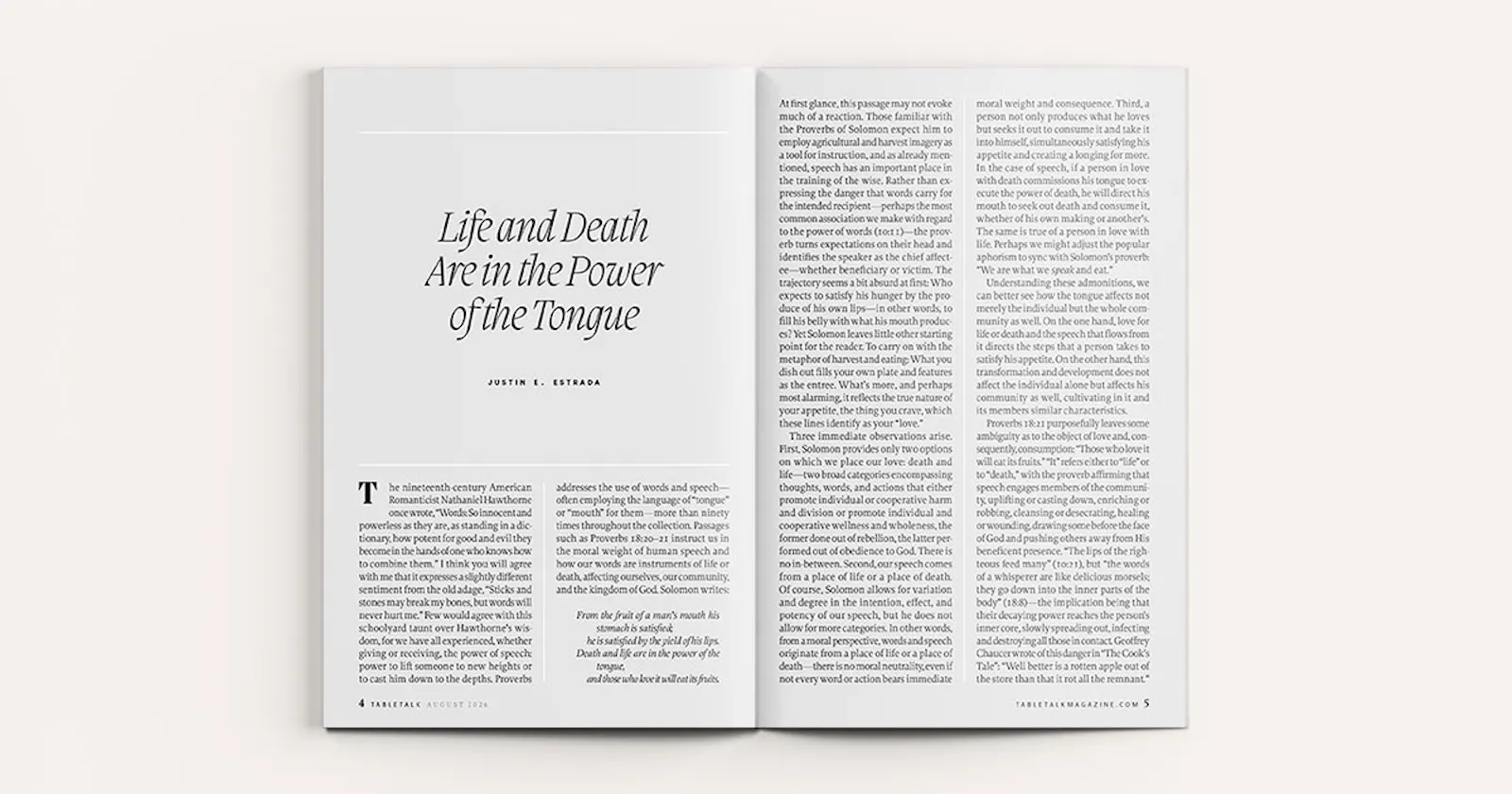
The nineteenth-century American Romanticist Nathaniel Hawthorne once wrote, “Words: So innocent and powerless as they are, as standing in a dictionary, how potent for good and evil they become in the hands of one who knows how to combine them.” I think you will agree with me that it expresses a slightly different sentiment from the old adage, “Sticks and stones may break my bones, but words will never hurt me.” Few would agree with this schoolyard taunt over Hawthorne’s wisdom, for we have all experienced, whether giving or receiving, the power of speech: power to lift someone to new heights or to cast him down to the depths. Proverbs addresses the use of words and speech—often employing the language of “tongue” or “mouth” for them—more than ninety times throughout the collection. Passages such as Proverbs 18:20–21 instruct us in the moral weight of human speech and how our words are instruments of life or death, affecting ourselves, our community, and the kingdom of God. Solomon writes:
From the fruit of a man’s mouth his stomach is satisfied;
he is satisfied by the yield of his lips.
Death and life are in the power of the tongue,
and those who love it will eat its fruits.
At first glance, this passage may not evoke much of a reaction. Those familiar with the Proverbs of Solomon expect him to employ agricultural and harvest imagery as a tool for instruction, and as already mentioned, speech has an important place in the training of the wise. Rather than expressing the danger that words carry for the intended recipient—perhaps the most common association we make with regard to the power of words (10:11)—the proverb turns expectations on their head and identifies the speaker as the chief affectee—whether beneficiary or victim. The trajectory seems a bit absurd at first: Who expects to satisfy his hunger by the produce of his own lips—in other words, to fill his belly with what his mouth produces? Yet Solomon leaves little other starting point for the reader. To carry on with the metaphor of harvest and eating: What you dish out fills your own plate and features as the entree. What’s more, and perhaps most alarming, it reflects the true nature of your appetite, the thing you crave, which these lines identify as your “love.”
Three immediate observations arise. First, Solomon provides only two options on which we place our love: death and life—two broad categories encompassing thoughts, words, and actions that either promote individual or cooperative harm and division or promote individual and cooperative wellness and wholeness, the former done out of rebellion, the latter performed out of obedience to God. There is no in-between. Second, our speech comes from a place of life or a place of death. Of course, Solomon allows for variation and degree in the intention, effect, and potency of our speech, but he does not allow for more categories. In other words, from a moral perspective, words and speech originate from a place of life or a place of death—there is no moral neutrality, even if not every word or action bears immediate moral weight and consequence. Third, a person not only produces what he loves but seeks it out to consume it and take it into himself, simultaneously satisfying his appetite and creating a longing for more. In the case of speech, if a person in love with death commissions his tongue to execute the power of death, he will direct his mouth to seek out death and consume it, whether of his own making or another’s. The same is true of a person in love with life. Perhaps we might adjust the popular aphorism to sync with Solomon’s proverb: “We are what we speak and eat.”
Understanding these admonitions, we can better see how the tongue affects not merely the individual but the whole community as well. On the one hand, love for life or death and the speech that flows from it directs the steps that a person takes to satisfy his appetite. On the other hand, this transformation and development does not affect the individual alone but affects his community as well, cultivating in it and its members similar characteristics.
Proverbs 18:21 purposefully leaves some ambiguity as to the object of love and, consequently, consumption: “Those who love it will eat its fruits.” “It” refers either to “life” or to “death,” with the proverb affirming that speech engages members of the community, uplifting or casting down, enriching or robbing, cleansing or desecrating, healing or wounding, drawing some before the face of God and pushing others away from His beneficent presence. “The lips of the righteous feed many” (10:21), but “the words of a whisperer are like delicious morsels; they go down into the inner parts of the body” (18:8)—the implication being that their decaying power reaches the person’s inner core, slowly spreading out, infecting and destroying all those in contact. Geoffrey Chaucer wrote of this danger in “The Cook’s Tale”: “Well better is a rotten apple out of the store than that it rot all the remnant.”
If you read the instruction of Proverbs 18:20–21 as more warning than exhortation, more caution than encouragement, you don’t need to apologize or think twice: Even a perfunctory reading of the book of Proverbs reveals that Solomon prefers warning against bad speech more than directly encouraging good. This is a powerful teaching tool, for not only does it call for somber acknowledgment by the entire community of believers that sin and corruption make them more prone to use words unto their personal and collective harm, but for the wise, it demands that they spend more time reflecting on—or should I say chewing on—the kind and character of speech that truly pleases God by supporting and building up His community. The explicit negatives force contemplation of the opposite, the positive, perhaps even through this question: How do I cultivate life-giving speech unto my good, the benefit of my community, and the growth of the kingdom of God? While this question merits sincere reconsideration by us all, don’t forget that it begins with developing an appetite for the words of one “who knows how to combine them”—to return to Hawthorne’s earlier statement—an appetite for the true and everlasting Word, the Logos, Jesus Christ, through whom God the Father has spoken His final word of life-giving peace (Heb. 1:1–4), which to the wise is “sweeter also than honey and drippings from the honeycomb” (Ps. 19:10). If we partake from this Tree of Life, we may rest assured that our tongue will bear the sweet fruit of life.