
July 2026
Many Members, One Body: Gifts and Love in the Church
Feature Article
July 2026

Request your free, three-month trial to Tabletalk magazine. You’ll receive the print issue monthly and gain immediate digital access to decades of archives. This trial is risk-free. No credit card required.
Try Tabletalk NowAlready receive Tabletalk magazine every month?
Verify your email address to gain unlimited access.
Throughout the New Testament, the biblical authors use a whole host of metaphors to describe the church. The church is a bride, a family, a flock, a kingdom—but no metaphor is employed more frequently than that of a body. Perhaps this is why R.B. Kuiper titled his work on ecclesiology The Glorious Body of Christ. He writes: “The church is glorious because of the resplendent majesty of its Head. It is glorious also because of the beautiful harmony of its members.” Sadly, that harmony is often disrupted by the sin and pride of its members, which is why studying what the church is called to be is a needed discipline. First Corinthians 12:12–31 is a great place to do that, since we find here the most extended treatment of the body metaphor. As we look at this text and the verses that bookend it, we learn vital lessons on how the church is formed and how it is meant to function.
how the church is formed
Paul’s use of the body metaphor is important in the first place because it tells us how the church is formed. How does the church come together? Just as we don’t assemble our bodies in our mothers’ wombs, neither does the church put itself together. Paul says that it is the Spirit who draws us together: “For in one Spirit we were all baptized into one body—Jews or Greeks, slaves or free—and all were made to drink of one Spirit” (1 Cor. 12:13).
It is the Spirit who brings us into one body. And it is God who makes us all “to drink of one Spirit”—that is, it is the Spirit of God who provides the nourishment that we need to live as Christians. While the Spirit’s work is invisible to our eyes, God strengthens our faith by giving a visible reminder and confirmation that the Spirit really is at work through baptism. But it’s all about God here, not us. Listen to Martin Luther’s beautiful words about the Spirit’s work:
I believe that I can not, by my own reason or strength, believe in Jesus Christ my Lord, or come to him; but the Holy Ghost has called me through the Gospel, enlightened me by his gifts, and sanctified and preserved me in the true faith; just as he calls, gathers, enlightens, and sanctifies the whole Christian Church on earth, and preserves it in union with Jesus Christ in the one true faith.
So it is the Spirit who does the work of forming the church. Interestingly, He includes in the membership of the church people that you and I would easily disregard. Paul says that we are all baptized into one body, whether “Jews or Greeks, slaves or free.” These were the greatest divides in the ancient world, the people who held one another in the greatest disdain. Who are those for you? Whoever they are, it is not beyond the Spirit to bring them into the church with you, or you into the church with them.
Would we choose a diverse congregation like this if it were up to us? Would we want these many different backgrounds and different opinions in the local church if it were up to us? Perhaps we fear that some of these differences would threaten our unity. But maybe the question about our differences is not whether they threaten our unity but whether they threaten our homogeneity. And that’s good if they do. If we formed the church, it would look pathetically bland. Thank God that He forms the church and is pleased to use all of us to make up the intricate tapestry that is His worldwide salvation: a people from every tribe, tongue, language, and nation.
The church is not formed by the voluntary association of its members who want to belong to a club where everyone agrees with them. The church is formed by divine decree. The Spirit brings us together and constitutes us as Christ’s body.
how the church functions
But now the question is, How is the church meant to function together? Whereas the formation of the church is an objective reality in Christ, the functioning of the church is subjective—a responsibility placed on us to live out the reality of the Spirit’s work in our lives. What can we do to ensure that the church functions the way that it is meant to? Again, the body metaphor is very helpful to answer this question.
The first thing that the body image teaches is this: You matter. My seven-year-old son’s tae kwon do class almost always begins with the children’s repeating some sort of mantra for the day, usually a variation of “I am strong,” “I am confident,” “I can do this.” We’ve all seen that sort of thing morph into nauseating therapeutic nonsense, but in the right dose it’s very healthy. Especially at kids’ formative age, the only way for them to be a positive contributor to their team or to their sport is to think that they actually have something to contribute.
Paul is gathering the church around him now and getting them to understand something similar. It’s sort of a silly thing that he does: He pictures individual body parts as pouting that they are not as cool or as seemingly important as other body parts (1 Cor. 12:14–20). We do that in the church, don’t we? “If only I had my kids as well behaved as she does,” we think. Or “If only I could serve as frequently as he does.” Or “If only I could contribute more meaningfully to Bible studies like the other people.” We think that if we were only more like others, we would be more helpful, more useful, more needed in the life of the church.
Paul’s response to that way of thinking is to say, “If you were just the same as everyone else, that’d be like the body’s being only an eye” (see v. 17). We think an eyeball is important, and it is. But if a body is only an eyeball—well, then it’s only an eyeball. Without a brain, there’s nothing to process the images that it receives. Without feet, there is nothing to get you to that thing that you’re looking at. Without a mouth, there is no way to tell other people what you have seen. An eye as an eye is not much of anything. It’s certainly not a body (v. 19).
Therefore, the diversity of body parts is not detrimental to the body as a whole—it’s essential to it. What makes a body a body is the unity of the diversity. The same is true in the church: What makes it the church is the part you play. Your feeling like you have a part to play is not the deciding factor in whether you have a part to play. Whether you feel like it or not, you are essential. Leading up to his body metaphor, Paul spent ample time describing how the Spirit of God has equipped every single believer with distinct gifts (vv. 1–11). Our job is to exercise those gifts that are given to us. And that starts by recognizing that we have something to offer. Do away with envy and jealousy. In gratitude, recognize that the same undeserved grace and the same incalculable power that has gifted the “most impressive” person in the church has gifted you. You matter.
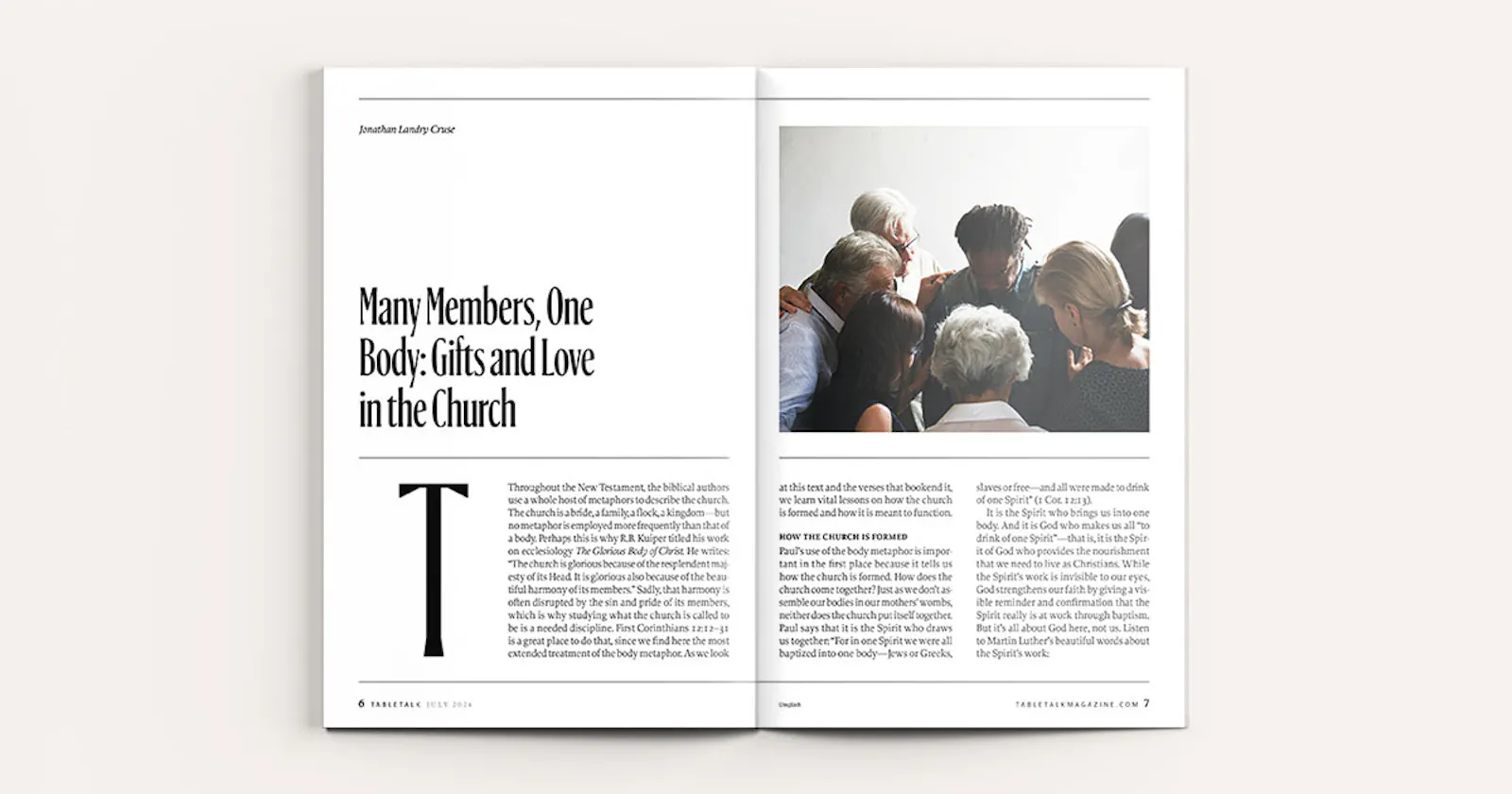
The second key to a properly functioning church is the inverse. In 1 Corinthians 12:14–20, Paul addresses people who think their gifts don’t matter; in verses 21–26, he addresses people who think other people’s gifts don’t matter. Just as there is no place for jealousy in the church, there is no place for pride either. “The eye cannot say to the hand, ‘I have no need of you,’ nor again the head to the feet, ‘I have no need of you’” (v. 21).
Actually, Paul suggests that the roles to which we give little to no attention actually deserve more (vv. 22–25). Just as those parts of our bodies of which we are most ashamed are not ignored but are instead covered, clothed, and protected more than the rest of the body, so, too, God wants honor to be bestowed on seemingly weaker or less showy gifts in the church so as to grant them further dignity. No one is indispensable (v. 22). The proper attitude in the church is to have a concern and appreciation for all the members, “that there may be no division in the body, but that the members may have the same care for one another” (v. 25).
How can we pursue that care? How can we ensure that there are no divisions in the body? Recognizing your gifting and the gifting of others is critical, but it’s not everything. What matters most of all is love. Whatever the gift might be—teaching, administration, and so on—all must be exercised to grow the body in mutual love. It is no accident that Paul’s great “love chapter” follows his teaching on spiritual gifts and the necessity of using them in the church. After all, even if we have the most impressive gifts imaginable but do not have love, as Paul soberly says, we are nothing (13:2).
All members of the church, therefore, have a responsibility of studying the “more excellent way” of living together in the body (12:31). And that excellent way is the patient, kind, humble, happy virtue of love (13:4–7). Faith working through love is what we are called to (Gal. 5:6). The greatest gift becomes a hurt, not a help, to the church when used in a loveless manner. And even a humble gift becomes a higher one when exercised in love.
This consideration of love ties back to the first point, which was how the church is formed. It functions only on love because it was formed by love. Were it not for the heart of God for sinners, were it not for the bleeding Christ on Calvary, were it not for the helping Spirit poured into our hearts, we would have nothing and would be nothing. But we were formed by God’s love, and so we must function as a church by showing and sharing that love as well, in whatever gifts the Lord has given us.