

Request your free, three-month trial to Tabletalk magazine. You’ll receive the print issue monthly and gain immediate digital access to decades of archives. This trial is risk-free. No credit card required.
Try Tabletalk NowAlready receive Tabletalk magazine every month?
Verify your email address to gain unlimited access.
In the wisdom and plan of God, He has allocated individual spiritual gifts to believers in His church to be cultivated and employed for the good of the body of Christ, the church. This is His revealed plan to bring glory to Himself (Eph. 4:8).
Although the apportioning of spiritual gifts is spoken of in Scripture as a work of the Holy Spirit (1 Cor. 12:4–11), the distribution of gifts is in fact a work of all three persons of the Trinity. Theologians have coined a Latin way of stating how all the external works of God are indivisible: Opera ad extra trinitatis indivisa sunt—the external works of God cannot be divided. Specific roles are appropriated by individual persons (the Son becomes incarnate, for example); nevertheless, the one Lord—Father, Son, and Holy Spirit—is the Author of the decree to distribute spiritual gifts. The Holy Spirit, therefore, does not act in isolation from the Father or the Son. Putting this in a different way, the distribution of spiritual gifts is not random but the product of the unified will of God. There cannot, for example, be a will of the Father and another will of the Son and yet another of the Holy Spirit. True, when we consider the incarnate Son, there is another will, the will of His human nature that is distinct from the will of His divine nature: “Not my will, but yours, be done” (Luke 22:42). The church was divided on whether the incarnate Christ possessed a unique human will, some advocating one will (monothelitism) and others advocating two separate wills (dyothelitism). Monothelitism was condemned as a heresy by the Third Council of Constantinople (AD 680–81). But when considering God—Father, Son, and Holy Spirit—the divine will is one, and the distribution of spiritual gifts is a work of the one Lord.
This Trinitarian perspective of the distribution of gifts provides us with a doxological perspective as to the purpose of spiritual gifts. Spiritual gifts are distributed so that they may give glory to the one Lord: Father, Son, and Holy Spirit. The Westminster Shorter Catechism’s first question and answer apply here as everywhere else: “What is the chief end of man? Man’s chief end is to glorify God, and to enjoy him forever.” The right use of spiritual gifts brings God much glory.
Spiritual gifting should make us consider the One who gives: God. In His infinite wisdom, He has decided what gifting each Christian will receive. The distribution of spiritual gifts may appear to us to be random, even whimsical. Worse, we may question the distribution, envying gifts given to others and not to ourselves. But God’s gifts are never random or whimsical. They are an outworking of His secret counsel, His divine will and purpose, and we must bow before His sovereign will, acknowledging His perfect plan in joyful worship and praise and employing the gifts He has given us.
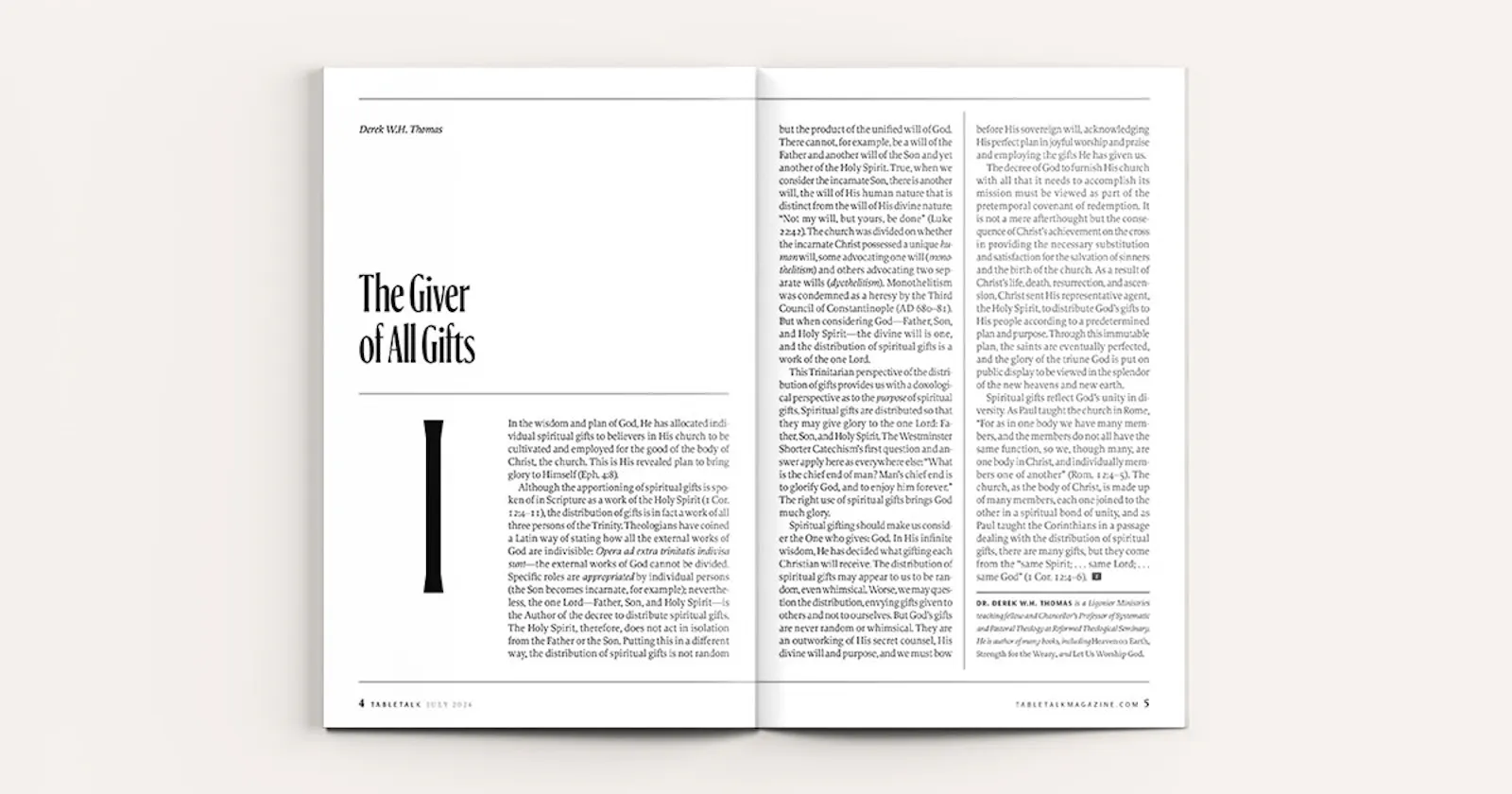
The decree of God to furnish His church with all that it needs to accomplish its mission must be viewed as part of the pretemporal covenant of redemption. It is not a mere afterthought but the consequence of Christ’s achievement on the cross in providing the necessary substitution and satisfaction for the salvation of sinners and the birth of the church. As a result of Christ’s life, death, resurrection, and ascension, Christ sent His representative agent, the Holy Spirit, to distribute God’s gifts to His people according to a predetermined plan and purpose. Through this immutable plan, the saints are eventually perfected, and the glory of the triune God is put on public display to be viewed in the splendor of the new heavens and new earth.
Spiritual gifts reflect God’s unity in diversity. As Paul taught the church in Rome, “For as in one body we have many members, and the members do not all have the same function, so we, though many, are one body in Christ, and individually members one of another” (Rom. 12:4–5). The church, as the body of Christ, is made up of many members, each one joined to the other in a spiritual bond of unity, and as Paul taught the Corinthians in a passage dealing with the distribution of spiritual gifts, there are many gifts, but they come from the “same Spirit; . . . same Lord; . . . same God” (1 Cor. 12:4–6).