
July 2026
Giving Gifts to Men: Christ’s Provision for His Church
Feature Article
July 2026

Request your free, three-month trial to Tabletalk magazine. You’ll receive the print issue monthly and gain immediate digital access to decades of archives. This trial is risk-free. No credit card required.
Try Tabletalk NowAlready receive Tabletalk magazine every month?
Verify your email address to gain unlimited access.
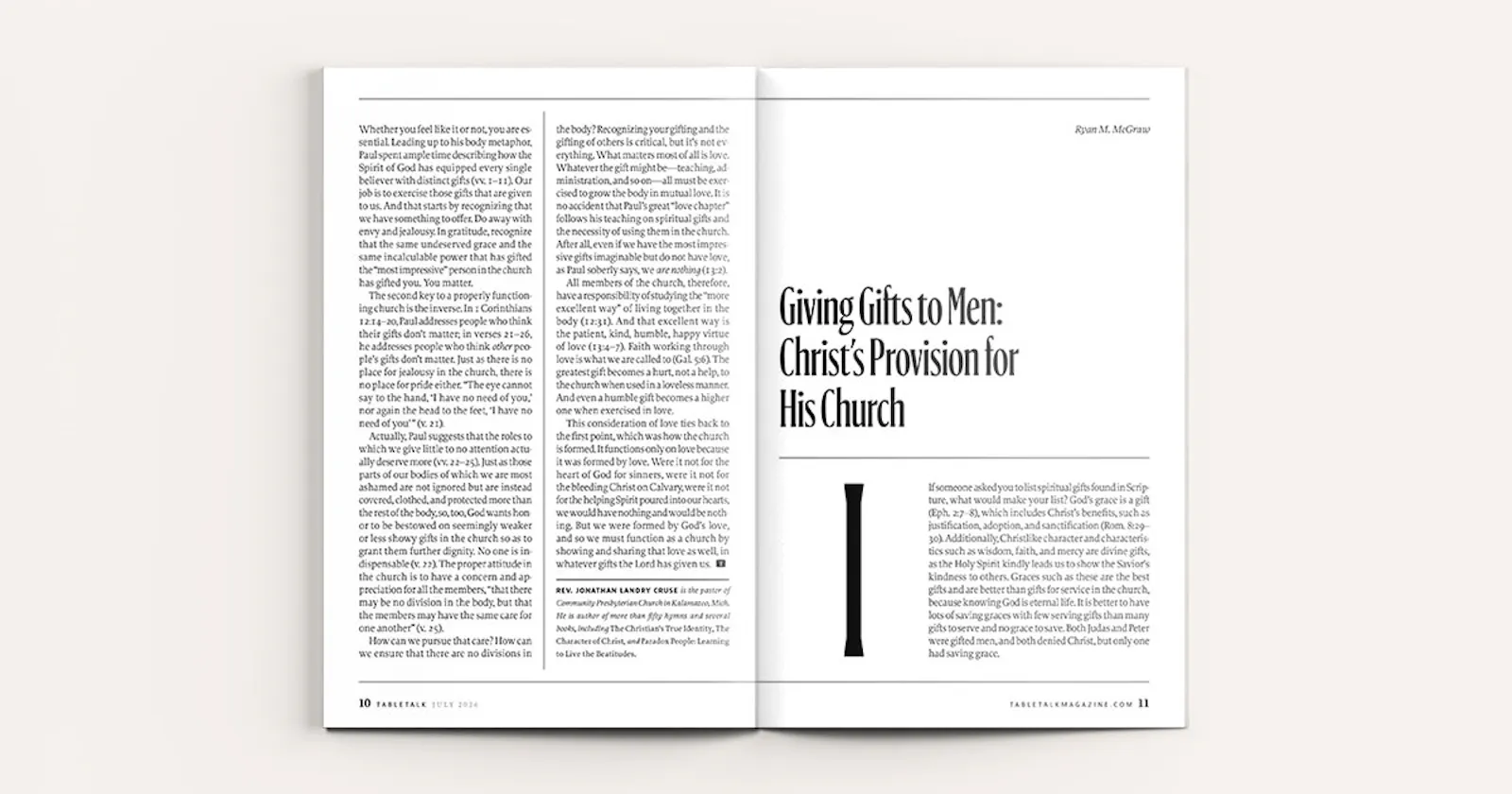
If someone asked you to list spiritual gifts found in Scripture, what would make your list? God’s grace is a gift (Eph. 2:7–8), which includes Christ’s benefits, such as justification, adoption, and sanctification (Rom. 8:29–30). Additionally, Christlike character and characteristics such as wisdom, faith, and mercy are divine gifts, as the Holy Spirit kindly leads us to show the Savior’s kindness to others. Graces such as these are the best gifts and are better than gifts for service in the church, because knowing God is eternal life. It is better to have lots of saving graces with few serving gifts than many gifts to serve and no grace to save. Both Judas and Peter were gifted men, and both denied Christ, but only one had saving grace.
This raises the question: “What do we mean by gifts? Do we mean gospel grace, godly character, or gifts and talents?” In Ephesians 4:1–16, Paul included all three distinctly and intertwined them. His basic point is that the gospel of the triune God results in graces among God’s people, promoted through gifts that Christ gives to the church. What may surprise some readers is that the only “gifts” that Paul listed in the third sense relate to teaching offices in the church. Rather than a granular examination of this rather lengthy passage, this article presents a high-level view of Christ’s provision for His church under the themes of gospel, grace, and gifts.
gospel
Having gifts in the church is like growing up. We need to be born, then develop, and then do something with our lives. But birth and development must come first. Any discussion of gifts must be grounded in gospel grace, which is itself grounded in God—more accurately, and blessedly, in the triune God and in Christ’s ascension. Rushing toward gifts and forgetting our grounding in the gospel would make us like a group of immature children running into the workforce but skipping the foundational identity and maturity that we must learn in the home before we can do anything else. The gospel of the triune God plants grace in our souls that must precede all gifts for service.
Paul packs a lot about God, the gospel, and Christ into these verses. Trinity and ascension take pride of place. The Ephesian church seemed to be doing fine spiritually, but Paul urged them to “maintain the unity of the Spirit in the bond of peace” (Eph. 4:3). Since they were “one body” and had “one Spirit,” God called them to a common hope (v. 4). On what ground? On “one Lord, one faith, one baptism” (v. 5). “Lord” refers to the Lord Jesus Christ and reminds us of the Nicene Creed’s statement “I believe in one Lord Jesus Christ.” Paul’s point is that our common calling to eternal life in God is rooted in the “one Spirit” dwelling in all our hearts, and the “one faith” we share in God through Christ. “One baptism” signifies or points to the Spirit’s washing our hearts in new birth (Titus 3:5) and our union with Christ in His death and resurrection (Rom. 6:4), being washed with His blood (Rev. 1:5). On these grounds, we have “one God and Father of all, who is over all and through all and in all” (Eph. 4:6). Gospel grace is saving grace, from the Father, through the Son, in the Spirit (1:3–14), so that in the Spirit, we might come through the Son to the Father (2:18).
What is gospel grace about? We have one Father, who has adopted us into His family by washing away our sins and justifying us in Christ, so that the same Spirit who gave us new birth (John 3:5), cleansing our hearts, might also sanctify us and cleanse our lives as we live in the church.
Are we ready to talk about gifts now? Not so fast. We need to reflect on the Giver a bit more. Based on the triune God’s saving work, “grace was given to each one of us according to the measure of Christ’s gift” (Eph. 4:7). After triumphing over His and our enemies in His death and resurrection, He ascended into heaven, and “when he ascended on high he led a host of captives, and he gave gifts to men” (v. 8). Christ is the conquering King of Psalm 68:18, who, receiving the spoils of war, distributes gifts to His children. He who descended to earth in His incarnation has now “ascended far above all the heavens, that he might fill all things” (Eph. 4:10; see 1:23). This means that He is Head over all things for the sake of the church (1:22). Our gifts come from Him because we receive grace through Him.
Does the Trinitarian grace of the gospel, conveyed through Christ’s person and work, take priority over your concern with spiritual gifts?
grace
Before children in families grow up and do something with their lives, God trains their character. Theoretically, learning self-denial, hard work, and serving others, ideally for Christ’s sake, mold a child’s character, affecting how he walks when he walks out the door. This is why we always told our children that who they are in Christ is more important than what job they get and where God takes them in life. Gospel grace produces gospel graces in us, enabling us to “walk in a manner worthy of the calling to which [we] have been called” (Eph. 4:1).
Let’s take a second look at Ephesians 4:1–10 to see what the gift of grace in our hearts should look like. God puts Himself into His work, and because “we are his workmanship, created in Christ Jesus for good works” (2:10), glimmers of His own character shine through the character of Christians. Like many lights illuminating a large room, the triune God shines more brilliantly through Christians gathered together than apart. Gifted grace fosters “humility and gentleness, with patience, bearing with one another in love” and being “eager to maintain the unity of the Spirit in the bond of peace” (4:2). Graces are others-centered, which means that gifts cannot be self-centered, because we are “one body” and share “one hope” (v. 4), and we must show deference and give dignity to “each one” receiving the same grace (v. 7). Baptism (v. 5) brings us into the church (Acts 2:41), and without godly living in Christ with other Christians, considering gifts is a nonstarter.
Do you value being called to be a Christian and living a godly life in Christ with other Christians as a greater grace than the grace of gifts and serving with them?
gifts
Paul discusses a wider array of gifts elsewhere (Rom. 12; 1 Cor. 12), but in Ephesians 4 he focuses on the gifts that Christ gave first upon His ascension, on which the rest depend. But you might be thinking, “That is all well and good, but I still need to do something with my life and use my talents.” Like an eighteen-year-old child getting ready to venture into the world, excited to do something, we want to figure out what our place in the church is and what our contributions to the church are. In this light, Paul’s list of gifts in Ephesians 4:11–16 might be disappointing. Paul implies, more or less, that though we are ready to work, we need to go to school. The only “gifts” he includes in his list to the Ephesians are “apostles,” “prophets,” “evangelists,” and “shepherds and teachers” (v. 11).
While some of these items are temporary (at least the first two) and others permanent (at least “shepherds and teachers”), all of them are teaching offices in the church. What is Paul’s point? Through the preaching of the Word, these gifts sustain the Trinitarian grace of the gospel and promote graces among Christians. Positively, the Spirit uses them to “equip the saints” for service, to build up Christ’s body, to bring unity and maturity in faith in Christ, and to lead us to grow up toward Christ’s godly “stature” (vv. 12–13). Negatively, teaching offices prevent us from remaining “children” and from being “carried about” by false doctrine and deceit (v. 14). Being in good churches under good teachers, hearing the truth spoken to us in love, trains us to speak the truth in love, as we grow and as Christ holds the body of the church together (vv. 15–16).
Do you recognize that without the gifts of teaching offices in the church, your graces would flounder because your life would become unstable and your gifts would be useless?
conclusion
What does Paul mean by “gifts” in Ephesians 4:1–16? He means gospel grace and grace-wrought character, sustained by grace-given offices. Gifting the church with officers here leads us back to where Paul started, in inverse order. The gifts of officers exist for the purposes of cultivating graces in Christians so that the church together might grow up toward God. Do these things make our list of spiritual gifts? Gifts should be more about the well-being of the whole church than the preoccupations of its individual members. The Trinitarian foundation of the gospel and the others-oriented graces built on it should never curve us in on ourselves but should bend us outward toward God and others.