
July 2026
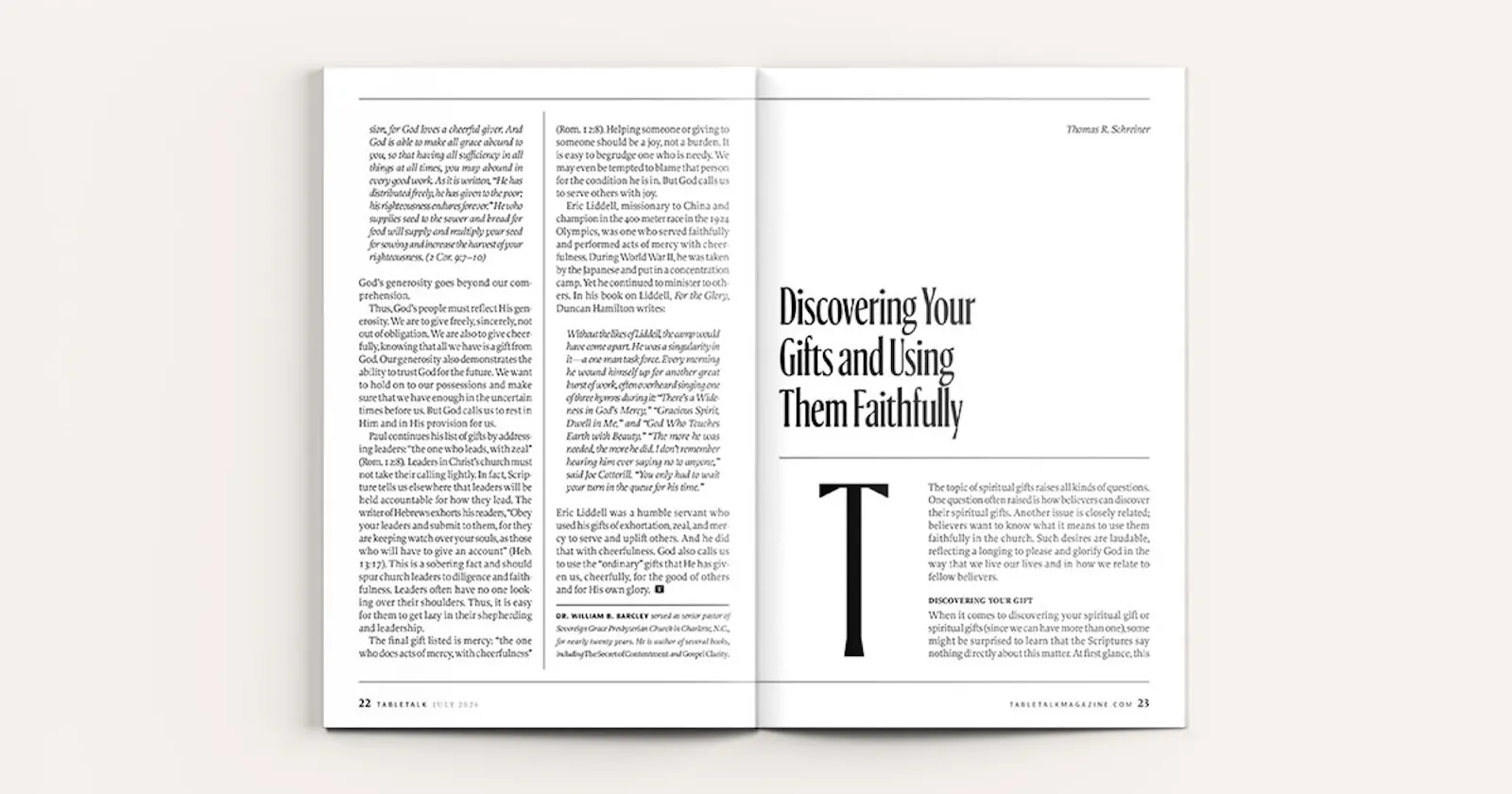
Discovering Your Gifts and Using Them Faithfully
Feature Article
July 2026

Request your free, three-month trial to Tabletalk magazine. You’ll receive the print issue monthly and gain immediate digital access to decades of archives. This trial is risk-free. No credit card required.
Try Tabletalk NowAlready receive Tabletalk magazine every month?
Verify your email address to gain unlimited access.
The topic of spiritual gifts raises all kinds of questions. One question often raised is how believers can discover their spiritual gifts. Another issue is closely related; believers want to know what it means to use them faithfully in the church. Such desires are laudable, reflecting a longing to please and glorify God in the way that we live our lives and in how we relate to fellow believers.
discovering your gift
When it comes to discovering your spiritual gift or spiritual gifts (since we can have more than one), some might be surprised to learn that the Scriptures say nothing directly about this matter. At first glance, this might seem puzzling, but the silence of the Scriptures is instructive. Sometimes this gap is filled when churches hand out surveys and questionnaires to help us discern our gifts. Questionnaires such as these are not completely useless; we do learn something when we examine ourselves, considering our strengths and weaknesses. The problem, however, is that such an approach abstracts discovering your gift from life in the body of Christ. It gives the impression that you can know what your gift is in the privacy of your own room. In so doing, it feeds the individualism of our culture, as if gifts were about our own potential, fulfillment, and satisfaction.
In reality, we discover our gifts when we give ourselves to fellow believers in the body of Christ, when we invest in the lives of others, when we sacrifice ourselves for the sake of others. Our gifts become apparent as we live to love and serve others. Even if we are not conscious of our gifts, we are almost certainly exercising them if we invest in the lives of others. Sometimes we don’t see ourselves clearly, and thus others in the church may help us discern our gifts. We may not know what our gifts are initially, but as we grow as believers and give ourselves to others, our gifts will typically become clear to us.
using our gifts faithfully
As believers, we long to use our gifts in a way that pleases and glorifies God. We should keep four things in mind as we use our gifts.
Our gifts are from God. First, we need to recognize that our gifts can’t be ascribed to our own spirituality or goodness. Our gifts are due to the grace of God. Consider the following verses:
Now there are varieties of gifts, but the same Spirit; and there are varieties of service, but the same Lord; and there are varieties of activities, but it is the same God who empowers them all in everyone. (1 Cor. 12:4–6)
All these are empowered by one and the same Spirit, who apportions to each one individually as he wills. (v. 11)
But as it is, God arranged the members in the body, each one of them, as he chose. (v. 18)
And God has appointed in the church first apostles, second prophets, third teachers, then miracles, then gifts of healing, helping, administrating, and various kinds of tongues. (v. 28)
These verses, which all come from 1 Corinthians 12, impress on us that God in His sovereign grace and by the work of the Holy Spirit has given us our gifts. Our gifts are not a manifestation of ourselves or of our greatness (v. 7). They are entirely due to God’s grace. As Paul says in 1 Corinthians 4:7, everything we have is a gift; every good thing that we have has been received from God. It follows, then, that we will use our gifts faithfully if we use them humbly. If our gifts become a platform for pride, for self-exaltation, for self-promotion, we have forgotten about God’s grace.
A right estimate of ourselves. The second way that we use our gifts faithfully is closely related to the first. Consider again what Paul writes in 1 Corinthians 12:14–21:
For the body does not consist of one member but of many. If the foot should say, “Because I am not a hand, I do not belong to the body,” that would not make it any less a part of the body. And if the ear should say, “Because I am not an eye, I do not belong to the body,” that would not make it any less a part of the body. If the whole body were an eye, where would be the sense of hearing? If the whole body were an ear, where would be the sense of smell? But as it is, God arranged the members in the body, each one of them, as he chose. If all were a single member, where would the body be? As it is, there are many parts, yet one body.
The eye cannot say to the hand, “I have no need of you,” nor again the head to the feet, “I have no need of you.”
We learn here how to think about ourselves as we exercise our gifts, and three wrong perspectives on our gifts are corrected here. First, we should not think that we are inferior because of the gift we have. If we think we are only an ugly ear in the body of Christ, our thinking about ourselves is off-center. God has given us particular gifts, and they are valuable and important, and it is a mistake to put ourselves down and to think that our gifts are insignificant. Second, no member of the body is comprehensive. The body isn’t a giant eye or a massive ear. Every member of the body is important and imperative for the proper working of the body. Third, no member of the body is superior. Eyes can’t say that they don’t need hands, because without hands bodies are helpless. We use our gifts faithfully when we remember that every part of the body—every gift—is important for the proper working of the body of Christ. We need to think sensibly about ourselves, neither putting ourselves down nor exalting ourselves (Rom. 12:3).
Concentrate on your gifts. We learn another important lesson about gifts in Romans 12:6–8. Paul declares that if our gift is serving, we should use it “in our serving,” or that if our gift is teaching, we should use it “in . . . teaching” (v. 7). Similarly, if our gift is exhortation, we are to use it for “exhortation” (v. 8). What Paul teaches us here may seem obvious, but it is wise advice that we heed for our own good. We are instructed to focus most of our time on the gifts that God has given us, to invest most of our time on those particular gifts.
A word of caution is in order. Paul’s words here should not be used as an excuse for selfishness. We must not say, “I can’t be bothered to share the gospel because I don’t have the gift of evangelism.” Neither can we say, “I can’t help set up chairs because I don’t have the gift of serving.” We are called to function in areas in which we are not gifted. That is the path of love. At the same time, the advice given here is wonderfully practical. We need to invest most of our energy and time in the areas in which we are particularly gifted. Life is short, and we must decide how to spend our time. We help other believers the most if we devote ourselves to the gifts that God has granted us. Doing this is not selfish but loving, because the church is edified most when we dedicate ourselves to the areas in which we are strongest. Thus, Paul says that if you have the gift of service, concentrate on serving, or if it is teaching, focus on your teaching.
Gifts edify the body. I conclude with one of the most important emphases regarding gifts, one that is easily missed in our individualistic culture, which is that gifts are for “the common good” (1 Cor. 12:7). God gave us gifts so that we care for one another, which means that we rejoice with those who are happy and grieve with those who are suffering (vv. 25–26). Our motive in using the gifts is to build up the church (14:5, 12, 17), to benefit others (v. 6), “for building up the body of Christ” (Eph. 4:12), so that the church becomes more like Christ (v. 15).
Here is where 1 Corinthians 13 comes in. We are using our gifts faithfully when we exercise them in love for others. Gifts are not given to parade our abilities. They are not a manifestation of self but a “manifestation of the Spirit” (1 Cor. 12:7). Our gifts are used in a way that pleases God when they are God-centered instead of being me-centered, when they are God-exalting instead of self-exalting, when they are God-glorifying instead of being self-praising. As Peter says, whether we speak or serve, we are to rely on God’s strength so that God will be glorified in our service (1 Peter 4:10–11).
a final word
God in His grace and in His love has given us gifts, and we in turn show our love for fellow believers when we use our gifts for His glory, not to advertise ourselves but to build up fellow believers.