

Request your free, three-month trial to Tabletalk magazine. You’ll receive the print issue monthly and gain immediate digital access to decades of archives. This trial is risk-free. No credit card required.
Try Tabletalk NowAlready receive Tabletalk magazine every month?
Verify your email address to gain unlimited access.
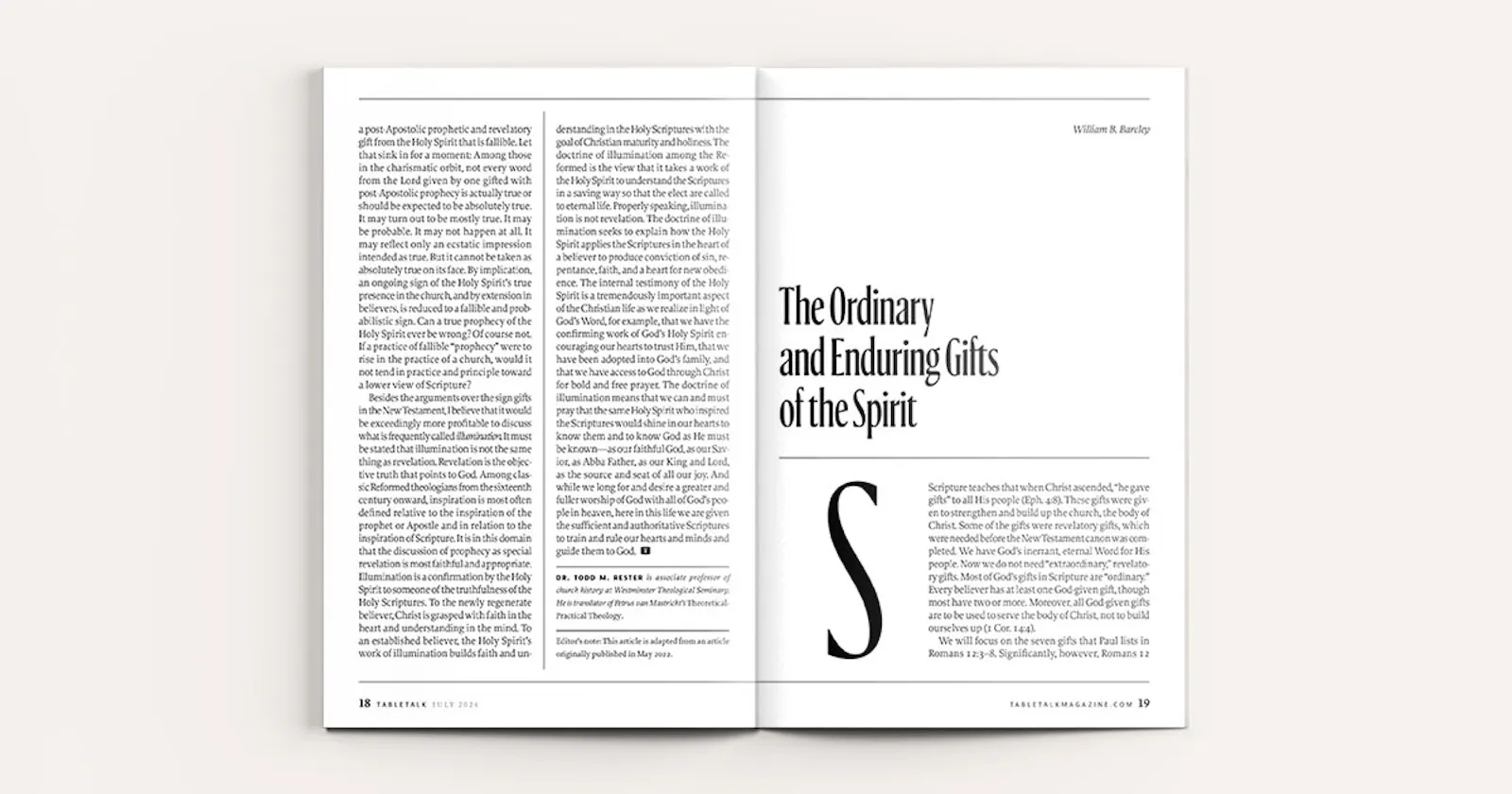
Scripture teaches that when Christ ascended, “he gave gifts” to all His people (Eph. 4:8). These gifts were given to strengthen and build up the church, the body of Christ. Some of the gifts were revelatory gifts, which were needed before the New Testament canon was completed. We have God’s inerrant, eternal Word for His people. Now we do not need “extraordinary,” revelatory gifts. Most of God’s gifts in Scripture are “ordinary.” Every believer has at least one God-given gift, though most have two or more. Moreover, all God-given gifts are to be used to serve the body of Christ, not to build ourselves up (1 Cor. 14:4).
We will focus on the seven gifts that Paul lists in Romans 12:3–8. Significantly, however, Romans 12 begins with an exhortation to “present your bodies as a living sacrifice, holy and acceptable to God” (v. 1). One way that we do this is by using our gifts to serve Christ and His church. This requires humility. Paul begins this section with the exhortation to everyone “not to think of himself more highly than he ought to think” (v. 3). In Philippians 2, Paul uses Jesus as an example of humility. Humility is the mark of a servant, and God’s people must use their God-given gifts humbly.
The first gift that Paul lists is “prophecy” (Rom. 12:6). It is unclear in this text whether “prophecy” here refers to an extraordinary, revelatory gift, or to proclaiming (preaching or teaching) the Word of God. John Calvin, along with many others, argued that it simply referred to proclaiming God’s Word. Most likely, in Paul’s day, before the canon of Scripture was closed, “prophecy” here refers to authoritative, divine revelation that was given to the early church. Today, the canon is closed. No one is to add to it. The Bible is the sole infallible source of authority given by God. Preachers and teachers today are to proclaim to others what God has revealed in His Word.
It is significant that prophecy heads the list. The preaching of the Word of God is God’s way to bring sinners to repentance. As Paul writes, “So faith comes from hearing, and hearing through the word of Christ” (Rom. 10:17). Paul similarly wrote to the church in Galatia, “Did you receive the Spirit by works of the law or by hearing with faith?” (Gal. 3:2). Preaching is central to God’s plan of salvation.
Second, Paul lists the gift of service: “if service, in our serving” (Rom. 12:7). In one way, all are called to serve the Lord and one another. Some, however, have the gift of serving. The Greek word for “servant” is diakonos, from which we get our English word deacon. In the New Testament, deacons were set apart for serving God’s church and His people in tangible ways (see Acts 6). Yet others also have the gift of serving. A precious saint in our church, who is now with the Lord, would often come to the church during the week and look for ways to serve. She would straighten the hymnals in the pew racks, dust, sometimes vacuum—just doing whatever she could to serve the church. She also called others on their birthdays and sang to them. She had the gift of service. Although what she did during the week was unknown to most of the congregation, she joyfully served Christ and His church.
The next two gifts are tied closely together: “the one who teaches, in his teaching; the one who exhorts, in his exhortation” (Rom. 12:7–8). Teaching God’s Word is central to building up the saints. Many times in the Gospels, Jesus is called “Teacher.” Luke begins the book of Acts by saying, “In the first book, O Theophilus, I have dealt with all that Jesus began to do and teach” (Acts 1:1). But Jesus also commands His disciples to teach:
“All authority in heaven and on earth has been given to me. Go therefore and make disciples of all nations, baptizing them in the name of the Father and of the Son and of the Holy Spirit, teaching them to observe all that I have commanded you. And behold, I am with you always, to the end of the age.” (Matt. 28:18–20)
God calls and equips teachers so that His church may grow in knowledge and maturity.
While “teaching” refers to the content of what is taught, “exhortation” is applying God’s Word to the lives of God’s people and summoning them to action. James writes, “But be doers of the word, and not hearers only, deceiving yourselves” (James 1:22). Paul instructs Timothy, “Preach the word; be ready in season and out of season; reprove, rebuke, and exhort, with complete patience and teaching” (2 Tim. 4:2). To “reprove” means seeking to convince someone that he is in error. “Rebuke” entails pointing out someone’s wrong, perhaps publicly, and calling him to repentance. In contrast, “exhort” has an element of tenderness, urging others to walk in the truth and grow in holiness.
The next gift is generosity: “the one who contributes, in generosity” (Rom. 12:8). The gift of generosity is a wonderful gift and reflects the character of God. Paul writes to the church in Corinth:
Each one must give as he has decided in his heart, not reluctantly or under compulsion, for God loves a cheerful giver. And God is able to make all grace abound to you, so that having all sufficiency in all things at all times, you may abound in every good work. As it is written, “He has distributed freely, he has given to the poor; his righteousness endures forever.” He who supplies seed to the sower and bread for food will supply and multiply your seed for sowing and increase the harvest of your righteousness. (2 Cor. 9:7–10)
God’s generosity goes beyond our comprehension.
Thus, God’s people must reflect His generosity. We are to give freely, sincerely, not out of obligation. We are also to give cheerfully, knowing that all we have is a gift from God. Our generosity also demonstrates the ability to trust God for the future. We want to hold on to our possessions and make sure that we have enough in the uncertain times before us. But God calls us to rest in Him and in His provision for us.
Paul continues his list of gifts by addressing leaders: “the one who leads, with zeal” (Rom. 12:8). Leaders in Christ’s church must not take their calling lightly. In fact, Scripture tells us elsewhere that leaders will be held accountable for how they lead. The writer of Hebrews exhorts his readers, “Obey your leaders and submit to them, for they are keeping watch over your souls, as those who will have to give an account” (Heb. 13:17). This is a sobering fact and should spur church leaders to diligence and faithfulness. Leaders often have no one looking over their shoulders. Thus, it is easy for them to get lazy in their shepherding and leadership.
The final gift listed is mercy: “the one who does acts of mercy, with cheerfulness” (Rom. 12:8). Helping someone or giving to someone should be a joy, not a burden. It is easy to begrudge one who is needy. We may even be tempted to blame that person for the condition he is in. But God calls us to serve others with joy.
Eric Liddell, missionary to China and champion in the 400-meter race in the 1924 Olympics, was one who served faithfully and performed acts of mercy with cheerfulness. During World War II, he was taken by the Japanese and put in a concentration camp. Yet he continued to minister to others. In his book on Liddell, For the Glory, Duncan Hamilton writes:
Without the likes of Liddell, the camp would have come apart. He was a singularity in it—a one-man task force. Every morning he wound himself up for another great burst of work, often overheard singing one of three hymns during it: “There’s a Wideness in God’s Mercy,” “Gracious Spirit, Dwell in Me,” and “God Who Touches Earth with Beauty.” “The more he was needed, the more he did. I don’t remember hearing him ever saying no to anyone,” said Joe Cotterill. “You only had to wait your turn in the queue for his time.”
Eric Liddell was a humble servant who used his gifts of exhortation, zeal, and mercy to serve and uplift others. And he did that with cheerfulness. God also calls us to use the “ordinary” gifts that He has given us, cheerfully, for the good of others and for His own glory.