
Request your free, three-month trial to Tabletalk magazine. You’ll receive the print issue monthly and gain immediate digital access to decades of archives. This trial is risk-free. No credit card required.
Try Tabletalk NowAlready receive Tabletalk magazine every month?
Verify your email address to gain unlimited access.
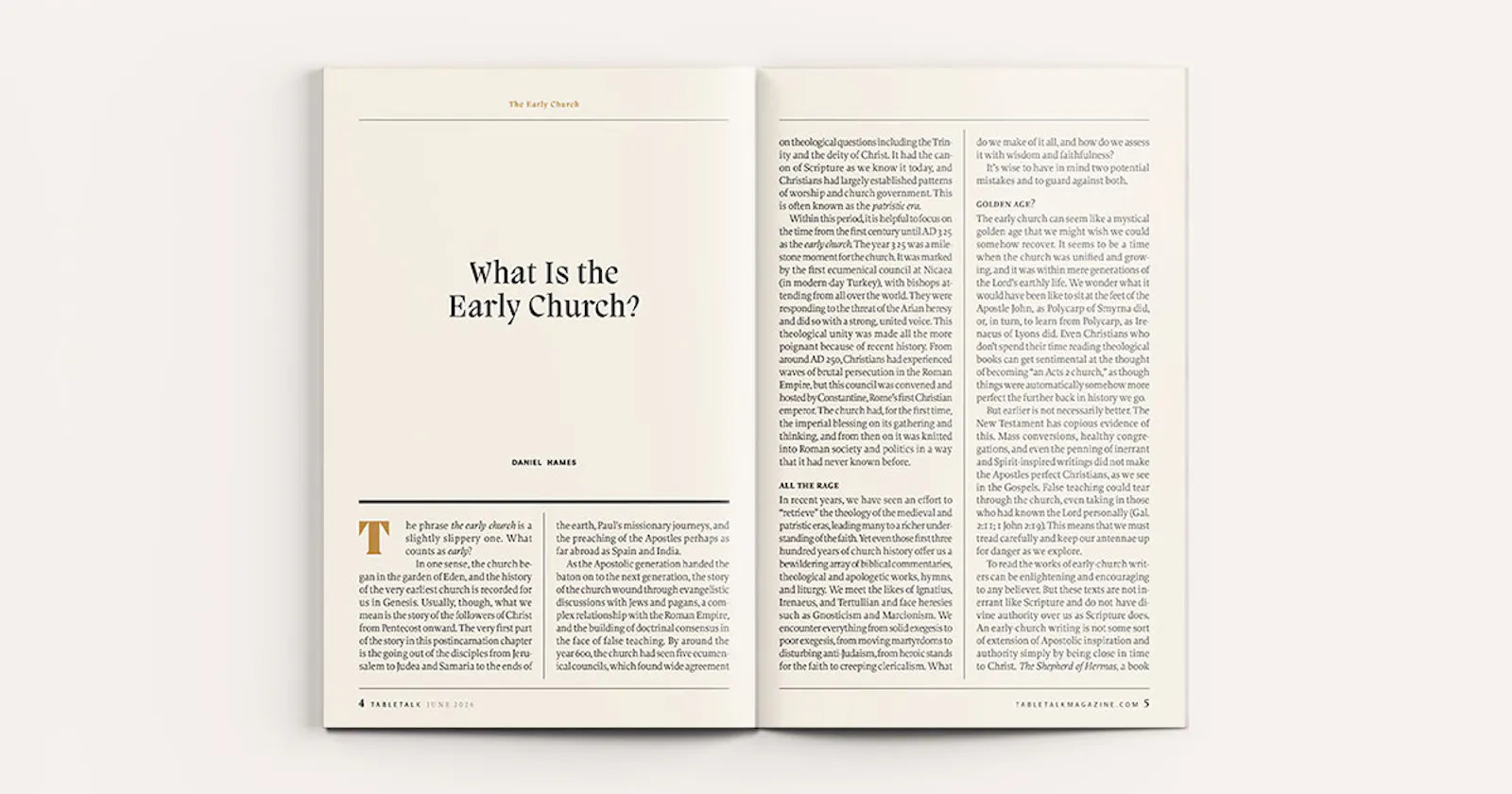
The phrase the early church is a slightly slippery one. What counts as early?
In one sense, the church began in the garden of Eden, and the history of the very earliest church is recorded for us in Genesis. Usually, though, what we mean is the story of the followers of Christ from Pentecost onward. The very first part of the story in this postincarnation chapter is the going out of the disciples from Jerusalem to Judea and Samaria to the ends of the earth, Paul’s missionary journeys, and the preaching of the Apostles perhaps as far abroad as Spain and India.
As the Apostolic generation handed the baton on to the next generation, the story of the church wound through evangelistic discussions with Jews and pagans, a complex relationship with the Roman Empire, and the building of doctrinal consensus in the face of false teaching. By around the year 600, the church had seen five ecumenical councils, which found wide agreement on theological questions including the Trinity and the deity of Christ. It had the canon of Scripture as we know it today, and Christians had largely established patterns of worship and church government. This is often known as the patristic era.
Within this period, it is helpful to focus on the time from the first century until AD 325 as the early church. The year 325 was a milestone moment for the church. It was marked by the first ecumenical council at Nicaea (in modern-day Turkey), with bishops attending from all over the world. They were responding to the threat of the Arian heresy and did so with a strong, united voice. This theological unity was made all the more poignant because of recent history. From around AD 250, Christians had experienced waves of brutal persecution in the Roman Empire, but this council was convened and hosted by Constantine, Rome’s first Christian emperor. The church had, for the first time, the imperial blessing on its gathering and thinking, and from then on it was knitted into Roman society and politics in a way that it had never known before.
all the rage
In recent years, we have seen an effort to “retrieve” the theology of the medieval and patristic eras, leading many to a richer understanding of the faith. Yet even those first three hundred years of church history offer us a bewildering array of biblical commentaries, theological and apologetic works, hymns, and liturgy. We meet the likes of Ignatius, Irenaeus, and Tertullian and face heresies such as Gnosticism and Marcionism. We encounter everything from solid exegesis to poor exegesis, from moving martyrdoms to disturbing anti-Judaism, from heroic stands for the faith to creeping clericalism. What do we make of it all, and how do we assess it with wisdom and faithfulness?
It’s wise to have in mind two potential mistakes and to guard against both.
golden age?
The early church can seem like a mystical golden age that we might wish we could somehow recover. It seems to be a time when the church was unified and growing, and it was within mere generations of the Lord’s earthly life. We wonder what it would have been like to sit at the feet of the Apostle John, as Polycarp of Smyrna did, or, in turn, to learn from Polycarp, as Irenaeus of Lyons did. Even Christians who don’t spend their time reading theological books can get sentimental at the thought of becoming “an Acts 2 church,” as though things were automatically somehow more perfect the further back in history we go.
But earlier is not necessarily better. The New Testament has copious evidence of this. Mass conversions, healthy congregations, and even the penning of inerrant and Spirit-inspired writings did not make the Apostles perfect Christians, as we see in the Gospels. False teaching could tear through the church, even taking in those who had known the Lord personally (Gal. 2:11; 1 John 2:19). This means that we must tread carefully and keep our antennae up for danger as we explore.
To read the works of early-church writers can be enlightening and encouraging to any believer. But these texts are not inerrant like Scripture and do not have divine authority over us as Scripture does. An early-church writing is not some sort of extension of Apostolic inspiration and authority simply by being close in time to Christ. The Shepherd of Hermas, a book that was well loved by many early Christians, is fascinating to read but would be a pastoral disaster if put into practice. Ignatius of Antioch bravely went to his death for Christ’s sake but also seemed to teach an unquestioning obedience to bishops.
We ought not to romanticize the early church or imagine that recovering it would deal with all of today’s problems in a flash. It was far more complex and flawed than that.
cage stage?
Reading early-church theology can be enchanting. It feels like uncovering deep roots that run right back to the time of the Apostles. Sadly, this has led some (many of them young men) to depart to Eastern Orthodoxy or Roman Catholicism, which each claim to be the only “true” church, in contrast to what can feel like “shallow” evangelicalism. This trend can make us overly guarded. Wary pastors may warn their people about getting entangled in early writers who have contributed to the doctrine of transubstantiation, the veneration of Mary, or muddiness on justification. Simply pulling up the drawbridge like this is as much a mistake as the naivete of the first error.
It is true that the early church was deeply imperfect, and it can seem all the more alien to us since people in second-century Greece or Asia Minor simply did not think like we do today. Yet we should not dismiss all interest in the early church as a minefield of pagan incursions on the gospel or Roman Catholicism in disguise. In the very earliest days of the church, we will also find wonderful stands for gospel truth, pastor-theologians shepherding their flocks with great integrity, and a heart for mission that propelled the gospel around the world.
It’s to the early Christians that we owe some of the most beautiful expressions of our faith. Think of the majestic lines about the identity of Jesus Christ from the Nicene Creed:
[We believe in] one Lord Jesus Christ, the only-begotten Son of God, begotten of His Father before all worlds; God of God, Light of Light, very God of very God; begotten, not made, being of one substance with the Father, by whom all things were made. Who, for us men and for our salvation, came down from heaven, and was incarnate by the Holy Spirit of the virgin Mary, and was made man.
Or this gorgeous hymn about the atonement from the Epistle to Diognetus:
He gave His own Son as a ransom for us, the holy One for transgressors, the blameless One for the wicked, the righteous One for the unrighteous, the incorruptible One for the corruptible, the immortal One for those who are mortal. For what other thing was capable of covering our sins than His righteousness? By what other one was it possible that we, the wicked and ungodly, could be justified, than by the only Son of God? O sweet exchange! O unsearchable operation! O benefits surpassing all expectation! That the wickedness of many should be hid in a single righteous One, and that the righteousness of One should justify many transgressors!
Clearly, there are riches to enjoy here, and going “cage stage” or locking down against the thought and history of the early church would be a great loss of our own heritage.
As C.S. Lewis once wrote, “every age has its own outlook” and is both good at seeing certain truths and liable to make its own “characteristic mistakes.” Getting to know the early church can teach us by correction and by way of a warning. We should tread carefully, but we may tread on nonetheless. The Holy Spirit was at work in Christ’s church then as He is now, and there is so much to appreciate. With His help and armed with the truth of Scripture, let us take up and read.