
Request your free, three-month trial to Tabletalk magazine. You’ll receive the print issue monthly and gain immediate digital access to decades of archives. This trial is risk-free. No credit card required.
Try Tabletalk NowAlready receive Tabletalk magazine every month?
Verify your email address to gain unlimited access.
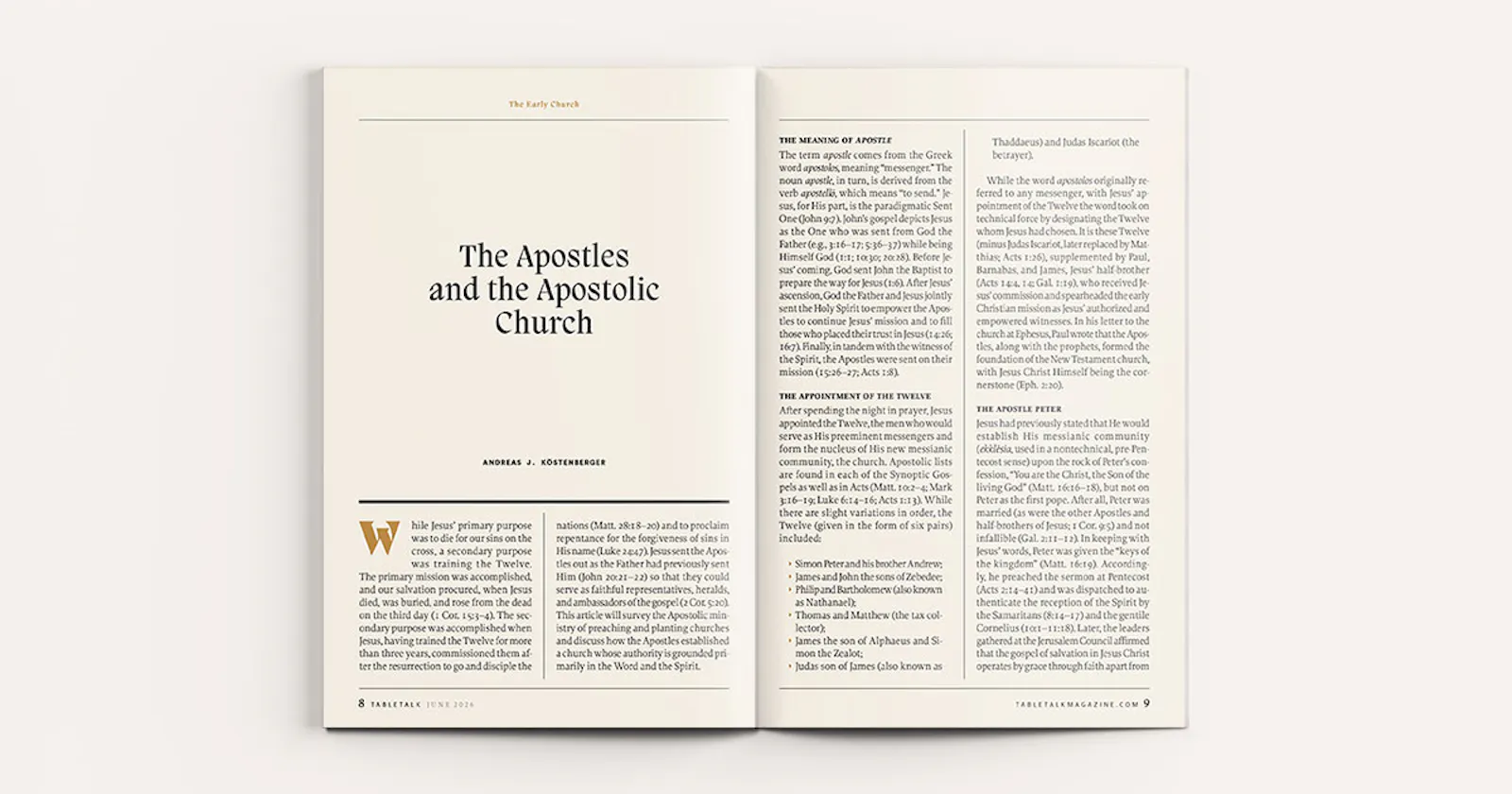
While Jesus’ primary purpose was to die for our sins on the cross, a secondary purpose was training the Twelve. The primary mission was accomplished, and our salvation procured, when Jesus died, was buried, and rose from the dead on the third day (1 Cor. 15:3–4). The secondary purpose was accomplished when Jesus, having trained the Twelve for more than three years, commissioned them after the resurrection to go and disciple the nations (Matt. 28:18–20) and to proclaim repentance for the forgiveness of sins in His name (Luke 24:47). Jesus sent the Apostles out as the Father had previously sent Him (John 20:21–22) so that they could serve as faithful representatives, heralds, and ambassadors of the gospel (2 Cor. 5:20). This article will survey the Apostolic ministry of preaching and planting churches and discuss how the Apostles established a church whose authority is grounded primarily in the Word and the Spirit.
The Meaning of Apostle
The term apostle comes from the Greek word apostolos, meaning “messenger.” The noun apostle, in turn, is derived from the verb apostellō, which means “to send.” Jesus, for His part, is the paradigmatic Sent One (John 9:7). John’s gospel depicts Jesus as the One who was sent from God the Father (e.g., 3:16–17; 5:36–37) while being Himself God (1:1; 10:30; 20:28). Before Jesus’ coming, God sent John the Baptist to prepare the way for Jesus (1:6). After Jesus’ ascension, God the Father and Jesus jointly sent the Holy Spirit to empower the Apostles to continue Jesus’ mission and to fill those who placed their trust in Jesus (14:26; 16:7). Finally, in tandem with the witness of the Spirit, the Apostles were sent on their mission (15:26–27; Acts 1:8).
The Appointment of the Twelve
After spending the night in prayer, Jesus appointed the Twelve, the men who would serve as His preeminent messengers and form the nucleus of His new messianic community, the church. Apostolic lists are found in each of the Synoptic Gospels as well as in Acts (Matt. 10:2–4; Mark 3:16–19; Luke 6:14–16; Acts 1:13). While there are slight variations in order, the Twelve (given in the form of six pairs) included:
– Simon Peter and his brother Andrew;
– James and John the sons of Zebedee;
– Philip and Bartholomew (also known as Nathanael);
– Thomas and Matthew (the tax collector);
– James the son of Alphaeus and Simon the Zealot;
– Judas son of James (also known as Thaddaeus) and Judas Iscariot (the betrayer).
While the word apostolos originally referred to any messenger, with Jesus’ appointment of the Twelve the word took on technical force by designating the Twelve whom Jesus had chosen. It is these Twelve (minus Judas Iscariot, later replaced by Matthias; Acts 1:26), supplemented by Paul, Barnabas, and James, Jesus’ half-brother (Acts 14:4, 14; Gal. 1:19), who received Jesus’ commission and spearheaded the early Christian mission as Jesus’ authorized and empowered witnesses. In his letter to the church at Ephesus, Paul wrote that the Apostles, along with the prophets, formed the foundation of the New Testament church, with Jesus Christ Himself being the cornerstone (Eph. 2:20).
The Apostle Peter
Jesus had previously stated that He would establish His messianic community (ekklēsia, used in a nontechnical, pre-Pentecost sense) upon the rock of Peter’s confession, “You are the Christ, the Son of the living God” (Matt. 16:16–18), but not on Peter as the first pope. After all, Peter was married (as were the other Apostles and half-brothers of Jesus; 1 Cor. 9:5) and not infallible (Gal. 2:11–12). In keeping with Jesus’ words, Peter was given the “keys of the kingdom” (Matt. 16:19). Accordingly, he preached the sermon at Pentecost (Acts 2:14–41) and was dispatched to authenticate the reception of the Spirit by the Samaritans (8:14–17) and the gentile Cornelius (10:1–11:18). Later, the leaders gathered at the Jerusalem Council affirmed that the gospel of salvation in Jesus Christ operates by grace through faith apart from works (15:1–29), and this was the gospel that Paul consistently proclaimed (e.g., Rom. 1:16–17; 3:21–26; Eph. 2:8–9).
The Apostle Paul
The ninth chapter of the book of Acts recounts Paul’s conversion by the risen Jesus on the road to Damascus. The story is told three times in Acts and marks a pivotal juncture in the rise of the early Christian movement (Acts 9:1–19; 22:1–21; 26:1–23). Paul called himself an “untimely” Apostle (1 Cor. 15:8) because he had been persecuting the early Christians when Jesus drafted him into service (Acts 7:58; 8:3; 9:1–2). Paul’s mission, first to the Jews (preaching in local synagogues) but beyond them to gentiles (non-Jews; see Rom. 1:16), entailed the establishment of local congregations across the Greco-Roman empire. In three missionary journeys, he extended the reach of the gospel from Jerusalem all the way to Rome (15:18–21), with further plans to travel to Spain (vv. 24, 28). In his letter openings, Paul always identified himself as an Apostle, a missionary and church planter who derived his authority from none other than the risen Christ (e.g., Gal. 1:1). Paul also identified himself as a herald (1 Tim. 2:7; 2 Tim. 1:11) who would enter a city, proclaim the gospel, plant a church, and then move on to the next urban center.
The book of Acts shows that the Apostolic proclamation focused on Jesus’ resurrection (Acts 2:24, 32; 3:15, 26; 4:10). It narrates the irresistible progress of the gospel empowered by the Spirit (1:8). External obstacles (persecution) and internal obstacles (lying to the Holy Spirit, the need to clarify the essence of the gospel) were no match for the Spirit’s power (5:1–11; 15:1–35). As churches were established, Paul and his associates appointed elders in every local congregation (14:23; Titus 1:5). This plurality of leaders was built on the precedent of local Jewish synagogues (e.g., Acts 18:7–8, 19).
Elders and Deacons
In his letters to his Apostolic delegates, Timothy and Titus, Paul stipulated requirements for church leaders, both elders and deacons (1 Tim. 3; Titus 1:6–9). Elders are to be faithful husbands (if married, which was the norm; 1 Tim. 3:2; Titus 1:6), in keeping with the biblical pattern of male leadership seen from Adam to the patriarchs and in national deliverers and priests and kings, culminating in Jesus’ being incarnated as a man, and the twelve male Apostles.
The elders (presbyteroi) or overseers (episkopoi—the two terms are used synonymously in the New Testament (see Acts 20:28; 1 Tim. 3:1–2; 5:17; Titus 1:6–9)—must manage their households well, since the family is the basic societal unit and microcosm of the church, God’s household (1 Tim. 3:4–5, 15). They must be spiritually mature men who exhibit proven character (see the requirements in 1 Tim. 3:1–7 and Titus 1:6–9 pertaining to a man’s integrity, control of temper, etc.). Elders must also be “able to teach” (didaktikos; 1 Tim. 3:2). While not all will teach as their primary role, all “rule”—that is, provide authoritative oversight for the church (5:17). Likewise, deacons are to be of mature character; theirs is a servant (not teaching or ruling) role (Phil. 1:1; 1 Tim. 3:8–12).
The Authority of the Apostolic Church
With the death of the last Apostle (most likely John) around the close of the first century AD, the Apostolic era ceased. The period of Apostolic “signs and wonders,” performed in the absence of a finalized New Testament canon of writings, gave way to the completed and closed canon of sixty-six books consisting of thirty-nine Old Testament and twenty-seven New Testament books. While Paul stipulated a set of two offices—elders/overseers and deacons—the authority of the church is grounded primarily in the Word and the Spirit, not passed on through lines of Apostolic succession. We still have the same Word today, just as we have the same Spirit as the One who indwelled the first Christians and empowered the Apostolic mission. Serving our risen Lord in our day, we are writing a new chapter in the church’s history as we seek to fulfill His commission to disciple the nations and await His triumphant return.