

Request your free, three-month trial to Tabletalk magazine. You’ll receive the print issue monthly and gain immediate digital access to decades of archives. This trial is risk-free. No credit card required.
Try Tabletalk NowAlready receive Tabletalk magazine every month?
Verify your email address to gain unlimited access.
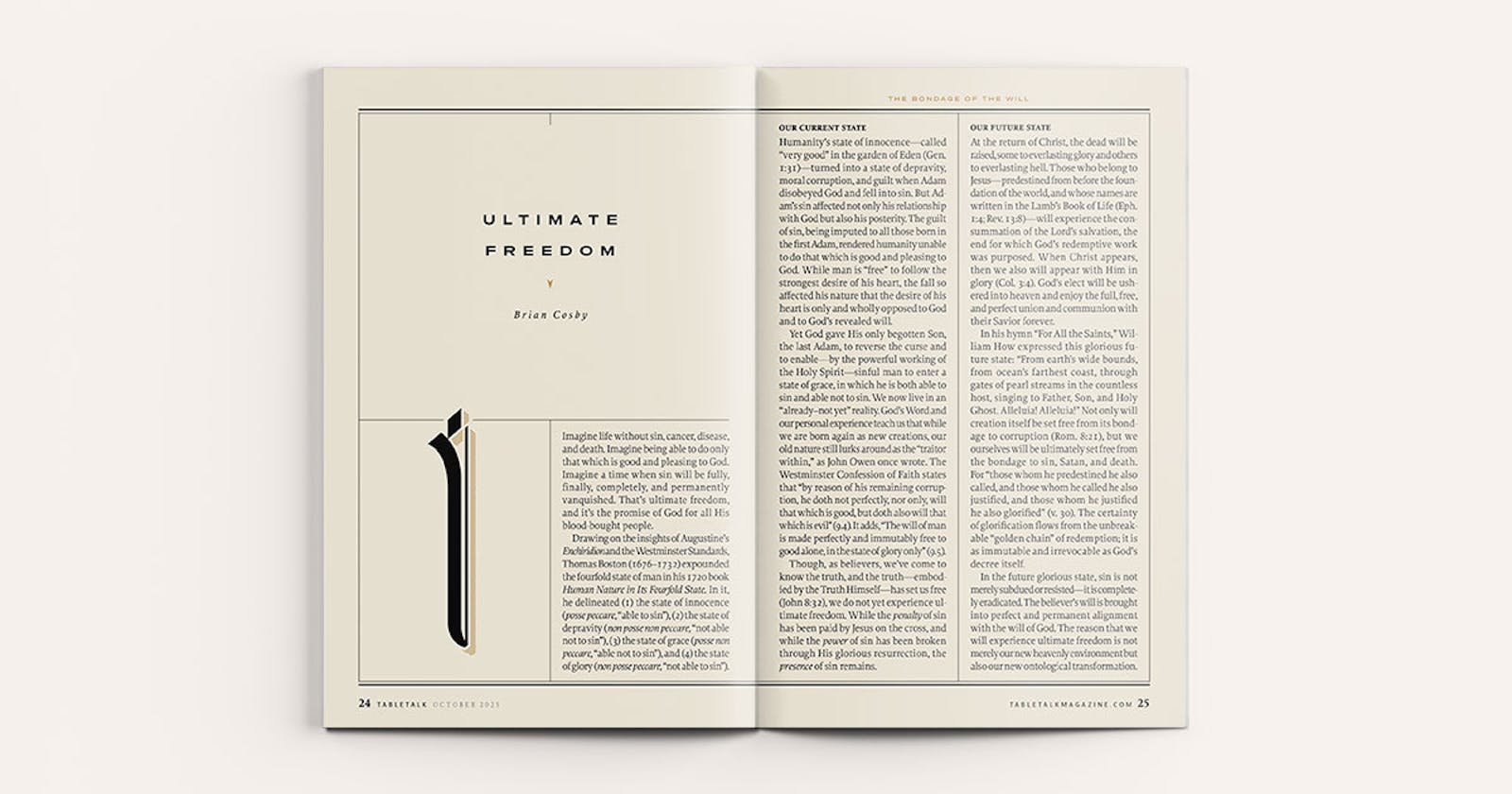
Imagine life without sin, cancer, disease, and death. Imagine being able to do only that which is good and pleasing to God. Imagine a time when sin will be fully, finally, completely, and permanently vanquished. That’s ultimate freedom, and it’s the promise of God for all His blood-bought people.
Drawing on the insights of Augustine’s Enchiridion and the Westminster Standards, Thomas Boston (1676–1732) expounded the fourfold state of man in his 1720 book Human Nature in Its Fourfold State. In it, he delineated (1) the state of innocence (posse peccare, “able to sin”), (2) the state of depravity (non posse non peccare, “not able not to sin”), (3) the state of grace (posse non peccare, “able not to sin”), and (4) the state of glory (non posse peccare, “not able to sin”).
our current state
Humanity’s state of innocence—called “very good” in the garden of Eden (Gen. 1:31)—turned into a state of depravity, moral corruption, and guilt when Adam disobeyed God and fell into sin. But Adam’s sin affected not only his relationship with God but also his posterity. The guilt of sin, being imputed to all those born in the first Adam, rendered humanity unable to do that which is good and pleasing to God. While man is “free” to follow the strongest desire of his heart, the fall so affected his nature that the desire of his heart is only and wholly opposed to God and to God’s revealed will.
Yet God gave His only begotten Son, the last Adam, to reverse the curse and to enable—by the powerful working of the Holy Spirit—sinful man to enter a state of grace, in which he is both able to sin and able not to sin. We now live in an “already–not yet” reality. God’s Word and our personal experience teach us that while we are born again as new creations, our old nature still lurks around as the “traitor within,” as John Owen once wrote. The Westminster Confession of Faith states that “by reason of his remaining corruption, he doth not perfectly, nor only, will that which is good, but doth also will that which is evil” (9.4). It adds, “The will of man is made perfectly and immutably free to good alone, in the state of glory only” (9.5).
Though, as believers, we’ve come to know the truth, and the truth—embodied by the Truth Himself—has set us free (John 8:32), we do not yet experience ultimate freedom. While the penalty of sin has been paid by Jesus on the cross, and while the power of sin has been broken through His glorious resurrection, the presence of sin remains.
our future state
At the return of Christ, the dead will be raised, some to everlasting glory and others to everlasting hell. Those who belong to Jesus—predestined from before the foundation of the world, and whose names are written in the Lamb’s Book of Life (Eph. 1:4; Rev. 13:8)—will experience the consummation of the Lord’s salvation, the end for which God’s redemptive work was purposed. When Christ appears, then we also will appear with Him in glory (Col. 3:4). God’s elect will be ushered into heaven and enjoy the full, free, and perfect union and communion with their Savior forever.
In his hymn “For All the Saints,” William How expressed this glorious future state: “From earth’s wide bounds, from ocean’s farthest coast, through gates of pearl streams in the countless host, singing to Father, Son, and Holy Ghost. Alleluia! Alleluia!” Not only will creation itself be set free from its bondage to corruption (Rom. 8:21), but we ourselves will be ultimately set free from the bondage to sin, Satan, and death. For “those whom he predestined he also called, and those whom he called he also justified, and those whom he justified he also glorified” (v. 30). The certainty of glorification flows from the unbreakable “golden chain” of redemption; it is as immutable and irrevocable as God’s decree itself.
In the future glorious state, sin is not merely subdued or resisted—it is completely eradicated. The believer’s will is brought into perfect and permanent alignment with the will of God. The reason that we will experience ultimate freedom is not merely our new heavenly environment but also our new ontological transformation. Thus, we will be not only sinless but also unable to sin (non posse peccare).
In this glorified state, God’s people will be so fully changed and transformed that sin becomes impossible. The heart will be so aligned with God, the will so purified, and the affections so sanctified that the very desire for sin will be utterly abolished. The Apostle John writes that “when [Christ] appears we shall be like him, because we shall see him as he is” (1 John 3:2). Paul concurs. When Jesus returns, He will “transform our lowly body to be like his glorious body” (Phil. 3:21). In the future state of glory, the believer will be transformed and conformed to Christ’s glorious body.
This inability to sin is not a limitation of freedom but its ultimate fulfillment. Ultimate freedom is not the mere capacity to choose between good and evil but the unimpeded ability to choose the good only. In glory, our freedom is perfected.
Additionally, our future glorious state will be comprehensive, inclusive of both body and soul. We will experience ultimate freedom from the “body of death” (Rom. 7:24) as our bodies and souls are joined together forever. For “what is sown is perishable; what is raised is imperishable” (1 Cor. 15:42).
The inability to sin in heaven is the result not of the believer’s good works or efforts but of the culmination of God’s transformative grace. What God began in you will be brought to completion at the day of Christ Jesus (Phil. 1:6). The glorified state is the final answer to Christ’s High Priestly Prayer: “Sanctify them in the truth; your word is truth” (John 17:17). We will have ultimate freedom because we will no longer endure the traitor within and no longer battle to align our wills to God’s. He has sovereignly decreed to bring His people into perfect union with Himself forever, a union incompatible with sin.
practical implications
God’s promise of ultimate freedom not only benefits us in the future but also has many practical implications for us in the present.
First, God’s promise of ultimate freedom gives us hope that sin will be vanquished and we will be fully and finally sanctified. For Christians battling indwelling sin, the promise of a sinless state is not escapism but hope grounded in the sure promises of God.
Second, God’s promise of ultimate freedom gives us assurance that the proclamation of the Word, the sacrament of the Lord’s Supper, and the prayers of God’s people will be made effectual for the elect. God uses these means of grace to both save and sanctify His people, enlisting and incorporating the preached Word, the Lord’s Supper, and the faithful prayers of His people into His eternal plan and purposes. One day, we will experience the full fruition of those earthly means. But for now, we can have the assurance that “for those who love God all things work together for good, for those who are called according to his purpose” (Rom. 8:28).
Third, God’s promise of ultimate freedom provides encouragement to us as fellow members of the bride of Christ. Though tainted with sin now, Christ will one day “present the church to himself in splendor, without spot or wrinkle or any such thing, that she might be holy and without blemish” (Eph. 5:27). The fellowship we enjoy now is but a foretaste of our gathering as the church triumphant in glory.
Fourth, God’s promise of ultimate freedom fuels perseverance. While the pilgrimage is long and arduous, the destination is sure. The believer presses on, battling sin, knowing that one day the fight will be over—not just paused or relieved but fully won. Our daily perseverance reflects God’s gracious preservation as we journey through this world toward a better one.
Finally, God’s promise of ultimate freedom magnifies the glory of God in salvation. Only God can so transform sinners into such a state that they not only cease from sin but are rendered incapable of sinning. Such a freedom showcases God’s holiness, sovereignty, faithfulness, and love. In heaven, the redeemed will eternally praise God not only for their deliverance from hell but also for their deliverance from sin itself.
The Christian’s ultimate freedom from sin is not merely the cessation of sinful acts, but the culmination of God’s redemptive plan to create a holy people for Himself. Glorification represents the final and irrevocable stage of salvation, in which believers are made forever perfect in splendor. In glory, we will not be able to sin because our hearts will be wholly and joyfully captivated by the vision of God’s glory. This is not a loss of freedom, but its perfection. In that final state, the Christian will be truly and eternally free—free from sin, free for righteousness, free to glorify God and to enjoy God forever.
As we long for that day of ultimate freedom, may we continually pray, “Come, Lord Jesus!” (Rev. 22:20).