

Request your free, three-month trial to Tabletalk magazine. You’ll receive the print issue monthly and gain immediate digital access to decades of archives. This trial is risk-free. No credit card required.
Try Tabletalk NowAlready receive Tabletalk magazine every month?
Verify your email address to gain unlimited access.
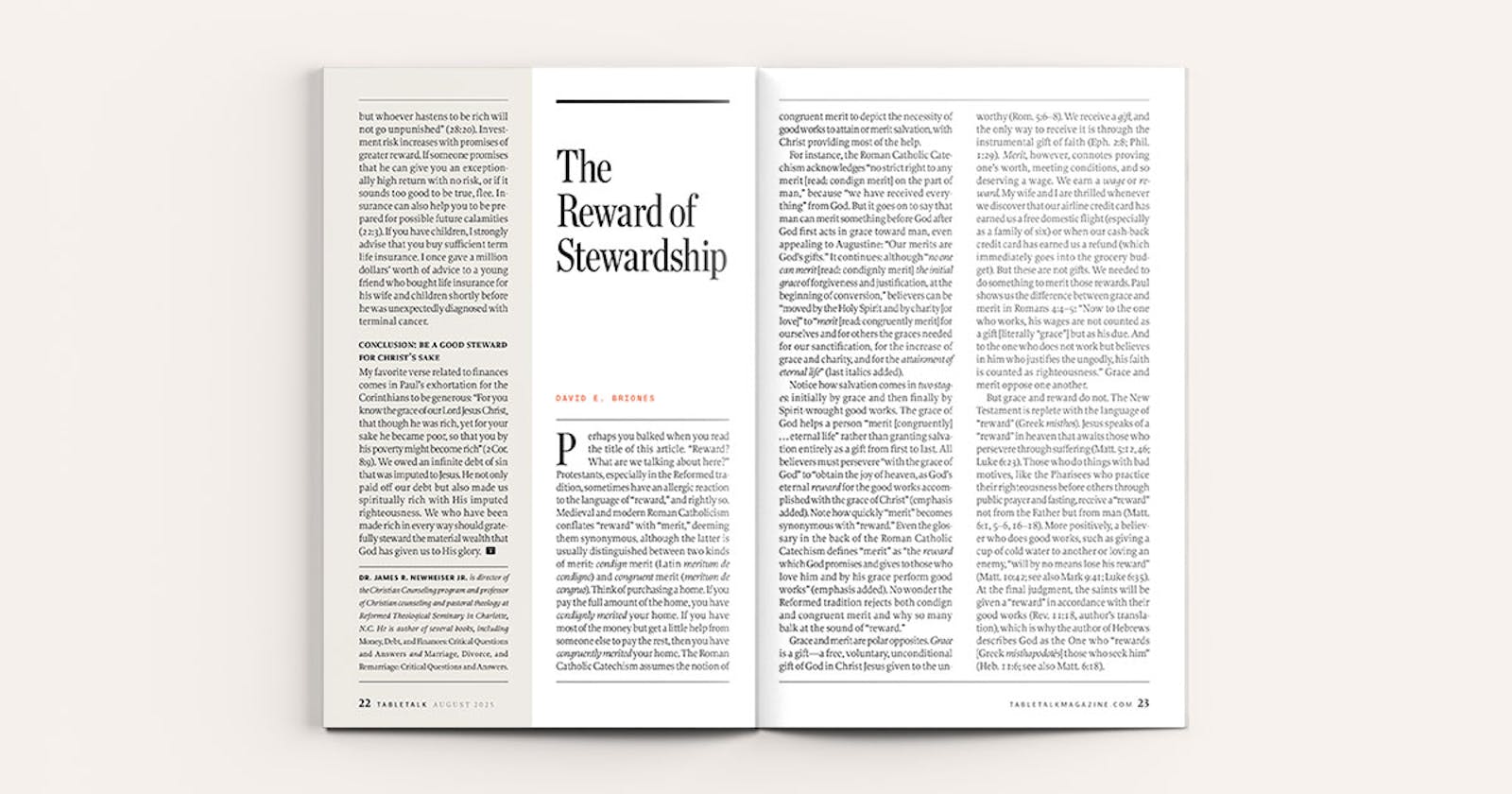
Perhaps you balked when you read the title of this article. “Reward? What are we talking about here?” Protestants, especially in the Reformed tradition, sometimes have an allergic reaction to the language of “reward,” and rightly so. Medieval and modern Roman Catholicism conflates “reward” with “merit,” deeming them synonymous, although the latter is usually distinguished between two kinds of merit: condign merit (Latin meritum de condigno) and congruent merit (meritum de congruo). Think of purchasing a home. If you pay the full amount of the home, you have condignly merited your home. If you have most of the money but get a little help from someone else to pay the rest, then you have congruently merited your home. The Roman Catholic Catechism assumes the notion of congruent merit to depict the necessity of good works to attain or merit salvation, with Christ providing most of the help.
For instance, the Roman Catholic Catechism acknowledges “no strict right to any merit [read: condign merit] on the part of man,” because “we have received everything” from God. But it goes on to say that man can merit something before God after God first acts in grace toward man, even appealing to Augustine: “Our merits are God’s gifts.” It continues: although “no one can merit [read: condignly merit] the initial grace of forgiveness and justification, at the beginning of conversion,” believers can be “moved by the Holy Spirit and by charity [or love]” to “merit [read: congruently merit] for ourselves and for others the graces needed for our sanctification, for the increase of grace and charity, and for the attainment of eternal life” (last italics added).
Notice how salvation comes in two stages: initially by grace and then finally by Spirit-wrought good works. The grace of God helps a person “merit [congruently] . . . eternal life” rather than granting salvation entirely as a gift from first to last. All believers must persevere “with the grace of God” to “obtain the joy of heaven, as God’s eternal reward for the good works accomplished with the grace of Christ” (emphasis added). Note how quickly “merit” becomes synonymous with “reward.” Even the glossary in the back of the Roman Catholic Catechism defines “merit” as “the reward which God promises and gives to those who love him and by his grace perform good works” (emphasis added). No wonder the Reformed tradition rejects both condign and congruent merit and why so many balk at the sound of “reward.”
Grace and merit are polar opposites. Grace is a gift—a free, voluntary, unconditional gift of God in Christ Jesus given to the unworthy (Rom. 5:6–8). We receive a gift, and the only way to receive it is through the instrumental gift of faith (Eph. 2:8; Phil. 1:29). Merit, however, connotes proving one’s worth, meeting conditions, and so deserving a wage. We earn a wage or reward. My wife and I are thrilled whenever we discover that our airline credit card has earned us a free domestic flight (especially as a family of six) or when our cash-back credit card has earned us a refund (which immediately goes into the grocery budget). But these are not gifts. We needed to do something to merit those rewards. Paul shows us the difference between grace and merit in Romans 4:4–5: “Now to the one who works, his wages are not counted as a gift [literally “grace”] but as his due. And to the one who does not work but believes in him who justifies the ungodly, his faith is counted as righteousness.” Grace and merit oppose one another.
But grace and reward do not. The New Testament is replete with the language of “reward” (Greek misthos). Jesus speaks of a “reward” in heaven that awaits those who persevere through suffering (Matt. 5:12, 46; Luke 6:23). Those who do things with bad motives, like the Pharisees who practice their righteousness before others through public prayer and fasting, receive a “reward” not from the Father but from man (Matt. 6:1, 5–6, 16–18). More positively, a believer who does good works, such as giving a cup of cold water to another or loving an enemy, “will by no means lose his reward” (Matt. 10:42; see also Mark 9:41; Luke 6:35). At the final judgment, the saints will be given a “reward” in accordance with their good works (Rev. 11:18, author’s translation), which is why the author of Hebrews describes God as the One who “rewards [Greek misthapodotēs] those who seek him” (Heb. 11:6; see also Matt. 6:18).
At times, grace may seem to conflict with reward, especially when one realizes that the Greek word misthos is often translated “wages” or “recompense” in the ESV. In Jesus’ parable of the vineyard, “the owner of the vineyard said to his foreman, ‘Call the laborers and pay them their wages [misthon], beginning with the last, up to the first’” (Matt. 20:8). When Jesus sends out the seventy-two, He tells them that “the laborer deserves his wages [misthou]” (Luke 10:7; see also 1 Tim. 5:18; James 5:4). After Paul mentions those who plant and those who water in gospel ministry, he says, “Each will receive his wages [misthon] according to his labor” (1 Cor. 3:8). Those who therefore build on the foundation of Christ “with gold, silver, [and] precious stones” will receive “a reward” (misthon; 1 Cor. 3:12, 14). That is because when Jesus returns to judge the living and the dead, He will bring His “recompense” (misthos) with Him, “to repay each one for what he has done” (Rev. 22:12).
Before you think all this accords with a Roman Catholic framework, consider that the Reformed tradition consistently affirms that the only righteousness that avails before the tribunal of God is the absolutely perfect righteousness of Christ, which is imputed to us and received by faith alone (see Westminster Confession of Faith 11; Rom. 4:5–8; 2 Cor. 5:21); “our best works in this life are all imperfect and stained with sin” (Heidelberg Catechism 62; see WCF 16.6). The very next question in the Heidelberg Catechism then asks, “How can our good works be said to merit nothing when God promises to reward them in this life and the next?” Answer: “This reward is not merited; it is a gift of grace” (HC 63). Grace radically excludes merit. That’s why Paul calls “eternal life” a “gift” rather than “pay” (Rom. 6:23). From beginning to end, it is an undeserved gift—the singular gift of grace (Rom. 11:6: “If it is by grace, it is no longer on the basis of works; otherwise grace would no longer be grace”).
Even so, believers still receive a gracious reward. Several texts depict believers’ receiving a “crown” for remaining faithful to the end (1 Cor. 9:25; 1 Thess. 2:19; 2 Tim. 4:8; James 1:12; 1 Peter 5:4). But at the same time, you also see twenty-four elders “cast their crowns before the throne, saying, ‘Worthy are you, our Lord and God, to receive glory and honor and power, for you created all things, and by your will they existed and were created’” (Rev. 4:10–11, emphasis added). If the crown is a reward for perseverance, then these elders acknowledge their unworthiness to receive the reward. Why? Ultimately, because God, who alone is worthy, equips us “with everything good that [we] may do his will, working in us that which is pleasing in his sight, through Jesus Christ, to whom be glory forever and ever. Amen” (Heb. 13:21; see HC 64).
Two similar parables are also noteworthy, that of the talents (Matt. 25:14–30) and ten minas (Luke 19:11-27). In both, a master entrusts three slaves with “his property” (Matt. 25:14) or “minas” (Luke 19:13). Two are faithful stewards of the master’s possessions, earning him some level of interest. But these are contrasted with one unfaithful slave. He does nothing with the master’s mina because he is “afraid” of that “severe man” who takes what he did not deposit and reaps what he did not sow (Luke 19:20–21; see Matt. 25:24–25). This “worthless servant”—clearly, an unbeliever—is cast into “outer darkness,” where there is “weeping and gnashing of teeth” (Matt. 25:30). But the faithful stewards hear the glorious words: “Well done, good and faithful servant. You have been faithful over a little; I will set you over much. Enter into the joy of your master” (v. 23).
The exact nature of the reward is not clearly identified in Scripture. Some take it to be greater or lesser degrees of joy in heaven. Others assume that it refers to being entrusted with more responsibility in the new heavens and new earth. Still others think it refers to God or heaven itself as our inheritance. The point is that we don’t know for certain. What we do know, however, is that whatever is meant by “reward,” it is received by the singular, all-encompassing gift of grace, not merit. More importantly, what gets rewarded is God’s gracious work in and through us as faithful (yet imperfect) stewards of His grace (Phil. 2:12–13; Heb. 13:20–21). In that sense, Augustine was right: “God crowns His own gifts.” May He give us grace to be wise stewards until we receive Him as our blessed reward (WCF 7.1).