

Request your free, three-month trial to Tabletalk magazine. You’ll receive the print issue monthly and gain immediate digital access to decades of archives. This trial is risk-free. No credit card required.
Try Tabletalk NowAlready receive Tabletalk magazine every month?
Verify your email address to gain unlimited access.
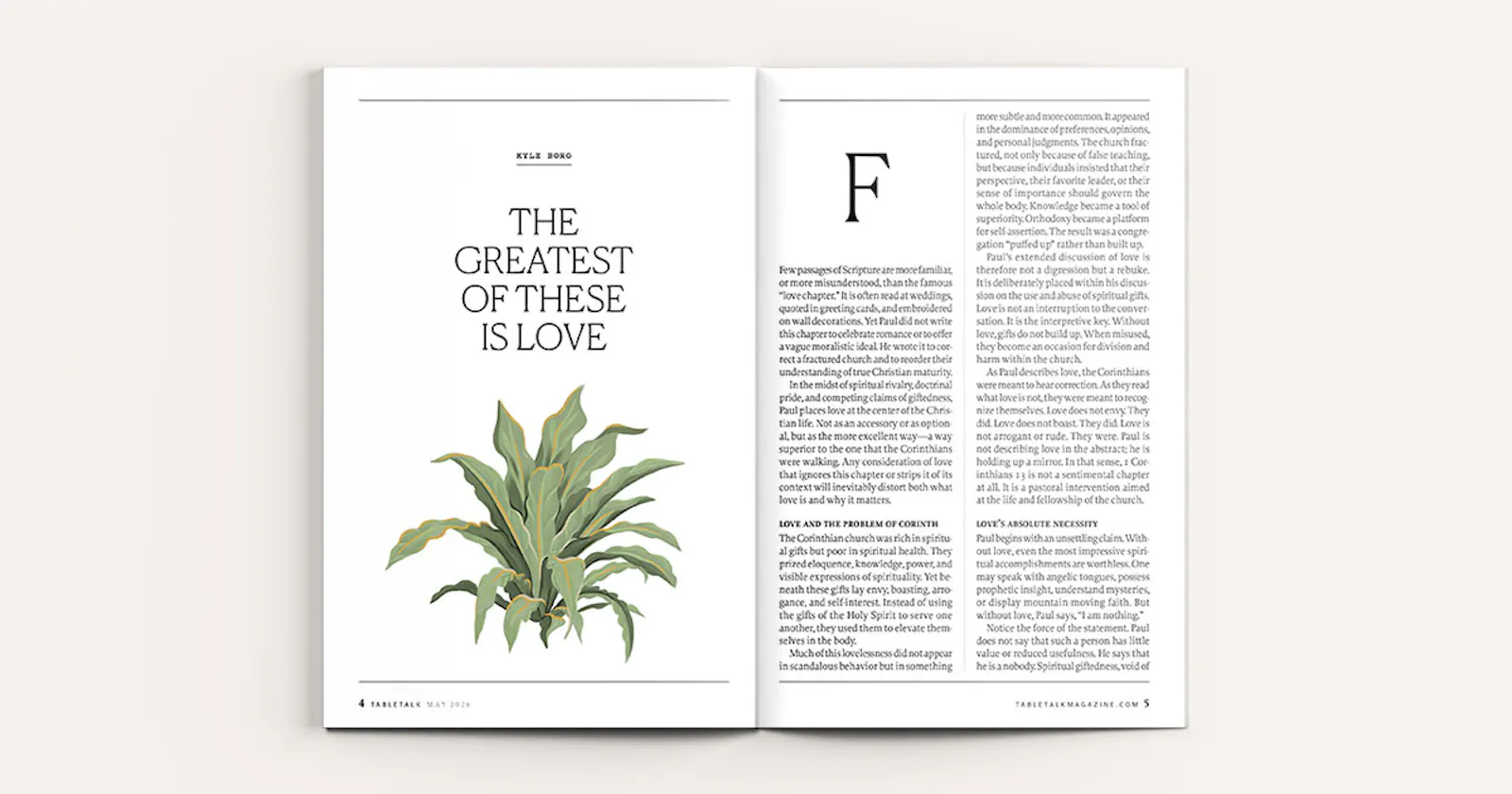
Few passages of Scripture are more familiar, or more misunderstood, than the famous “love chapter.” It is often read at weddings, quoted in greeting cards, and embroidered on wall decorations. Yet Paul did not write this chapter to celebrate romance or to offer a vague moralistic ideal. He wrote it to correct a fractured church and to reorder their understanding of true Christian maturity.
In the midst of spiritual rivalry, doctrinal pride, and competing claims of giftedness, Paul places love at the center of the Christian life. Not as an accessory or as optional, but as the more excellent way—a way superior to the one that the Corinthians were walking. Any consideration of love that ignores this chapter or strips it of its context will inevitably distort both what love is and why it matters.
love and the problem of corinth
The Corinthian church was rich in spiritual gifts but poor in spiritual health. They prized eloquence, knowledge, power, and visible expressions of spirituality. Yet beneath these gifts lay envy, boasting, arrogance, and self-interest. Instead of using the gifts of the Holy Spirit to serve one another, they used them to elevate themselves in the body.
Much of this lovelessness did not appear in scandalous behavior but in something more subtle and more common. It appeared in the dominance of preferences, opinions, and personal judgments. The church fractured, not only because of false teaching, but because individuals insisted that their perspective, their favorite leader, or their sense of importance should govern the whole body. Knowledge became a tool of superiority. Orthodoxy became a platform for self-assertion. The result was a congregation “puffed up” rather than built up.
Paul’s extended discussion of love is therefore not a digression but a rebuke. It is deliberately placed within his discussion on the use and abuse of spiritual gifts. Love is not an interruption to the conversation. It is the interpretive key. Without love, gifts do not build up. When misused, they become an occasion for division and harm within the church.
As Paul describes love, the Corinthians were meant to hear correction. As they read what love is not, they were meant to recognize themselves. Love does not envy. They did. Love does not boast. They did. Love is not arrogant or rude. They were. Paul is not describing love in the abstract; he is holding up a mirror. In that sense, 1 Corinthians 13 is not a sentimental chapter at all. It is a pastoral intervention aimed at the life and fellowship of the church.
love’s absolute necessity
Paul begins with an unsettling claim. Without love, even the most impressive spiritual accomplishments are worthless. One may speak with angelic tongues, possess prophetic insight, understand mysteries, or display mountain-moving faith. But without love, Paul says, “I am nothing.”
Notice the force of the statement. Paul does not say that such a person has little value or reduced usefulness. He says that he is a nobody. Spiritual giftedness, void of love, empties a person rather than making him something.
Paul presses the point further. Even acts of extreme generosity or personal sacrifice—such as giving away all of one’s possessions or surrendering one’s body—can be worthless if they are not motivated by love. The issue is not the costliness of the act but the orientation of the heart. Self-sacrifice can still be self-directed. Generosity can still seek recognition, be a means of control, or give moral leverage. Without love, even the most dramatic acts of devotion gain nothing.
This cuts against a deeply ingrained instinct. We are prone to measuring spiritual maturity by visibility, intensity, or sacrifice. Paul insists that love—not giftedness, not knowledge, not zeal—is the essential mark of Christian maturity. Gifts matter. Sacrifice matters. But without love, none of it counts.
what love is and is not
Paul then turns to the character of love itself. It is crucial to remember that love is not a free-floating or self-defined thing. In the Bible, the Holy Spirit gives us a God-determined description of love. Paul begins positively: “Love is patient and kind” (v. 4). These two qualities belong together. Patience is love’s restraint; kindness is love’s initiative. Love does not merely suffer long with others; it actively seeks their good while bearing patiently with them.
Yet Paul spends more time defining love negatively than positively. Love does not envy or boast. It is not arrogant or rude. It does not insist on its own way. This is not because Paul is being negative but because love doesn’t have a simple definition. It must be known not only by what it does but also by what it refuses to do.
One striking feature of Paul’s description is that love is defined largely by verbs rather than adjectives. Love is not a mood or disposition. It is not mere affection or sentiment. It acts. It waits. It gives itself. It refuses certain postures and patterns of behavior for the sake of others.
Envy resents the good of another; love rejoices in it. Boasting draws attention to the self; love is content to labor unseen. Arrogance inflates self-importance; love walks in humility. Rudeness disregards what is appropriate and honorable in the way it treats another; love treats others with dignity.
At its core, love is fundamentally other- oriented. It is not preoccupied with self- assertion or self-protection. Paul says that love “does not insist on its own way,” using deliberately broad language. “Its own way” is open-ended. Rights. Preferences. Recognition. Control. Nothing belonging to the self is exempt.
love, truth, and self-denial
This insistence on self-denial places love in direct opposition to modern ideas of personal fulfillment. We are accustomed to thinking of love as self-expression or self-validation. Paul presents it as self-surrender.
Yet even in surrender, love is not morally indifferent. Paul is explicit: Love “does not rejoice at wrongdoing, but rejoices with the truth” (v. 6). Love does not redefine good and evil for the sake of peace. It does not affirm sin in the name of compassion. Love’s reflex is joy, not in what is evil, but in what is good, true, and right before God. At its heart, love delights first in what pleases God and then in what genuinely promotes the good of others.
Because love is bound to truth, it is capable of both forgiveness and confrontation. Love covers sins not by denying them but by refusing to keep a record of wrongs. It overlooks offenses, yet it also seeks repentance and restoration. This covering love flows from the gospel itself. Those whose sins have been fully dealt with by Christ are freed to extend patience, restraint, and forgiveness toward one another.
In this way, love guards the church from two opposite dangers: cruelty disguised as truthfulness and compromise disguised as kindness.
love’s endurance
Paul concludes his description with four sweeping claims. “Love bears all things, believes all things, hopes all things, endures all things” (v. 7). These statements are not blind optimism. Paul is not suggesting that love ignores reality or suspends discernment. He is describing love’s resilience.
Love bears burdens rather than fleeing from them. Love believes, not in the sense of gullibility, but in its refusal to default to cynicism. Love hopes, not because circumstances guarantee improvement, but because God is faithful and continues to work. Love endures, not because it is easy, but because it is anchored in something greater than present conditions.
These qualities remind us that love is neither effortless nor sentimental. It is demanding. It calls for perseverance in relationships that are often strained, disappointing, or painful. Love continues, not because the other deserves it, but because God is faithful and sustains it.
love’s permanence and priority
Finally, Paul contrasts love with spiritual gifts by highlighting love’s permanence. Prophecies will pass away. Tongues will cease. Knowledge will fade. “Love never ends” (v. 8).
Gifts belong to the present age, when we see dimly and know in part. Love belongs not only to this age but to the age to come. Faith will give way to sight, and hope will give way to fulfillment, but love will remain. As Jonathan Edwards famously said, “Heaven is a world of love.” The life of love to which Paul calls the church now is a foretaste of our future communion with God and with one another.
walking the more excellent way
Paul’s message to the Corinthians is as necessary today as it was in the first century. Churches still struggle with pride, rivalry, and self-promotion. Christians still confuse giftedness with maturity and sacrifice with love.
First Corinthians 13 cuts through these confusions. It reminds us that love is not optional, ornamental, or sentimental. It is demanding, costly, and essential. Without it, we gain nothing; we are nothing.
Yet this chapter does more than expose our lovelessness; it also directs us to hope. The love that Paul describes is not a bare obligation but a gracious privilege, and it is a love that the Holy Spirit has promised to work in the hearts of God’s people. Driven to Christ for forgiveness and dependent on the Spirit for transformation, the church is called to walk the most excellent way. It is the way that reflects the very character of God in our relationships, builds up His church, and endures forever.