

Request your free, three-month trial to Tabletalk magazine. You’ll receive the print issue monthly and gain immediate digital access to decades of archives. This trial is risk-free. No credit card required.
Try Tabletalk NowAlready receive Tabletalk magazine every month?
Verify your email address to gain unlimited access.
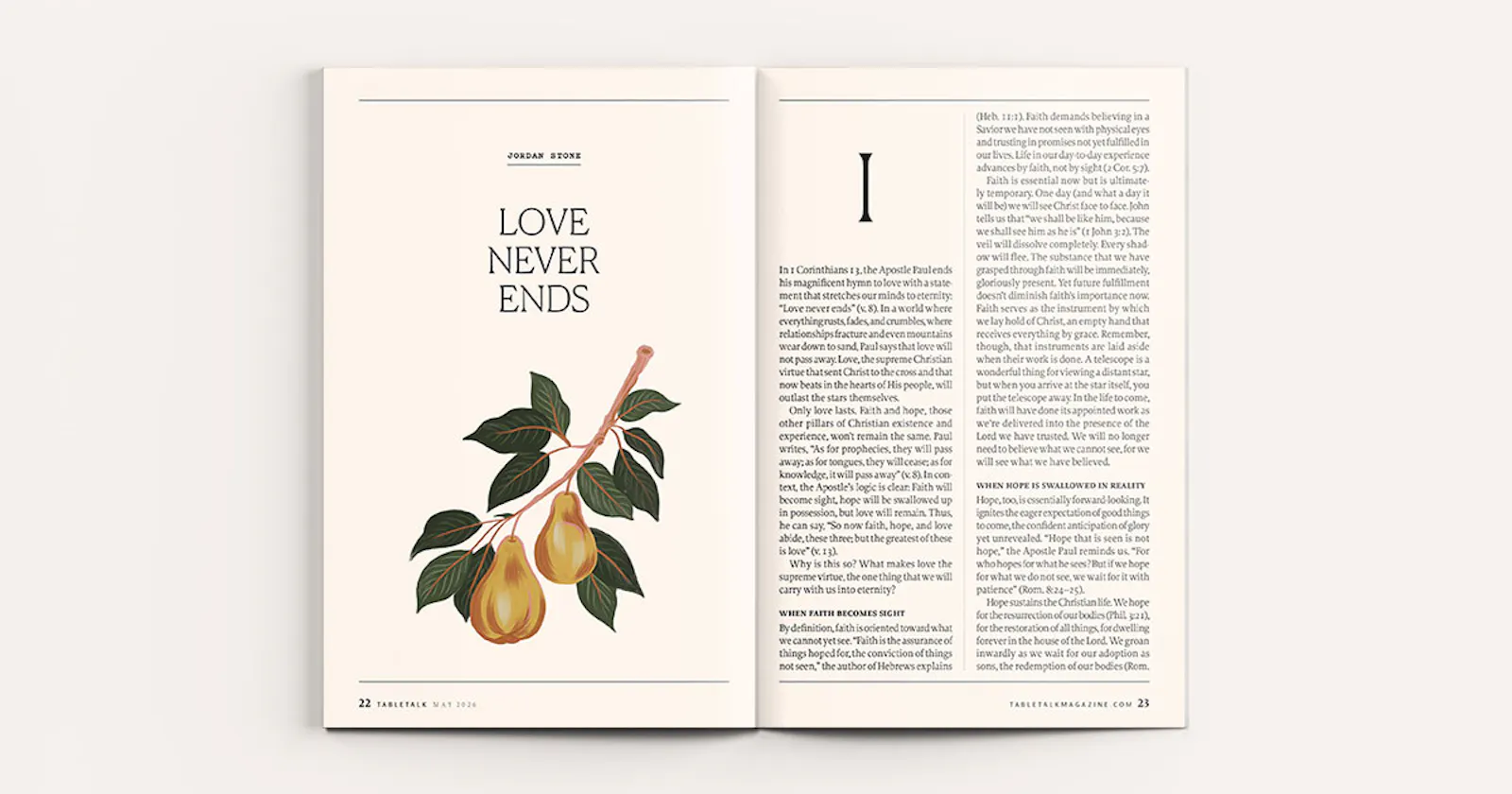
In 1 Corinthians 13, the Apostle Paul ends his magnificent hymn to love with a statement that stretches our minds to eternity: “Love never ends” (v. 8). In a world where everything rusts, fades, and crumbles, where relationships fracture and even mountains wear down to sand, Paul says that love will not pass away. Love, the supreme Christian virtue that sent Christ to the cross and that now beats in the hearts of His people, will outlast the stars themselves.
Only love lasts. Faith and hope, those other pillars of Christian existence and experience, won’t remain the same. Paul writes, “As for prophecies, they will pass away; as for tongues, they will cease; as for knowledge, it will pass away” (v. 8). In context, the Apostle’s logic is clear: Faith will become sight, hope will be swallowed up in possession, but love will remain. Thus, he can say, “So now faith, hope, and love abide, these three; but the greatest of these is love” (v. 13).
Why is this so? What makes love the supreme virtue, the one thing that we will carry with us into eternity?
when faith becomes sight
By definition, faith is oriented toward what we cannot yet see. “Faith is the assurance of things hoped for, the conviction of things not seen,” the author of Hebrews explains (Heb. 11:1). Faith demands believing in a Savior we have not seen with physical eyes and trusting in promises not yet fulfilled in our lives. Life in our day-to-day experience advances by faith, not by sight (2 Cor. 5:7).
Faith is essential now but is ultimately temporary. One day (and what a day it will be) we will see Christ face-to-face. John tells us that “we shall be like him, because we shall see him as he is” (1 John 3:2). The veil will dissolve completely. Every shadow will flee. The substance that we have grasped through faith will be immediately, gloriously present. Yet future fulfillment doesn’t diminish faith’s importance now. Faith serves as the instrument by which we lay hold of Christ, an empty hand that receives everything by grace. Remember, though, that instruments are laid aside when their work is done. A telescope is a wonderful thing for viewing a distant star, but when you arrive at the star itself, you put the telescope away. In the life to come, faith will have done its appointed work as we’re delivered into the presence of the Lord we have trusted. We will no longer need to believe what we cannot see, for we will see what we have believed.
when hope is swallowed in reality
Hope, too, is essentially forward-looking. It ignites the eager expectation of good things to come, the confident anticipation of glory yet unrevealed. “Hope that is seen is not hope,” the Apostle Paul reminds us. “For who hopes for what he sees? But if we hope for what we do not see, we wait for it with patience” (Rom. 8:24–25).
Hope sustains the Christian life. We hope for the resurrection of our bodies (Phil. 3:21), for the restoration of all things, for dwelling forever in the house of the Lord. We groan inwardly as we wait for our adoption as sons, the redemption of our bodies (Rom. 8:23). Hope sustains us through suffering, anchors us in storms, and lifts our eyes above the brutal facts of a fallen world to the glorious certainties of God’s promises.
But hope, by its very nature, also won’t last forever. When the thing hoped for arrives, hope transforms into something else—the joyful satisfaction of possession. You don’t hope for what you already have. When we see the new heavens and the new earth, when we receive our glorified bodies, when every tear is wiped away and death itself is thrown into the lake of fire (Rev. 21:4), what will remain to hope for? All will be consummated. Everything will be complete. Hope will have brought us home, and our eternal home is where hope is put to rest.
why love abides forever
Love is different. Love is not mainly about our need for salvation. Love is about relationship, one rooted in God Himself. John explains, “God is love” (1 John 4:8). It is of His very nature to love. The Father loves the Son. The Son loves the Father. The Spirit proceeds as the eternal love of the Father and Son. Love is essential to the inner life of God, and God is eternal, unchanging, infinite. If God is love, and God never ends, then love never ends.
When we love, we reflect the character of our Creator. We were created to love. Sin corrupted this capacity, twisting love into self-serving desire and idolatrous attachment. Yet grace restores our love. The indwelling Spirit is transforming us into Christ’s image, which means that we are being formed into people who love truly, with all our heart, soul, mind, and strength, and who love our neighbors as ourselves (Matt. 22:37–39; Mark 12:30–31).
Such holy love will flourish all the more when we see Christ clearly. “Now I know in part; then I shall know fully, even as I have been fully known,” Paul writes (1 Cor. 13:12). Our love for God will deepen infinitely when we comprehend more fully the height and depth and length and breadth of His love for us (Eph. 3:18). Our love for one another will grow richer when we see each other as glorified, perfected, fully ourselves yet completely Christ’s.
Therefore, love doesn’t become obsolete when its object is fully present. It intensifies. A lover doesn’t stop loving when the beloved enters the room. Rather, the love blazes brighter. When we stand before Christ, when we dwell in the city whose architect and builder is God (Heb. 11:10), when we walk among the redeemed from every tribe and tongue (Rev. 5:9), love won’t dissipate. Love will blossom into its glorified state. Love will be the atmosphere we breathe, the language we speak, and the activity that fills eternity. As Jonathan Edwards explained so memorably, heaven is “a world of love.”
love in the new heavens and new earth
What will love look like in the new creation? We will love God with undivided hearts. Every competing affection will have vanished, and every idol, disintegrated. We will see Him as He is, and adoring love will flood our souls. Worship will be effortless, joy constant, and gratitude unending. We will love Him not out of duty but out of delight, as we finally behold Him who is altogether lovely.
Furthermore, we will love one another without the distortions of sin. No more jealousy. No more wounded pride. No more bitterness or betrayal. We will serve one another gladly and rejoice in one another’s glory. Christ’s body will function perfectly; every member will contribute his part, and love will suffuse the whole of redeemed humanity. And perhaps most wonderfully, we will be loved perfectly forever. God’s love for us will be manifest in ways that we can scarcely imagine. We will know, deeply and constantly, that we are beloved. The insecurities that plague us now, the doubts about our worth, the fear of rejection—all of it will be gone. We will rest secure in God’s love. Perfect security will free us unto full and forever love.
living in light of forever love
The love that never ends isn’t only about a future reality. It has everything to do with how we live now. If love is the one thing that will last, should not love reign supreme in our lives?
Paul understood this. After his soaring description of love’s eternal nature, he commands the Corinthians to “pursue love” (1 Cor. 14:1). Make it your aim. Chase after it. Live faithful to the Apostle’s command: “Let love be genuine” (Rom. 12:9). Every act of genuine love that we perform now fits our souls for heaven. When we love our spouses faithfully, when we serve our neighbors sacrificially, when we forgive those who wrong us, and when we show patience with difficult people, we are doing something that will echo in eternity. We are practicing for heaven. We are becoming the kind of people who will be at home in a world where love is all.
Faith will become sight. Hope will be fulfilled. But love will never end. Let us, then, be people of love—not sentimental or shallow love, but the robust, Christ-shaped, cross-bearing love that reflects God’s heart. Let us carry this love through the gates of death and into the Lord’s glorious presence, where love never ends.