
Request your free, three-month trial to Tabletalk magazine. You’ll receive the print issue monthly and gain immediate digital access to decades of archives. This trial is risk-free. No credit card required.
Try Tabletalk NowAlready receive Tabletalk magazine every month?
Verify your email address to gain unlimited access.
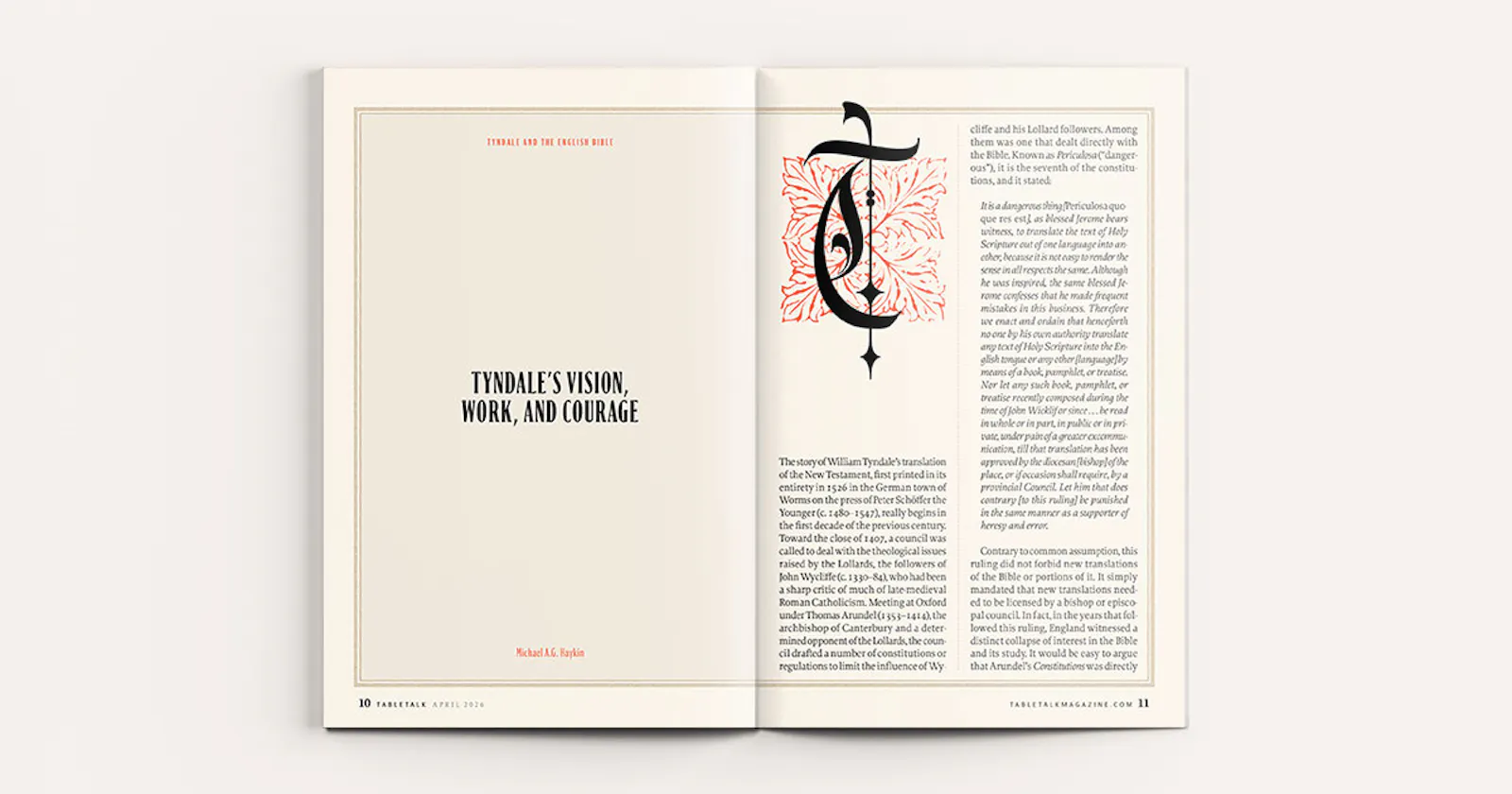
The story of William Tyndale’s translation of the New Testament, first printed in its entirety in 1526 in the German town of Worms on the press of Peter Schöffer the Younger (c. 1480–1547), really begins in the first decade of the previous century. Toward the close of 1407, a council was called to deal with the theological issues raised by the Lollards, the followers of John Wycliffe (c. 1330–84), who had been a sharp critic of much of late-medieval Roman Catholicism. Meeting at Oxford under Thomas Arundel (1353–1414), the archbishop of Canterbury and a determined opponent of the Lollards, the council drafted a number of constitutions or regulations to limit the influence of Wycliffe and his Lollard followers. Among them was one that dealt directly with the Bible. Known as Periculosa (“dangerous”), it is the seventh of the constitutions, and it stated:
It is a dangerous thing [Periculosa quoque res est], as blessed Jerome bears witness, to translate the text of Holy Scripture out of one language into another, because it is not easy to render the sense in all respects the same. Although he was inspired, the same blessed Jerome confesses that he made frequent mistakes in this business. Therefore we enact and ordain that henceforth no one by his own authority translate any text of Holy Scripture into the English tongue or any other [language] by means of a book, pamphlet, or treatise. Nor let any such book, pamphlet, or treatise recently composed during the time of John Wicklif or since . . . be read in whole or in part, in public or in private, under pain of a greater excommunication, till that translation has been approved by the diocesan [bishop] of the place, or if occasion shall require, by a provincial Council. Let him that does contrary [to this ruling] be punished in the same manner as a supporter of heresy and error.
Contrary to common assumption, this ruling did not forbid new translations of the Bible or portions of it. It simply mandated that new translations needed to be licensed by a bishop or episcopal council. In fact, in the years that followed this ruling, England witnessed a distinct collapse of interest in the Bible and its study. It would be easy to argue that Arundel’s Constitutions was directly responsible for this, but that does not appear to be the case.
By the 1510s, however, this situation began to change radically. With the printing of the Greek New Testament of Erasmus (c. 1466–1536) by the renowned Basel publisher Johann Froben (c. 1460–1527), a new age had dawned, one marked by a fresh fascination with the Bible. The five editions of Erasmus’ New Testament that were published in his lifetime (1516, 1519, 1522, 1527, and 1535) were reprinted sixty-nine times, which amounts to a printing once every four months for twenty years. George Faludy reckoned that by 1536, according to “the most conservative estimates more than three hundred thousand copies were in circulation.” Moreover, in his preface to the early editions of his New Testament, “Exhortation to the Pious Reader,” Erasmus explicitly called for vernacular translations of the Scriptures:
I completely disagree with those who are unwilling that Holy Scripture, translated into the people’s tongue, should be read by the unlearned, as if Christ taught such convoluted matters that they can scarcely be understood by a few theologians, or as if the bulwark of Christian religion consisted in its not being known. . . . I would like all women, even the humblest, to read the Gospels and the letters of St. Paul. I wish that they were translated into all languages, so that they could be read and understood not only by the Scots and the Irish but also by Turks and Saracens. . . . I wish that the farmer would sound out snatches of Scripture at his plough, that the weaver would chant some verses at his loom, that the traveller would relieve the weariness of the journey with Bible tales.
Not surprisingly, in response to this Erasmian call for the translation of the Bible into the vernacular, some in England went back to the 1407 constitution Periculosa and interpreted it to mean that Erasmus’ call was expressly forbidden by the fifteenth-century regulation. Braving this interpretation of Periculosa was William Tyndale (c.1490/1494–1536), whose courage in this regard changed the course of history for all English-speaking peoples. Little wonder that the article on him in the famous eleventh edition of the Encyclopædia Britannica states that he was “one of the greatest forces of the English Reformation,” a man whose writings “helped to shape the thought of the Puritan party in England.”
“to establish the lay people in . . . truth”
While several villages in Gloucestershire claim to be Tyndale’s initial home, the most likely are North Nibley and Stinchcombe. Although little is known about his family and upbringing, there is good evidence in Tyndale’s works that he grew up in a loving home. Indeed, the Tyndale scholar Ralph Werrell has argued that young Tyndale may well have been influenced by the Lollards, which would have provided an English root to his desire to see the Scriptures translated into his native tongue.
Tyndale went up to Oxford in 1506 and subsequently received his B.A. in 1512 and his M.A. in 1515. During these studies, he encountered the works of Erasmus, who by the 1510s was the most famous literary figure in Western Europe. In the following decade, Tyndale actually translated The Handbook of the Christian Soldier, which Erasmus had written in 1501. At some point, it also appears that Tyndale was in Cambridge, where he may have come to embrace evangelical convictions and the need for reforming the church, since this university town was ground zero for the English Reformation.
In 1521, he moved back to his native Gloucestershire to become a chaplain and private tutor in the home of Sir John Walsh at Little Sodbury Manor, a Cotswold estate twelve or so miles south of Stinchcombe. It was while in Walsh’s employ that Tyndale came to see that the printing of the New Testament in Greek was but a vital first step in reforming the church. Since it was in Greek, it remained a closed book to all who were not scholars and who could not read that language. Tyndale therefore became determined to translate God’s Word into English.
In strong contrast to medieval Roman Catholicism, whose piety was focused on the proper performance of certain external actions, the Reformers emphasized that at the heart of Christianity was faith, which presupposed an understanding of what was believed. Knowledge of the Scriptures was therefore essential to Christian spirituality. Thus, Tyndale stated, “I . . . perceived by experience, how that it was impossible to establish the lay people in any truth, except the Scripture were plainly laid before their eyes in their mother tongue.”
Tyndale had probably begun his translation of the New Testament while staying in the Walsh home. Possibly mindful of the 1407 constitution about having a translation endorsed by a bishop, he initially sought out the patronage of the bishop of London, Cuthbert Tunstall (1474–1559), who was known as a friend of Erasmus. Tunstall wanted nothing to do with such a translation, though, and Tyndale realized that he would have to go abroad to the Continent to undertake his work of translation. So in April 1524, he sailed from England for the port of Hamburg, Germany, little knowing that he would never see his native land again.
“preache it unto al creatures”
Tyndale appears to have spent a year or so in Wittenberg, where he met the great German Reformer Martin Luther (1483–1546). Tyndale could have stayed in Wittenberg and translated the Scriptures in relative security with all the scholarly aids that he needed. Instead, he chose to go to Cologne, a Roman Catholic town, one of the three great trading ports of northeastern Europe. The major reason for the move undoubtedly had to do with the fact that Cologne was on the Rhine River. The Rhine flowed into the North Sea, and boats came there regularly on trading trips from England. Understandably, Tyndale wanted his translated Scriptures to be taken to England, where they could be read. An English translation would do very little good in the heart of Germany.
In Cologne, he finished his translation of the New Testament from the Greek. Accompanying it were marginal notes, many of which he took from Martin Luther’s translation of the Scriptures into German—an indication of his use of Luther’s German New Testament, which had appeared in 1522. All that has survived, however, is a manuscript up to Matthew 22, since, just as he was about to have it printed in the print shop of Peter Quentel (d. 1546), he was betrayed to Roman Catholic authorities. Tyndale managed to escape with his translation and made his way up the Rhine to Worms.
It was in Worms, on the printing press of Peter Schöffer Jr.—a master printer like his father, who had been trained by Johann Gutenberg (c. 1400–1468)—that three or six thousand copies of the first printed New Testament to be translated into English out of the original Greek were run off. It was a small octavo—that is, each printed sheet of paper was folded three times to form a quire, or set of sixteen pages, which was then bound with the rest of the quires of the book. Unlike the Cologne translation, the Worms edition contained no marginal notes, though Tyndale would reintroduce such notes in his definitive 1534 edition. Nor was there a prologue. There were no verse divisions, which did not come into vogue until the 1550s, only simple chapter breaks.
Up until November 1996, the details of the title page were unknown, since neither of the two surviving copies of the 1526 Tyndale New Testament contained one. One of these copies is in St. Paul’s Cathedral in London but is lacking seventy-one of its pages. The other copy, now held by the British Library, was once housed in the library of Bristol Baptist College, the oldest Baptist seminary in the world. It had once belonged to the personal library of Andrew Gifford Jr. (1700–1784), a London Baptist minister. The British Library purchased this copy from the Baptist seminary for a million pounds in 1994. Brian Lang, the chief executive of the British Library at the time, described the purchase as “certainly the most important acquisition in our 240-year history.” In 1996, however, a third copy, complete with the original title page, was discovered in the Württembergische Landesbibliothek in Stuttgart. The title page on this copy does not contain Tyndale’s name but simply states:
The newe Testament as it was written and caused to be written by them which herd yt. To whom also oure saveoure Christ Jesus commanded that they shulde preache it unto al creatures.
Tyndale’s missionary passion is clearly evident.
The New Testaments were then smuggled back into England on boats, hidden in bales of cloth and other innocent- looking containers. Tyndale’s dream of giving the common person the Word of God had started to become a reality. They were soon being sold openly in England for the equivalent of a week’s wages for a laborer like a bricklayer or carpenter. A response from church authorities, however, was not slow in coming. When word of Tyndale’s translation reached the ears of Cuthbert Tunstall, he ordered the scouring of boats coming into English harbors and ports for the precious books. Many of the New Testaments were seized or even bought, and Tunstall had them publicly burned in the heart of London in 1530. This led another friend of Erasmus, the powerful Thomas More (1478–1535), to declare that Tyndale was now the “captain of our Englyshe heretickes.” Ironically, the money that was paid for the copies eventually found its way back to Tyndale, who simply used it to finance another edition.
There is little doubt that Tyndale had a solid handle on the Greek language, its idioms, its shades of meaning, and its idiosyncrasies. A good example of his knowledge of Greek is found in Philemon 7, which Tyndale rightly translates in his 1534 edition, “For by thee (brother) the saints’ hearts are comforted.” Nearly a hundred years later, the King James Version translators rendered this verse as “the bowels [Greek splanchna] of the saints are refreshed by thee, brother,” translating the underlying Greek word literally. Tyndale, however, rightly recognized that the word is a metaphor for “heart.”
Equally important was his impressive grasp of the words and rhythms of the spoken English of his day. He knew how to render the Scriptures into the English vernacular so that they spoke with force and power. Tyndale aimed for clear, everyday, spoken English that would affect the minds and affections of his readers. In Hebrews 12:16, for example, instead of the KJV’s “as Esau, who for one morsel of meat sold his birthright,” Tyndale has Esau selling his birthright “for one breakfast.”
Many of his words and phrases have also become part of everyday English—words and phrases such as “peacemaker,” “longsuffering,” the “salt of the earth,” “fight the good fight,” “God forbid,” “the spirit is willing,” “there were shepherds abiding in the fields,” and “this thy brother was dead, and is alive again: and was lost, and is found.” Moreover, Tyndale’s translation of the New Testament was so good that when the KJV translators came to fashion a new translation at the start of the seventeenth century, they went back to Tyndale’s work and used no less than 90 percent of it, which also speaks volumes for his grasp of both Greek and English.
After completing the translation of the New Testament, Tyndale turned his attention to the Old. His translation of Genesis, which appeared in 1530, was the first English translation ever made from a Hebrew text. Only a tiny handful of Oxford and Cambridge scholars, if any at all, knew this language. In fact, most of the ordinary population would have been astonished to discover that Hebrew had anything to do with the Bible. All of their religion was wrapped up in Latin. Translations of a number of other books of the Old Testament followed, including the rest of the Pentateuch in 1530 and Jonah in 1531.
We have no idea where Tyndale learned Hebrew. It is quite unlikely that he learned it in England, since so little Hebrew was known there in the 1520s. The entire Jewish community in England had been driven out of the island in 1290, and the Jews would not be readmitted to the country until the 1650s, during the regime of Oliver Cromwell. Furthermore, Hebrew studies began to take root in England only during the reigns of Elizabeth I (r. 1558–1603) and James I (r. 1603–25). He had to have learned it, therefore, on the Continent, probably in Germany. David Daniell suggests that Tyndale may have studied Hebrew at Wittenberg when he was there in the mid-1520s. As with the Greek New Testament, Tyndale displays a wonderful facility for rendering the Hebrew Scriptures—a linguistic world utterly unlike any other in Europe at that time—into English. Terms that he coined, such as “Jehovah,” “Passover,” “scapegoat,” “shewbread,” and “mercy seat,” have become a part of standard English.
“lord, open the king of england’s eyes”
By the early 1530s, Tyndale was living in Antwerp, whence the smuggling of the Scriptures across to England could be easily carried out. In 1535, he was hard at work on translating the books of Joshua to 2 Chronicles, as well as making some minor revisions to his 1534 New Testament. The translation had not yet progressed beyond the manuscript stage when he was arrested on May 21, 1534. Tyndale was betrayed into the hands of Roman Catholic authorities. He was imprisoned in the infamous prison of Vilvorde, six miles north of Brussels. There he was put on trial for heresy—specifically for being a Lutheran—found guilty, and condemned to be burned to death. Two word-pictures from the last year of his life reveal the character of the man.
The first comes from a letter that he wrote in the Vilvorde prison in the autumn of 1535. It was found during the last century and is the only surviving example of his handwriting. Writing to the governor of the prison, the Marquis of Bergen, Tyndale requested
a lamp in the evening; it is indeed wearisome sitting alone in the dark. But most of all I beg and beseech your clemency to . . . permit me to have the Hebrew bible, Hebrew grammar and Hebrew dictionary, that I may pass the time in that study.
To the end, Tyndale was intent on the study and translation of God’s Word. It is unlikely that his petition was granted.
The other word-picture comes from the day of his death, traditionally October 6, 1536. The executioner, in an act of mercy to Tyndale, strangled him before he lit the wood piled around him. According to the martyrologist John Foxe, the last words that Tyndale was heard to utter were “Lord, open the King of England’s eyes.” The king, Henry VIII (r. 1509–47), had been firmly opposed to the free circulation of Tyndale’s translation, but within a year of Tyndale’s death, his New Testament was being openly published in England, though not under his name. That Tyndale was not recognized as the translator would not have bothered him at all.
“i did my duty”
A few years before his martyrdom, Tyndale had written the following in the preface to his book A Treatise of the Justification by Faith only, otherwise called the Parable of the Wicked Mammon (1528) regarding his translation of the New Testament:
Some man will ask peradventure, Why I take the labour to make this work, inasmuch as they will burn it, seeing they burnt the Gospel? I answer, in burning the New Testament they did none other thing than that I looked for: no more shall they do, if they burn me also, if it be God’s will it shall so be. Nevertheless, in translating the New Testament I did my duty.
What a glorious duty that was. Enshrined in the King James Version, his New Testament lived on for centuries after his death. As David Daniell has noted in his definitive biography of Tyndale, it was Tyndale who made the English people a “People of the Book.”