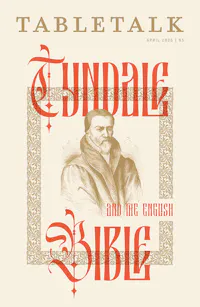

Request your free, three-month trial to Tabletalk magazine. You’ll receive the print issue monthly and gain immediate digital access to decades of archives. This trial is risk-free. No credit card required.
Try Tabletalk NowAlready receive Tabletalk magazine every month?
Verify your email address to gain unlimited access.
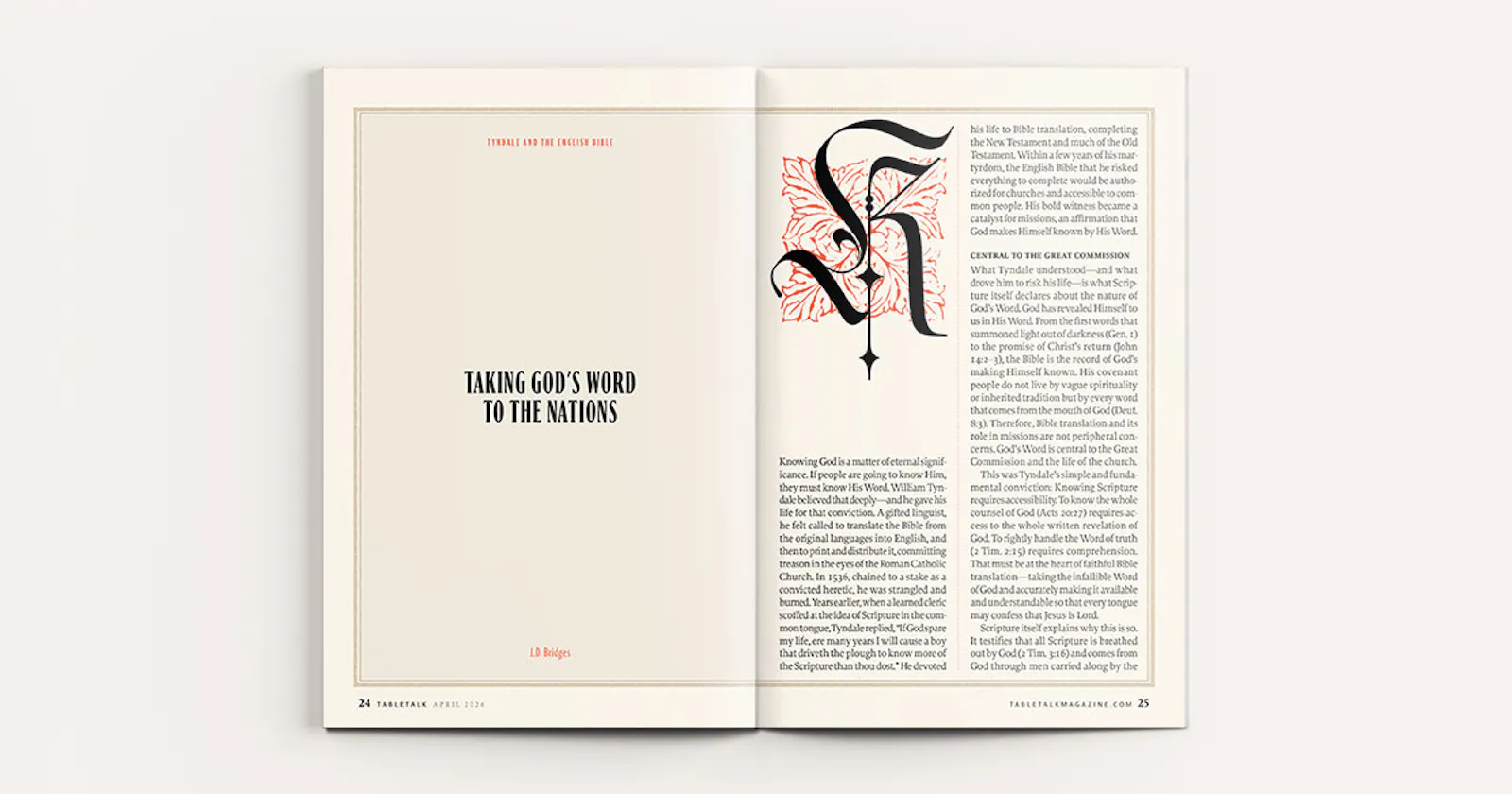
Knowing God is a matter of eternal significance. If people are going to know Him, they must know His Word. William Tyndale believed that deeply—and he gave his life for that conviction. A gifted linguist, he felt called to translate the Bible from the original languages into English, and then to print and distribute it, committing treason in the eyes of the Roman Catholic Church. In 1536, chained to a stake as a convicted heretic, he was strangled and burned. Years earlier, when a learned cleric scoffed at the idea of Scripture in the common tongue, Tyndale replied, “If God spare my life, ere many years I will cause a boy that driveth the plough to know more of the Scripture than thou dost.” He devoted his life to Bible translation, completing the New Testament and much of the Old Testament. Within a few years of his martyrdom, the English Bible that he risked everything to complete would be authorized for churches and accessible to common people. His bold witness became a catalyst for missions, an affirmation that God makes Himself known by His Word.
central to the great commission
What Tyndale understood—and what drove him to risk his life—is what Scripture itself declares about the nature of God’s Word. God has revealed Himself to us in His Word. From the first words that summoned light out of darkness (Gen. 1) to the promise of Christ’s return (John 14:2–3), the Bible is the record of God’s making Himself known. His covenant people do not live by vague spirituality or inherited tradition but by every word that comes from the mouth of God (Deut. 8:3). Therefore, Bible translation and its role in missions are not peripheral concerns. God’s Word is central to the Great Commission and the life of the church.
This was Tyndale’s simple and fundamental conviction: Knowing Scripture requires accessibility. To know the whole counsel of God (Acts 20:27) requires access to the whole written revelation of God. To rightly handle the Word of truth (2 Tim. 2:15) requires comprehension. That must be at the heart of faithful Bible translation—taking the infallible Word of God and accurately making it available and understandable so that every tongue may confess that Jesus is Lord.
Scripture itself explains why this is so. It testifies that all Scripture is breathed out by God (2 Tim. 3:16) and comes from God through men carried along by the Holy Spirit (2 Peter 1:21). God climactically reveals Himself in Jesus Christ, the Word made flesh (John 1:1–14). Translation, then, is indispensable to reaching the nations with the gospel. God is not discovered; He is heard and read. We are sent to proclaim and teach. Access to His Word is not a matter of convenience but is essential to knowing Him and making Him known. The Word has been given to His church to be taken to the nations.
This stewardship of the Word unfolds in a world of many tongues. In Genesis 11, humanity unites in sinful pride, and God’s judgment is to scatter and confuse their language. Yet the Bible’s storyline does not end with a single sacred language to which all nations must conform.
At Pentecost, the Holy Spirit causes people from every nation under heaven to hear the mighty works of God in their own languages (Acts 2:5–11). As God’s sovereign plan is further revealed, we see that linguistic diversity is not reversed but redeemed. The proclamation of the one true gospel will come through every tongue. In the darkness of sin and confusion, faithful translation provides lamps that shine the light of His Word (Ps. 119:105) and gives a foretaste of the day when a redeemed multitude from every language will worship the Lamb (Rev. 5:9; 7:9–10).
translation, understanding, and mission
Since God’s plan culminates in a redeemed multitude from every language, our present responsibility is clear. God’s Word is given to be understood. Therefore, translation is not a luxury but a prerequisite for helping the nations walk by faith and abide in Christ (John 8:31). From Nehemiah, we learn that leaders read from the Book of the Law “clearly” and “gave the sense” so that the people understood (Neh. 8:8). The Apostle Paul insisted that the church’s speech be intelligible (1 Cor. 14:9). People cannot call on Christ if they have not heard the Word of Christ (Rom. 10:14–17). Therefore, mission relies on Scripture’s being available in a language that speaks to the hearts and minds of the people being reached. Bible translation is not an optional support to mission; it is one of its central labors. Before churches from every nation can teach all that Christ commanded, His teaching must be fully available in their language.
Church history bears this out. The truths that we see in Scripture have been confirmed again and again on the front lines of mission. In the early nineteenth century, missionaries from the London Missionary Society arrived in Madagascar. They worked to create a Latin-based alphabet for the local language. Once that was in place, translation began and culminated with the printing of the first portions of Scripture. By 1835, the Malagasy Bible was complete. The work of the missionaries in Bible translation and establishing schools ignited a literacy movement that spread throughout the center of the country, rooting the Christian faith deep among the Malagasy. When the next monarch came into power, she began persecuting the church. Missionaries were expelled and believers were martyred, yet Malagasy Christians continued to cling to and circulate God’s Word in their own tongue. Their enduring witness became both the foundation of a vibrant, indigenous church and a model for missionary efforts across Africa, demonstrating the transformative power of Scripture in the language of a people.
Flowing from examples such as Madagascar—and from Scripture’s own teaching—is the call not only to have the Bible available but to be a people who read and hear it personally. God commanded the Israelites to teach His words diligently to their children, to talk of them at home, and to write them on their doorposts (Deut. 6:4–9). Israel’s kings were to write out the law and read it all the days of their lives (17:18–20). Yet possessing a Bible—and even hearing it read—is not the finish line. The church is called to study, to handle God’s Word with reverent care. Paul urges Timothy to present himself as “rightly handling the word of truth” (2 Tim. 2:15), reminding him that all Scripture is breathed out by God and sufficient to equip for every good work (3:16–17). The Bereans are commended because they “examin[ed] the Scriptures daily” to test what they heard (Acts 17:11). Shallow or incomplete engagement with Scripture leaves churches vulnerable to error, whereas deep immersion produces discernment, endurance, and joy. Translation is the precursor to discipleship.
mission: to the nations
Translating, teaching, and treasuring God’s Word converge in mission. The Great Commission is explicitly a teaching commission: “Make disciples of all nations, . . . teaching them to observe all that I have commanded you” (Matt. 28:18–20). You cannot teach all that Christ commanded without the Scriptures in the language of the discipled. Mission is not merely geographic expansion or humanitarian care; it is the spread of God’s revealed truth so that people might repent, believe, and obey. When churches give, send, go, and labor for Bible translation, pastor training, faithful preaching, and doctrinally rich resources, they are doing the very thing that Christ commanded His church to do.
The Great Commission is a global commission. Jesus commands all disciples everywhere to make disciples regardless of where they live. The call to be Christ’s witnesses to the end of the earth (Acts 1:8) and to make disciples of all nations (Matt. 28:19) is as binding on a Christian in India, the Philippines, or remote Africa as it is on a Christian in the West.
What sustains the costly work of translation and missions is confidence in God’s promise about His Word. He declares that just as rain waters the earth, so His Word will accomplish what He purposes and will not return empty (Isa. 55:10–11). It is living and abiding, the instrument through which God causes people to be born again (1 Peter 1:23–25). It is truth that sanctifies (John 17:17), a fire and a hammer that breaks hard hearts (Jer. 23:29). When that Word is faithfully translated, clearly preached, carefully studied, and courageously lived, God sovereignly gathers worshipers for His Son from the ends of the earth.
These truths explain why the church must care about Bible translation and missions—not because it is trendy but because the God who speaks has commanded us to make His speech known. Tyndale’s resolve that even a plowboy might know the Scriptures is transferable to the nations. Until every tribe and tongue can open the Scriptures and hear the voice of the Shepherd in their own language, the task remains unfinished—and the people of the Word must not grow weary, for their labor in the Word is labor for the everlasting glory of God.