

Request your free, three-month trial to Tabletalk magazine. You’ll receive the print issue monthly and gain immediate digital access to decades of archives. This trial is risk-free. No credit card required.
Try Tabletalk NowAlready receive Tabletalk magazine every month?
Verify your email address to gain unlimited access.
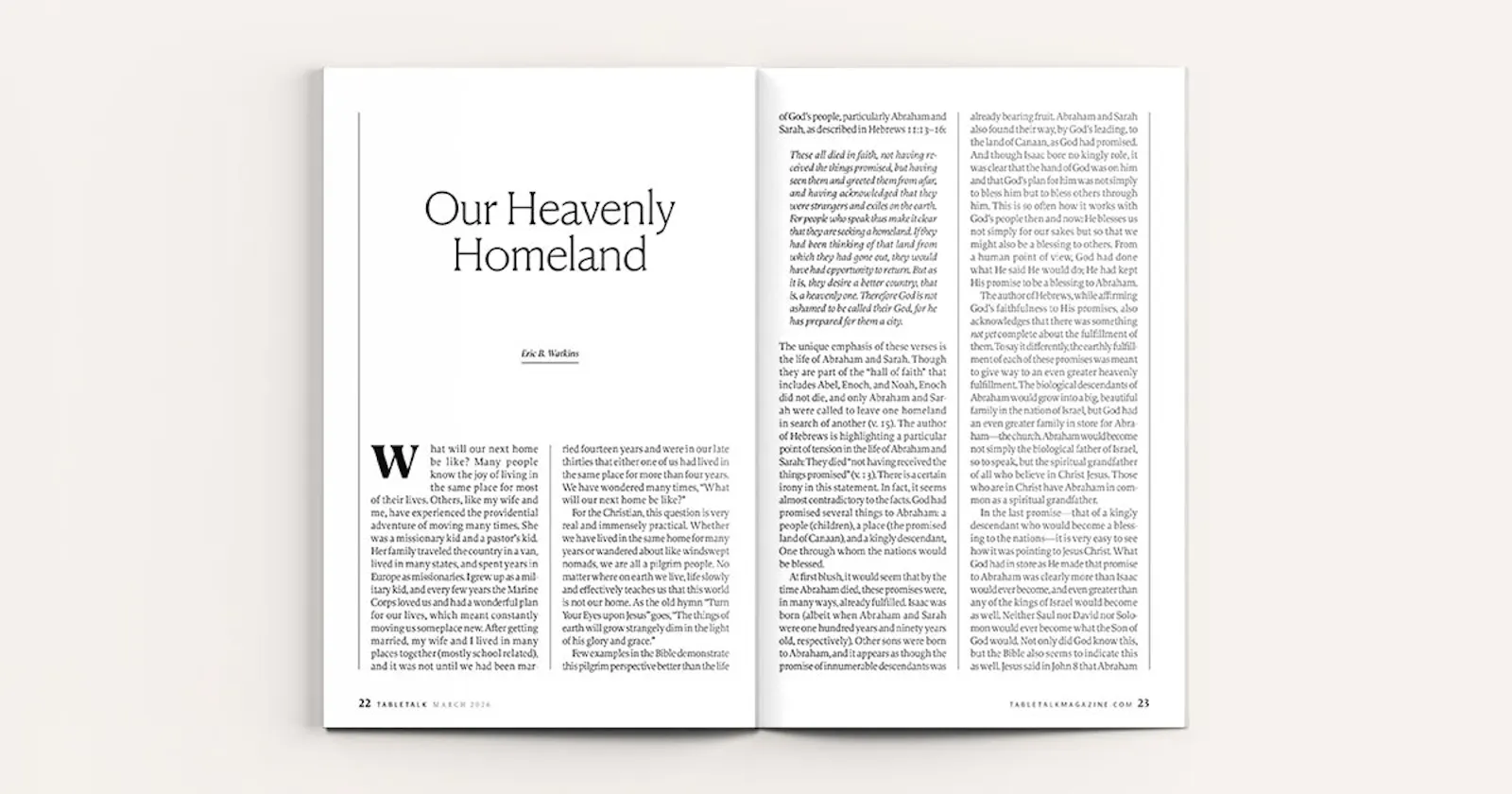
What will our next home be like? Many people know the joy of living in the same place for most of their lives. Others, like my wife and me, have experienced the providential adventure of moving many times. She was a missionary kid and a pastor’s kid. Her family traveled the country in a van, lived in many states, and spent years in Europe as missionaries. I grew up as a military kid, and every few years the Marine Corps loved us and had a wonderful plan for our lives, which meant constantly moving us someplace new. After getting married, my wife and I lived in many places together (mostly school related), and it was not until we had been married fourteen years and were in our late thirties that either one of us had lived in the same place for more than four years. We have wondered many times, “What will our next home be like?”
For the Christian, this question is very real and immensely practical. Whether we have lived in the same home for many years or wandered about like windswept nomads, we are all a pilgrim people. No matter where on earth we live, life slowly and effectively teaches us that this world is not our home. As the old hymn “Turn Your Eyes upon Jesus” goes, “The things of earth will grow strangely dim in the light of his glory and grace.”
Few examples in the Bible demonstrate this pilgrim perspective better than the life of God’s people, particularly Abraham and Sarah, as described in Hebrews 11:13–16:
These all died in faith, not having received the things promised, but having seen them and greeted them from afar, and having acknowledged that they were strangers and exiles on the earth. For people who speak thus make it clear that they are seeking a homeland. If they had been thinking of that land from which they had gone out, they would have had opportunity to return. But as it is, they desire a better country, that is, a heavenly one. Therefore God is not ashamed to be called their God, for he has prepared for them a city.
The unique emphasis of these verses is the life of Abraham and Sarah. Though they are part of the “hall of faith” that includes Abel, Enoch, and Noah, Enoch did not die, and only Abraham and Sarah were called to leave one homeland in search of another (v. 15). The author of Hebrews is highlighting a particular point of tension in the life of Abraham and Sarah: They died “not having received the things promised” (v. 13). There is a certain irony in this statement. In fact, it seems almost contradictory to the facts. God had promised several things to Abraham: a people (children), a place (the promised land of Canaan), and a kingly descendant, One through whom the nations would be blessed.
At first blush, it would seem that by the time Abraham died, these promises were, in many ways, already fulfilled. Isaac was born (albeit when Abraham and Sarah were one hundred years and ninety years old, respectively). Other sons were born to Abraham, and it appears as though the promise of innumerable descendants was already bearing fruit. Abraham and Sarah also found their way, by God’s leading, to the land of Canaan, as God had promised. And though Isaac bore no kingly role, it was clear that the hand of God was on him and that God’s plan for him was not simply to bless him but to bless others through him. This is so often how it works with God’s people then and now: He blesses us not simply for our sakes but so that we might also be a blessing to others. From a human point of view, God had done what He said He would do; He had kept His promise to be a blessing to Abraham.
The author of Hebrews, while affirming God’s faithfulness to His promises, also acknowledges that there was something not yet complete about the fulfillment of them. To say it differently, the earthly fulfillment of each of these promises was meant to give way to an even greater heavenly fulfillment. The biological descendants of Abraham would grow into a big, beautiful family in the nation of Israel, but God had an even greater family in store for Abraham—the church. Abraham would become not simply the biological father of Israel, so to speak, but the spiritual grandfather of all who believe in Christ Jesus. Those who are in Christ have Abraham in common as a spiritual grandfather.
In the last promise—that of a kingly descendant who would become a blessing to the nations—it is very easy to see how it was pointing to Jesus Christ. What God had in store as He made that promise to Abraham was clearly more than Isaac would ever become, and even greater than any of the kings of Israel would become as well. Neither Saul nor David nor Solomon would ever become what the Son of God would. Not only did God know this, but the Bible also seems to indicate this as well. Jesus said in John 8 that Abraham saw Christ’s day and rejoiced. What exactly Abraham saw and rejoiced over is a matter of curious speculation. Some commentators suggest that it was when God gave Isaac back to Abraham alive in Genesis 22 that Abraham understood that God was going to do what Abraham did not have to—that God was going to offer up His Son in sacrifice, taking the place of Abraham and taking the place of God’s people. Though this view of what Abraham “saw” cannot be proved, it seems reasonable. Either way, Abraham saw something of Christ’s day that caused him to rejoice. In this, Abraham would die an old man with many children and grandchildren, yet he would know that God still had something better in store for him, something that could find fulfillment only in Jesus.
What was true of these two promises was also true of the land. God had something far greater in store for Abraham and Sarah than real estate in the Holy Land. As good and pleasant as that land was, it was nothing in comparison to the heavenly land above that God had designed not just for Abraham and Sarah but also for all those who look to Him by faith in Christ Jesus. This is the pastoral point of Hebrews 11:13–16. Even during their walks of faith here on earth, Abraham and Sarah knew that they were a pilgrim people. They were “strangers and exiles” (v. 13) here, even while sojourning in the land that God had given them. This was exemplified, according to verses 9–10, in that the entire time that Abraham and Sarah lived in the land of promise, they dwelled in tents. Though the land was his, and Abraham was the “heir of the world” (Rom. 4:13), he lived like a pilgrim, sojourning in tents, indicating to himself, his family, and others that the temporary things of this present evil age were not his everlasting inheritance. God Himself was Abraham’s true reward (Gen. 15:1, KJV)—not just the land, not just children. Nothing that God promised to Abraham was greater than God Himself.
This takes us back to the question at the beginning of this article: What will our next home be like? My wife and I now live in a house and a city in which we would love to grow old. We love the people, the place, and our church family here. We love our home. But what makes a house a home? It’s not the dwelling place—the structure—but the people who live there that make a house into a home. What is so beautiful about heaven is not simply the fact that the effects of the curse (sin, death, and misery) are no longer present; what makes heaven truly heaven is the fact that God Himself is present there. This is what the author of Hebrews is emphasizing. God’s pilgrim people, even while enjoying the good gifts that God had given them, nevertheless realized that the gifts of God paled in comparison to the God of those gifts. They were a pilgrim people, learning to have the eyes of their souls farsightedly fixed on the things of heaven. This is often the struggle of the Christian life—not to fix our gaze on the things that are right in front of us, whether good or bad, but to fix our eyes on Christ and the better things that are yet to come in Him. As Abraham and Sarah fixed their eyes on heavenly things, God was not ashamed of them. He was not ashamed to be called their God, nor is He ashamed of us as we fix our eyes on our heavenly homeland.