

Request your free, three-month trial to Tabletalk magazine. You’ll receive the print issue monthly and gain immediate digital access to decades of archives. This trial is risk-free. No credit card required.
Try Tabletalk NowAlready receive Tabletalk magazine every month?
Verify your email address to gain unlimited access.
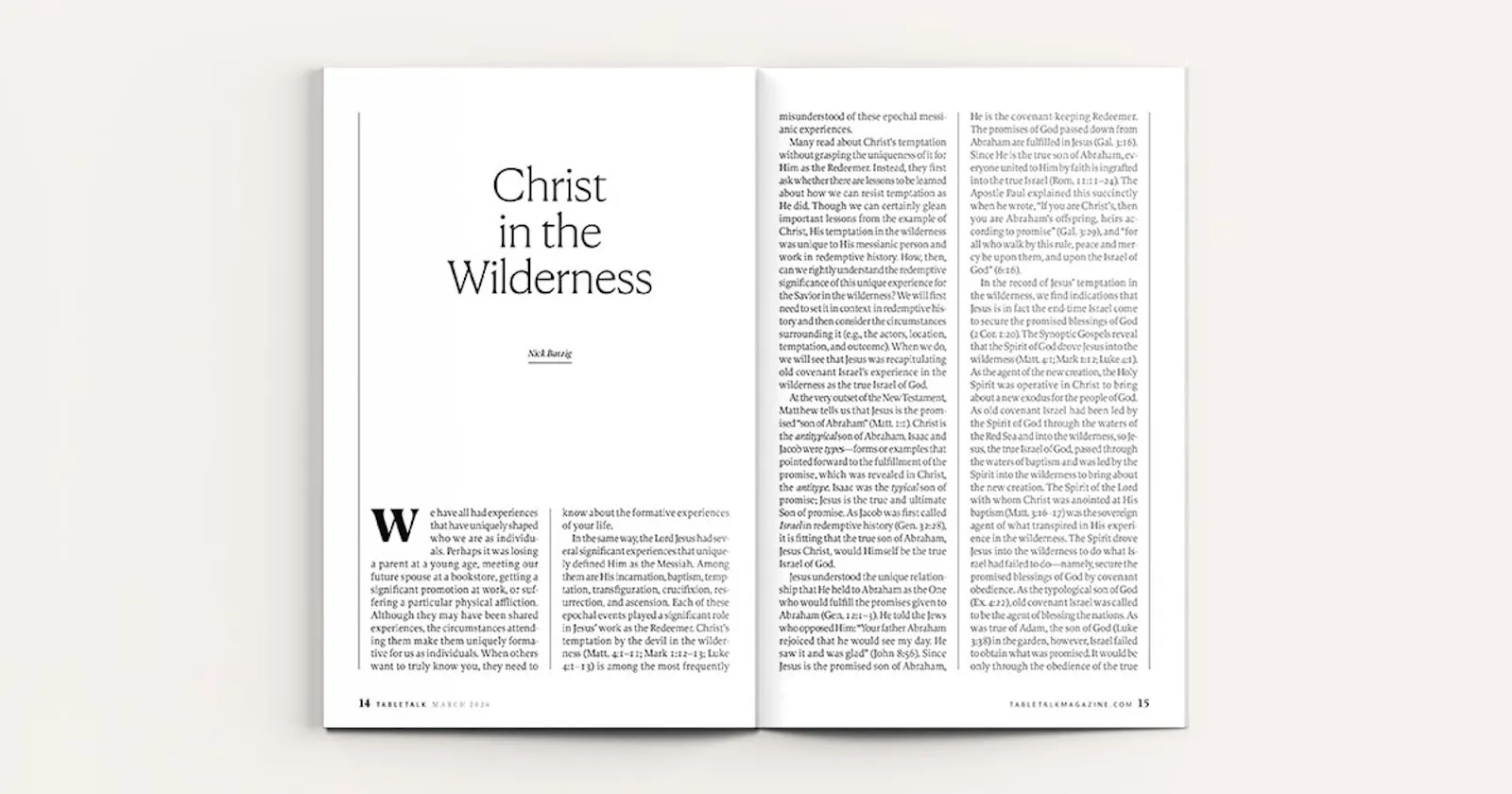
We have all had experiences that have uniquely shaped who we are as individuals. Perhaps it was losing a parent at a young age, meeting our future spouse at a bookstore, getting a significant promotion at work, or suffering a particular physical affliction. Although they may have been shared experiences, the circumstances attending them make them uniquely formative for us as individuals. When others want to truly know you, they need to know about the formative experiences of your life.
In the same way, the Lord Jesus had several significant experiences that uniquely defined Him as the Messiah. Among them are His incarnation, baptism, temptation, transfiguration, crucifixion, resurrection, and ascension. Each of these epochal events played a significant role in Jesus’ work as the Redeemer. Christ’s temptation by the devil in the wilderness (Matt. 4:1–11; Mark 1:12–13; Luke 4:1–13) is among the most frequently misunderstood of these epochal messianic experiences.
Many read about Christ’s temptation without grasping the uniqueness of it for Him as the Redeemer. Instead, they first ask whether there are lessons to be learned about how we can resist temptation as He did. Though we can certainly glean important lessons from the example of Christ, His temptation in the wilderness was unique to His messianic person and work in redemptive history. How, then, can we rightly understand the redemptive significance of this unique experience for the Savior in the wilderness? We will first need to set it in context in redemptive history and then consider the circumstances surrounding it (e.g., the actors, location, temptation, and outcome). When we do, we will see that Jesus was recapitulating old covenant Israel’s experience in the wilderness as the true Israel of God.
At the very outset of the New Testament, Matthew tells us that Jesus is the promised “son of Abraham” (Matt. 1:1). Christ is the antitypical son of Abraham. Isaac and Jacob were types—forms or examples that pointed forward to the fulfillment of the promise, which was revealed in Christ, the antitype. Isaac was the typical son of promise; Jesus is the true and ultimate Son of promise. As Jacob was first called Israel in redemptive history (Gen. 32:28), it is fitting that the true son of Abraham, Jesus Christ, would Himself be the true Israel of God.
Jesus understood the unique relationship that He held to Abraham as the One who would fulfill the promises given to Abraham (Gen. 12:1–3). He told the Jews who opposed Him: “Your father Abraham rejoiced that he would see my day. He saw it and was glad” (John 8:56). Since Jesus is the promised son of Abraham, He is the covenant-keeping Redeemer. The promises of God passed down from Abraham are fulfilled in Jesus (Gal. 3:16). Since He is the true son of Abraham, everyone united to Him by faith is ingrafted into the true Israel (Rom. 11:11–24). The Apostle Paul explained this succinctly when he wrote, “If you are Christ’s, then you are Abraham’s offspring, heirs according to promise” (Gal. 3:29), and “for all who walk by this rule, peace and mercy be upon them, and upon the Israel of God” (6:16).
In the record of Jesus’ temptation in the wilderness, we find indications that Jesus is in fact the end-time Israel come to secure the promised blessings of God (2 Cor. 1:20). The Synoptic Gospels reveal that the Spirit of God drove Jesus into the wilderness (Matt. 4:1; Mark 1:12; Luke 4:1). As the agent of the new creation, the Holy Spirit was operative in Christ to bring about a new exodus for the people of God. As old covenant Israel had been led by the Spirit of God through the waters of the Red Sea and into the wilderness, so Jesus, the true Israel of God, passed through the waters of baptism and was led by the Spirit into the wilderness to bring about the new creation. The Spirit of the Lord with whom Christ was anointed at His baptism (Matt. 3:16–17) was the sovereign agent of what transpired in His experience in the wilderness. The Spirit drove Jesus into the wilderness to do what Israel had failed to do—namely, secure the promised blessings of God by covenant obedience. As the typological son of God (Ex. 4:22), old covenant Israel was called to be the agent of blessing the nations. As was true of Adam, the son of God (Luke 3:38) in the garden, however, Israel failed to obtain what was promised. It would be only through the obedience of the true Israel of God that the blessings of God would be secured for His people out of every nation, tribe, language, and people (Rev. 5:9; 7:9; 13:7; 14:6).
The wilderness experience for old covenant Israel had been a period of testing. So, too, the wilderness experience for Jesus as the true Israel of God was one of testing. In the wilderness, God’s Son engaged in hand-to-hand combat with Satan. As soon as Adam brought sin and its deleterious effects into the world, the Lord gave the first gospel promise to man (the protoevangelium; Gen. 3:15). He graciously promised to send a Redeemer (i.e., the seed of the woman) to conquer the one who conquered man. In Christ’s coming into the world, the seed of the woman came to destroy the works of the evil one (1 John 3:8). In the wilderness, Christ faced off with the serpent of old. He struck a decisive blow to him by resisting his temptations. This initial combat was necessary for Jesus, as true Israel, to carry on the work that He had come to do in destroying the work of the evil one. The New Testament scholar G.K. Beale draws the connection between what Jesus was doing in the wilderness and what Israel had failed to do in the later conquest of Canaan:
The defeat of the devil in the wilderness may also be viewed secondarily to be Jesus’s first act of conquering the latter-day Canaanites in the promised land as true Israel. . . . Each of the Deuteronomy contexts reveals the goal of God’s desire for the people of Israel to remain faithful in the face of their temptations: they would “go in and possess the good land which the Lord swore” to give “by driving out all your enemies from before you” (Deut. 6:18–19).
The period of forty days and forty nights (Matt. 4:2) during which Jesus fasted in the wilderness is also a significant circumstance of His temptation. As Israel had been forty years in the wilderness, so Jesus experienced an analogous period of testing. Additionally, Jesus was acting as the greater Moses in the wilderness. The Lord called Moses to be the representative leader of His people throughout their time in the wilderness. Moses fasted for forty days and forty nights on the mountain as he received the revelation of God (Ex. 34:28). Jesus cited the very words that Moses spoke to Israel at the mountain (Deut. 8:3; 6:16; 6:13). Beale again explains:
Each response by Jesus to Satan is taken from a response by Moses to Israel’s failure in the wilderness (Deut. 8:3 in Matt. 4:4; Deut. 6:16 in Matt. 4:7; Deut. 6:13 in Matt. 4:10). Jesus succeeds in resisting the same temptations to which Israel succumbed.
Israel was tested with hunger but failed by complaining and grumbling about the Lord and His gracious provisions (Deut. 8:3). Israel was tested as to the fidelity of its worship but failed by worshiping the idol-gods of the nations around it (6:13–15). Israel rebelled at Meribah and at Massah by questioning God’s power (6:16). Jesus resisted the temptation to hunger, worship, and power in His three temptations. Behind this was the threefold temptation of our first parents in the garden. The temptation of Jesus in the wilderness carries with it the same structure as the temptation of Adam and Israel. Satan tempted our first parents with “the desires of the flesh and the desires of the eyes and pride of life” (1 John 2:16). Eve ate the fruit of the Tree of Knowledge of Good and Evil when she allowed herself to believe that it was “good for food, pleasant to the eyes and desirable to make one wise” (Gen. 3:6).
Jesus’ obedience in the wilderness was a necessary part of His accomplishment of redemption (Rom. 5:19). Whereas Adam and Israel disobeyed in their representative roles, Jesus obeyed as the last Adam and true Israel—the end-time Son of God and son of Abraham. By His obedience, Jesus struck a necessary blow to the evil one. By His death, Christ disarmed principalities and powers (see Col. 2:15). At Calvary, the promised seed of the woman crushed the head of the serpent while being bruised for our iniquities. In His resurrection, Jesus is shown to be the victorious last Adam and true Israel of God—the Head of a redeemed humanity. God calls us to trust Him alone for the enjoyment of the covenant blessings that He secured by His obedience.