

Request your free, three-month trial to Tabletalk magazine. You’ll receive the print issue monthly and gain immediate digital access to decades of archives. This trial is risk-free. No credit card required.
Try Tabletalk NowAlready receive Tabletalk magazine every month?
Verify your email address to gain unlimited access.
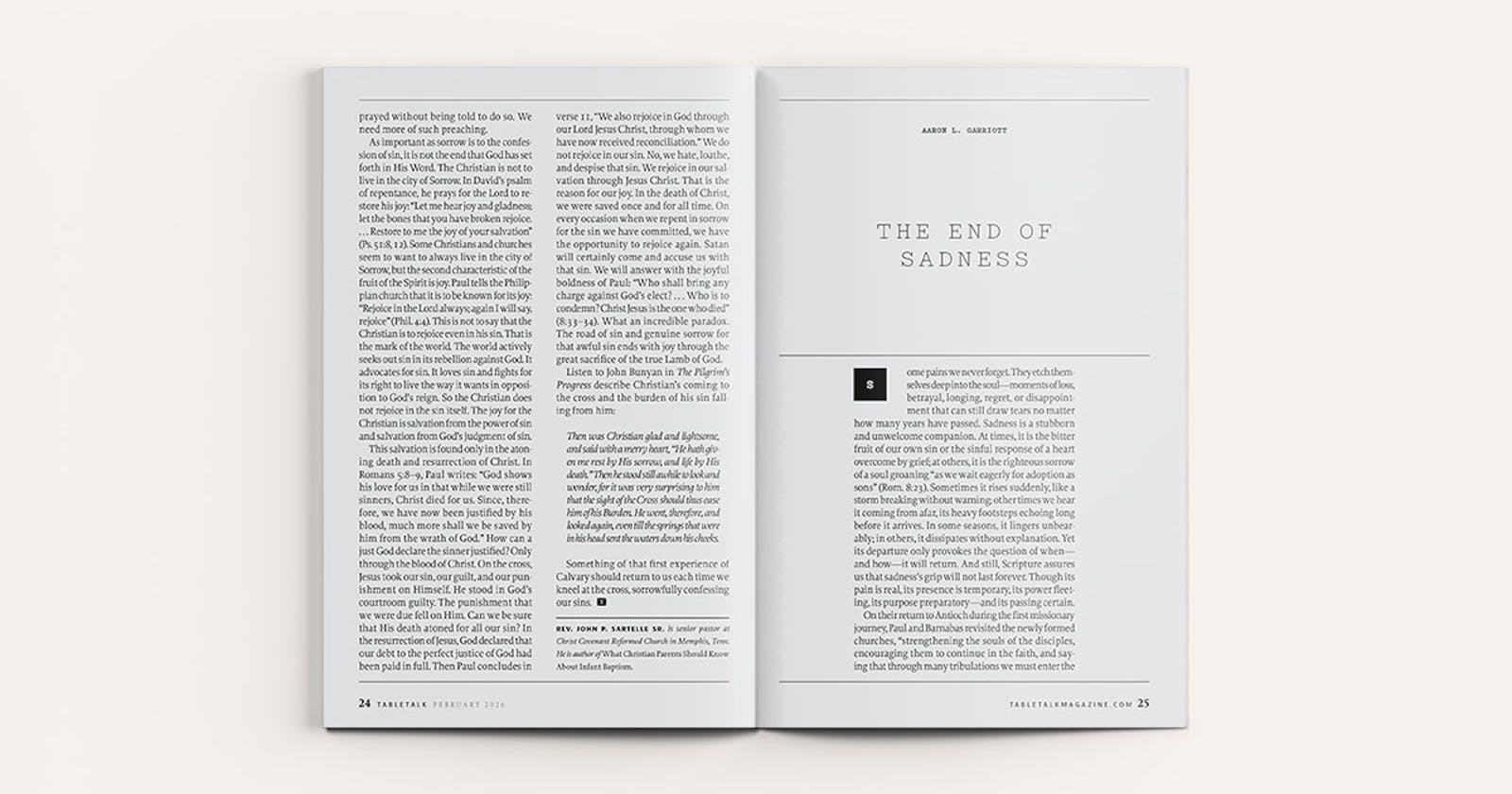
Some pains we never forget. They etch themselves deep into the soul—moments of loss, betrayal, longing, regret, or disappointment that can still draw tears no matter how many years have passed. Sadness is a stubborn and unwelcome companion. At times, it is the bitter fruit of our own sin or the sinful response of a heart overcome by grief; at others, it is the righteous sorrow of a soul groaning “as we wait eagerly for adoption as sons” (Rom. 8:23). Sometimes it rises suddenly, like a storm breaking without warning; other times we hear it coming from afar, its heavy footsteps echoing long before it arrives. In some seasons, it lingers unbearably; in others, it dissipates without explanation. Yet its departure only provokes the question of when—and how—it will return. And still, Scripture assures us that sadness’s grip will not last forever. Though its pain is real, its presence is temporary, its power fleeting, its purpose preparatory—and its passing certain.
On their return to Antioch during the first missionary journey, Paul and Barnabas revisited the newly formed churches, “strengthening the souls of the disciples, encouraging them to continue in the faith, and saying that through many tribulations we must enter the kingdom of God” (Acts 14:22). Years later, writing to some of the same Christians, Peter echoes the same truth:
In this you rejoice, though now for a little while, if necessary, you have been grieved by various trials, so that the tested genuineness of your faith—more precious than gold that perishes though it is tested by fire—may be found to result in praise and glory and honor at the revelation of Jesus Christ. (1 Peter 1:6–7)
Paul and Peter know something of the way that keeping in mind the end of sadness strengthens us to endure in the midst of great sadness. God sets before our eyes the glories of our future blessedness before we attain it so that we might “run with endurance the race that is set before us” (Heb. 12:1). While our passage to glory is secure, it is nevertheless full of sadness. Our destination, however, knows nothing of the tears and pain of sadness that are so familiar to us now.
We would do well to remember David’s well-placed confidence that there is One who remembers better than we the tears that we have shed: “You have kept count of my tossings; put my tears in your bottle. Are they not in your book?” (Ps. 56:8). The Lord not only counts our tears but has put an expiration date on them. The Man of Sorrows became acquainted with grief so that we could be with Him where He is in the city that has foundations but no tears (Isa. 53:3; John 17:24; Heb. 11:10).
If a life and a land without sadness and tears is hard to imagine, it’s because we have no frame of reference for such a world. Like Abraham, we see it from afar by faith (Heb. 11:13). Even the Apostle whom Jesus loved admitted to a level of ignorance: “Beloved, we are God’s children now, and what we will be has not yet appeared.” But then John tells us what he does know: “But we know that when he appears we shall be like him, because we shall see him as he is” (1 John 3:2).
This is the beatific vision—when our faith will become sight and we will see the Lord face-to-face. It is at this point that we know more than David did: Not only does our God bottle our tears, but in an act of unspeakable power and friendship, He wipes every one of those bottled tears away forever:
They shall hunger no more, neither thirst anymore;
the sun shall not strike them,
nor any scorching heat.
For the Lamb in the midst of the throne will be their shepherd,
and he will guide them to springs of living water,
and God will wipe away every tear from their eyes. (Rev. 7:16–17)
Could it be otherwise? If He did not wipe away our tears, how could we at last “see him as he is” in all His glory and grace?
This is an eschatological promise. It is true that this promise does not numb the pain. The aches of a deceased child don’t lessen when the eyes of faith penetrate the unseen country of unceasing joy. But something else does happen, and it’s a mysterious work of the unseen Holy Spirit. That sorrow somehow begins to morph into an abiding hope. The tears that God is bottling somehow accumulate into a holy preparation by which we are being made ready for that tearless life: “For this light momentary affliction is preparing for us an eternal weight of glory beyond all comparison” (2 Cor. 4:17). Perhaps we will look back on the valley of tears and be able to say with the psalmist, “It is good for me that I was afflicted” (Ps. 119:71).
The Puritan Timothy Rogers urged the sorrowful Christian to see the tears that God’s providence orders in light of this eschatological promise:
Out of the ruins of our flesh God raises the glorious structure of the new creature, and from the destruction of our earthly comforts He causes heavenly joys to spring. Let us not find fault with God’s providence, for it will turn our water into wine, our tears of grief into the most pleasant joys. As at the marriage of Cana, we will have the best at last. Our afflictions will increase our grace, and we shall, before long, mount up from the wilderness of this world.
Dear Christian, take heart—the waves of sorrow that now crash against your soul will before long be stilled. The raging seas of grief will give way to a sea of glass in the blessed presence of the Lord (Rev. 4:6; 15:2). “Weeping may tarry for the night, but joy comes with the morning” (Ps. 30:5)—and that morning will be the dawn of the new creation, when God wipes away every tear from our eyes and death, mourning, crying, and pain will be no more (Rev. 21:4). The long night of sadness is nearly over; eternal joy is already rising on the horizon.