

Request your free, three-month trial to Tabletalk magazine. You’ll receive the print issue monthly and gain immediate digital access to decades of archives. This trial is risk-free. No credit card required.
Try Tabletalk NowAlready receive Tabletalk magazine every month?
Verify your email address to gain unlimited access.
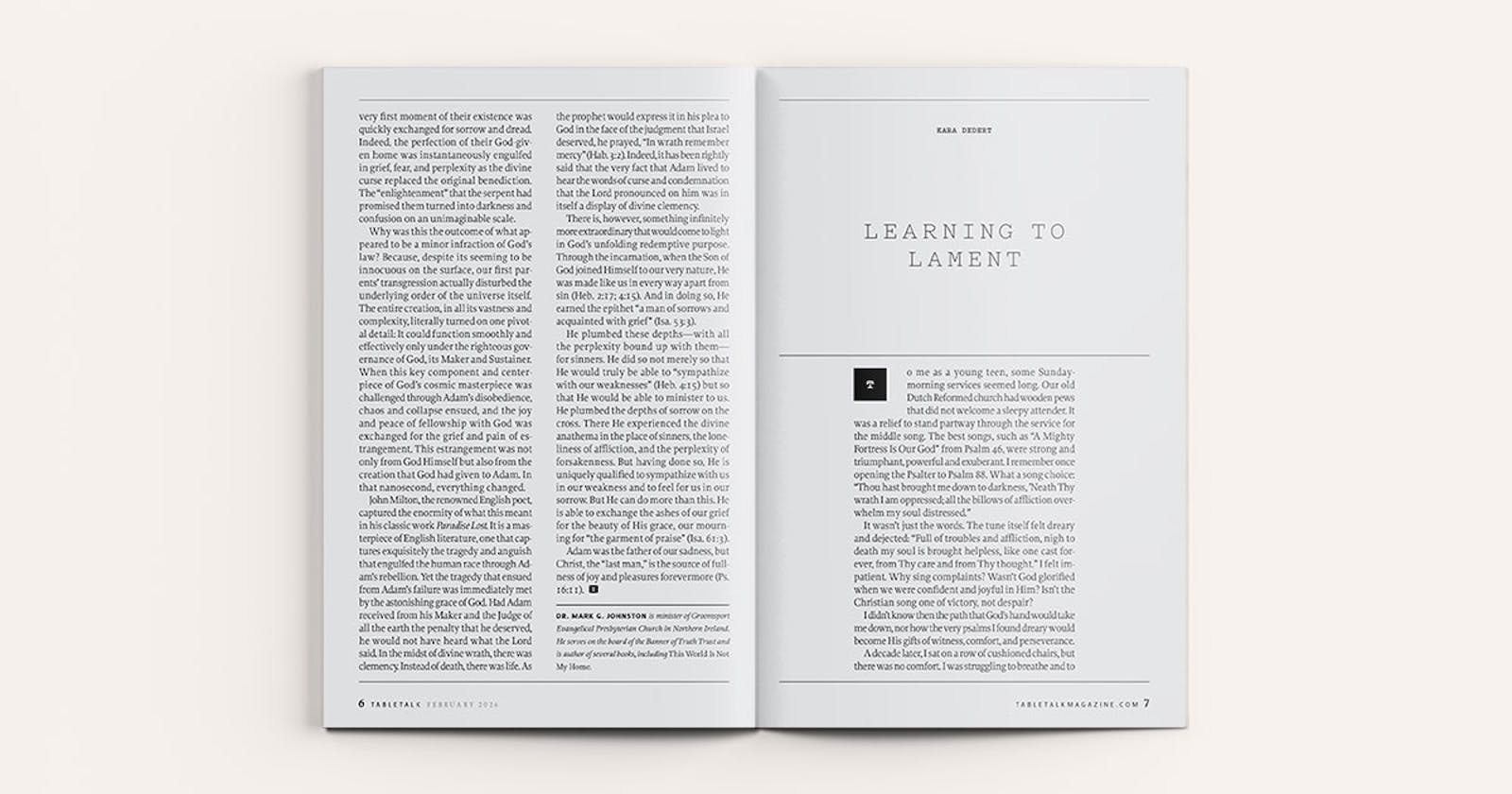
To me as a young teen, some Sunday- morning services seemed long. Our old Dutch Reformed church had wooden pews that did not welcome a sleepy attender. It was a relief to stand partway through the service for the middle song. The best songs, such as “A Mighty Fortress Is Our God” from Psalm 46, were strong and triumphant, powerful and exuberant. I remember once opening the Psalter to Psalm 88. What a song choice: “Thou hast brought me down to darkness, ’Neath Thy wrath I am oppressed; all the billows of affliction overwhelm my soul distressed.”
It wasn’t just the words. The tune itself felt dreary and dejected: “Full of troubles and affliction, nigh to death my soul is brought helpless, like one cast forever, from Thy care and from Thy thought.” I felt impatient. Why sing complaints? Wasn’t God glorified when we were confident and joyful in Him? Isn’t the Christian song one of victory, not despair?
I didn’t know then the path that God’s hand would take me down, nor how the very psalms I found dreary would become His gifts of witness, comfort, and perseverance.
A decade later, I sat on a row of cushioned chairs, but there was no comfort. I was struggling to breathe and to find words for prayer. Our five-year-old son, Noah, was on the operating table undergoing open-heart surgery. At the same time, our two-year-old son, Calvin, was fighting to live, having been severely affected by the Zika virus. His daily struggle and constant worsening, on top of Noah’s fragility, was becoming impossible to bear.
Pain in this fallen world can knock us off our feet. It comes uninvited with no apology. It undoes vital plans, good hopes, and even God-glorifying purposes. “In the world you will have tribulation,” Jesus said (John 16:33). But this? The truths I believed felt suspended in the air, unable to hold me.
At that moment, no matter how true the sentiments may have been, it didn’t help to hear about all the wonderful things that God could do with this. The cost was too high. The appeal to be an inspiration of determination and joy seemed to dismiss the real suffering that I was holding in my arms. The ground kept sinking lower, and the bleakness all around obscured any future. “Save me, O God! For the waters have come up to my neck. I sink in deep mire, where there is no foothold” (Ps. 69:1–2). The psalms that I had once found dreary came alive and became familiar companions.
The morning after surgery, I was allowed into Noah’s room. He looked over to me; the breathing tube prevented him from speaking and the chest tube from reaching for me. I crawled into the bed next to him as carefully as I could. A mix of relief and pain filled his face as silent tears began to roll down his face. I was his mom; I wasn’t looking for false bravado or borrowed strength. Instead, I felt relief that he trusted me with his tears. I leaned in closer.
Isn’t this how God desires us to come? Not with tidy understanding or facades of strength but with full disclosure. Lament, then, is not weakness but actually the evidence of trust and our union with Christ. Without Christ, we are people of self-contained agony. With Christ, we give the crushing sorrow to Him: “Surely he has borne our griefs and carried our sorrows” (Isa. 53:4).
There is something deeply comforting when someone enters our context and realizes the weight with us. Lament calls on the Lord to do just that: “Consider my affliction and my trouble, and forgive all my sins” (Ps. 25:18). We do not cry into a void but call out to a personal God who is intimately acquainted with our grief. Lament, then, is not faith unraveling but faith refusing to let go. It is the intentional bearing of our wounds to the One who was wounded for us.
This is the paradox at the heart of lament: The sovereign God who ordains our suffering is the same God who, in Christ, entered it, bore it, and will redeem it. Without His sovereignty, lament would be only therapeutic with no lasting hope. Without His goodness, we would fear His intentions. So our protests, questions, and darkest cries find relief here: “If God is for us, who can be against us? He who did not spare his own Son but gave him up for us all, how will he not also with him graciously give us all things?” (Rom. 8:31–32).
Years passed, and Noah healed. Calvin did not. Those around us understandably moved on from the crisis and became busy with their own lives. But how do you live when life never gets back to normal? When each season brings new adjustments and fresh dimensions of broken bodies and broken dreams? The physical demands and emotional weight tempted me to bitterness or resignation, even while I looked to the Lord. How did He expect us to continue?
What a gift Scripture became, giving me language and companions whose words were lifelines. I was not the first to feel pressed down with no way out. I echoed the words of Job: “He has walled up my way, so that I cannot pass, and he has set darkness upon my paths” (Job 19:8). The turmoil of the saints before me gave language to my own. When God finally answered Job, not with explanations but with sweeping descriptions of His power, majesty, and dominion over all things, it renewed comfort and confidence.
While not offering answers, the laments in Scripture are tools in God’s hand to keep our heart soft, pulling us away from bitterness, frustration, and apathy, which seem like the natural defaults that corrode and harden the heart. Lament becomes a life-giving pattern of relief and renewal for living with broken dreams. We become either receptive or hard-hearted. We grow in love or in bitterness. We grow in devotion or in apathy.
Those years became an invitation to develop rhythms of joy and grace even in valleys of sorrow, a call to live as ordinary people with an extraordinary hope. I used to think that God protected His people from breaking. I’ve realized now that following Jesus often means being broken again and again, and then bound up again and again with the hope that we have in Christ.
The real danger is not grief itself. The danger comes when we make our grief the cross rather than placing our grief beneath the cross. That path leaves us withering. There is no redeeming power in grief itself. Restoration and healing come only when we bring it to Christ. “He heals the brokenhearted and binds up their wounds” (Ps. 147:3). He heals and binds; He does not shield us from descent into overwhelming places. He allows us to reach the end of our emotional, physical, and mental strength, but there He preserves us and works life in us.
This is how perseverance is formed. As we resist turning inward in despair, God draws us outward toward Him. Lament trains us in honesty, trust, and submission, tethering us to Him: “Cast your burden on the Lord, and he will sustain you” (Ps. 55:22). When we hand over our griefs, our weak faith is strengthened. The valleys we dread are where He shapes us into the likeness of Christ: “that I may know him and the power of his resurrection, and may share his sufferings, becoming like him in his death” (Phil. 3:10).
Lament is not the end: “For a brief moment I deserted you, but with great compassion I will gather you” (Isa. 54:7). God’s grace will keep us and shape us through every valley until hope becomes sight.
Another decade has passed since that agonizing waiting room. I’m standing in the same church again. Noah is beside me, Calvin in the wheelchair in front of me. We open our songbooks and join with David’s relief and resolve in Psalm 116: “I love the Lord, the fount of life and grace; he hears my voice, my cry and supplication. Inclines his ear, gives strength and consolation; in life, in death, my heart will seek his face.”
One day lament will give way to praise. One day faith will no longer cry in the dark but will rejoice in the eternal day. The Man of Sorrows who carried our griefs will wipe away every tear and turn every lament into a song of praise. Until that day, lament is faith in motion—trusting God to see, to comfort, to sustain, and to finish what He began.