
Request your free, three-month trial to Tabletalk magazine. You’ll receive the print issue monthly and gain immediate digital access to decades of archives. This trial is risk-free. No credit card required.
Try Tabletalk NowAlready receive Tabletalk magazine every month?
Verify your email address to gain unlimited access.
Christians who know Reformation theology are keen to point out that sinners are justified through faith alone, apart from works (Gal. 2:16). Unfortunately, there has been a tendency in some parts to conclude that good works are therefore not an important part of the Christian life. But such a view could not be further from the thought of both Jesus and His Apostles. Jesus spoke of good fruit as the natural fruit of a healthy tree (Matt. 7:17). He emphasized that while we are justified apart from our good works, godly fruit that results from our salvation is a necessary and inevitable consequence of His saving work in our lives.
The question will be especially raised by weak Christians and new believers: “How is a sinful person like me supposed to do good works?” The answer is given by Paul in Philippians 2:12–13: “Work out your own salvation with fear and trembling, for it is God who works in you, both to will and to work for his good pleasure.”
because god works in us
The first reason that Christians have power to do good deeds—works that serve the Lord and bless other people—is that God is at work in believers’ lives. How crippling it is to think that we must generate good deeds out of our own power. It is true that the Christian life requires effort from believers, as Paul instructs: “Work out your own salvation with fear and trembling” (Phil. 2:12). We must apply our faith to every area of our lives, changing our approach to work, play, relationships, sexuality, money, life goals, and daily habits. But lest we despair of so difficult a task, Paul adds that “it is God who works in you, both to will and to work for his good pleasure” (v. 13). We have power to do good works because God is working in us for His good pleasure.
As Paul sees it, our doing is because of what we are becoming. This “be, therefore do” principle permeates the Bible’s approach to sanctification and good works. The greatest change begins when a sinner is born again to saving faith in Jesus. This means that if you trust in Christ, the greatest change has already happened to you. John wrote, “No one born of God makes a practice of sinning, for God’s seed abides in him; and he cannot keep on sinning, because he has been born of God” (1 John 3:9). John does not mean that born-again people never sin (see 1:8) but means that we are no longer on a trajectory of sin but rather on a trajectory of righteousness. We therefore must never view a believer—even ourselves—as we do an unbeliever. Sin is the principle working out in an unbeliever’s life. But the believer has been born again and therefore has the impulse to do good works and the power of God to do them. Born-again Christians are new creatures (2 Cor. 5:17), and therefore we do good works that reflect God’s new creation in Christ.
by walking in the holy spirit
The new birth establishes the fact that believers have power to do good works. But what is the manner in which Christians experience this power? The answer is given in Romans 8:4, where Paul states that because of God’s gift of his Son, “the righteous requirement of the law might be fulfilled in us, who walk not according to the flesh but according to the Spirit.”
Paul means that Christians pursue good works by an indirect approach. Knowing that our “doing” flows out of our “being,” we direct ourselves to living in step with the Holy Spirit, as Galatians 5:16 says: “Walk by the Spirit, and you will not gratify the desires of the flesh.”
Christians walk by the Spirit first by living self-consciously in God’s Word (of which the Holy Spirit is the Author). The result is that our minds are shaped by the Spirit’s power through Scripture. Romans 8:5 says, “Those who live according to the flesh set their minds on the things of the flesh, but those who live according to the Spirit set their minds on the things of the Spirit.” Paul is primarily describing the results of a daily commitment to studying and meditating on God’s Word. We find this emphasis in Psalm 1, where the blessed man delights in God’s Word and meditates on it day and night (v. 2). The result is an abundance of the fruit of good works: “He is like a tree planted by streams of water that yields its fruit in its season, and its leaf does not wither” (v. 3). A tree does not become fruitful because we staple leaves and fruits to its branches. Instead, we make sure that it is well watered, in which case the life of the stream makes it fruitful within and then bountiful without. So also Christians gain the power to do good works by drinking daily and deeply from the stream of life that is God’s Word.
A second way that Christians walk in the Spirit and do good works is through a commitment to regular prayer. Here again, this is an activity in which the Holy Spirit is directly involved: “The Spirit helps us in our weakness,” and “the Spirit himself intercedes for us” in and through our prayers (Rom. 8:26). Certainly, we must pray for opportunities to do good works and for God to motivate us to do good works. Prayer is used by God to change us by His grace so that good works are the result (Phil. 4:6–9).
The third way that Christians walk by the Spirit—and also the third divinely given “means of grace”—is regular attendance in gathered worship, including the sacraments. It is amazing what ten years of regular worship together with God’s people will do in terms of enabling good works. Indeed, many of us attest that our lives were changed by a single year of commitment to God’s Word, prayer, and the sacraments and marvel at what good works resulted.
because it is god’s sovereign will
At the conclusion of his teaching on an individual’s salvation in Ephesians 2, Paul makes an astonishing and most encouraging statement: “For we are his workmanship, created in Christ Jesus for good works, which God prepared beforehand, that we should walk in them” (v. 10). Here is another reason that believers have power to do good works: God has sovereignly ordained them and sovereignly orchestrates them.
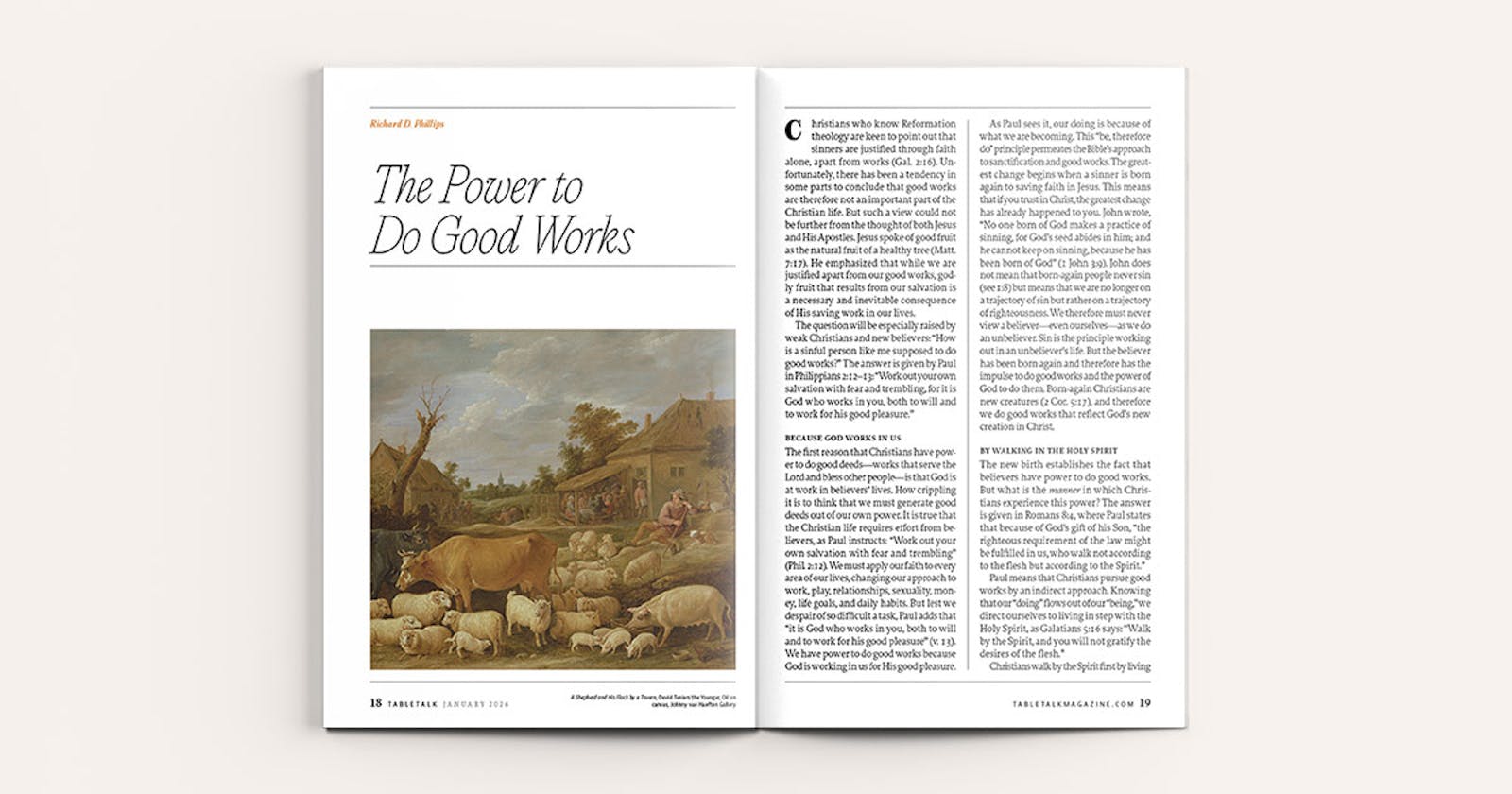
We learn from this verse that there are good works that we are intended to do and that God therefore places in our paths. A new or weak Christian may ask, “How can someone like me turn from sin and selfishness to do good works?” The answer is that God has planned them for your life. Therefore, as you live out each day, you as a Christian should be looking for the good works that God has ordained: a friend who needs to be encouraged, a sacrifice that will make a difference, or a witness that may lead someone to eternal life. So certain is it that you will do good works that Paul writes that Jesus died, in part, “to purify for himself a people for his own possession who are zealous for good works” (Titus 2:14). Therefore, as you live each day as a Christian, Christ will enable and empower you to do the good works for which He redeemed you at the cost of His own blood.
we all can do good works
So integral are good works to the Christian life that when Jesus foretold the final judgment, He emphasized the praise He will heap on His people for their works: “I was hungry and you gave me food, I was thirsty and you gave me drink, I was a stranger and you welcomed me, I was naked and you clothed me, I was sick and you visited me” (Matt. 25:35–36). We are reminded by this statement of how much Jesus values our good works, not only as the fruit and the proof of saving faith, but because “as you did it to one of the least of these my brothers, you did it to me” (v. 40).
If we are discouraged about good works, it might be because we think of them mainly as great public achievements for the gospel. But notice how important to Jesus are the small acts of daily kindness, sacrificial ministry, and tender love for those in need. If God is working in you and if you are walking by the Spirit through His Word, in prayer, and in worship, then God has ordained good works like these and has given you power to do them. And when we realize how much our smallest godly deeds mean to Jesus, how eager and happy we are to embrace this power and do good works.