
Request your free, three-month trial to Tabletalk magazine. You’ll receive the print issue monthly and gain immediate digital access to decades of archives. This trial is risk-free. No credit card required.
Try Tabletalk NowAlready receive Tabletalk magazine every month?
Verify your email address to gain unlimited access.
Why do I exist? Who am I supposed to be? Questions of identity touch the heart of our human condition. They also broach some of the most challenging issues of the modern period. We need to know what it means to be human.
You might well be wondering how identity relates to good works and why good works matter. In truth, good works are more important to understanding ourselves than you might imagine. Westminster Confession of Faith 4.2 summarizes key facets concerning humanity:
After God had made all other creatures, he created man, male and female, with reasonable and immortal souls, endued with knowledge, righteousness, and true holiness, after his own image; having the law of God written in their hearts, and power to fulfill it: and yet under a possibility of transgressing, being left to the liberty of their own will, which was subject unto change. Beside this law written in their hearts, they received a command, not to eat of the tree of the knowledge of good and evil; which while they kept, they were happy in their communion with God, and had dominion over the creatures.
The confession invokes the key themes of righteousness, holiness, and knowledge of the law as well as the power to fulfill it. All these catchpoints connect in some way to the issue of good works. Remarkably, the confession closely ties them to another fundamental truth: God’s image.
This article explores why good works matter. Our main idea is that who you are—who God designed you to be—reveals what sort of life will lead to true flourishing. God made you to bear His image, which entails that you have the purpose of reflecting His holiness.
fit for purpose
For most things, we can understand why they exist by looking at their blueprints. Buildings are designed to provide shelter and protection. Cars are crafted for transportation. Watches are made for keeping time. The design plans for each of these things make their purpose clear. What about humanity?
God designed humanity to bear His image. The triune God Himself explained His purpose in creating us:
Then God said, “Let us make man in our image, after our likeness. And let them have dominion over the fish of the sea and over the birds of the heavens and over the livestock and over all the earth and over every creeping thing that creeps on the earth.”
So God created man in his own image,
in the image of God he created him;
male and female he created them.And God blessed them. And God said to them, “Be fruitful and multiply and fill the earth and subdue it, and have dominion over the fish of the sea and over the birds of the heavens and over every living thing that moves on the earth.” (Gen. 1:26–28)
God described humanity’s blueprint. His expressed intent for us sheds light on our design. He tells us our identity and why we exist.
Stunningly, God made us to bear His image. This precious role of carrying the divine likeness comes with responsibility. The Apostle Paul elaborates that we were “created after the likeness of God in true righteousness and holiness” (Eph. 4:24). Even in Genesis 1, we were supposed to rule over creation in a righteous and holy way and to fill it increasingly with more of God’s image bearers. At rock bottom, that commission to reign over God’s creation was a task. It was a good work.
Our responsibility to that work related directly to our position as God’s image bearers. God made us with work to do. As those made in the divine likeness, we were supposed to bring God’s goodness to bear on creation by reflecting His goodness as we carry out our works. In other words, God made us for the purpose of good works. He made us fit for the purpose that we would make His goodness known by doing good works.
a covenant of love
Why are good works part of the flourishing of human life? Reformed theology teaches that God made a covenant with Adam at creation, often called the covenant of works or the covenant of life. Westminster Shorter Catechism 12 explains, “When God had created man, he entered into a covenant of life with him, upon condition of perfect obedience; forbidding him to eat of the tree of the knowledge of good and evil, upon pain of death.” This covenant tells us a lot about why good works matter in connection to who we are.
A covenant is a formal relationship. God’s covenants with His people are bonds of affection. As Psalm 25:14 says, “The friendship of the Lord is for those who fear him, and he makes known to them his covenant” (emphasis added). Do not overlook that the covenant of works was God’s act of binding Himself to Adam in friendship.
The covenant of works’ condition of perfect obedience might give us pause. But at creation, Adam had not yet sinned. Before Adam’s sin brought condemnation and death upon all humanity, the condition of perfect obedience was no problem. God made Adam upright and truly righteous by nature (Eccl. 7:29). As we saw in Westminster Confession 4.2, God made Adam with the natural ability to fulfill the law. Obedience was not a problem before sin.
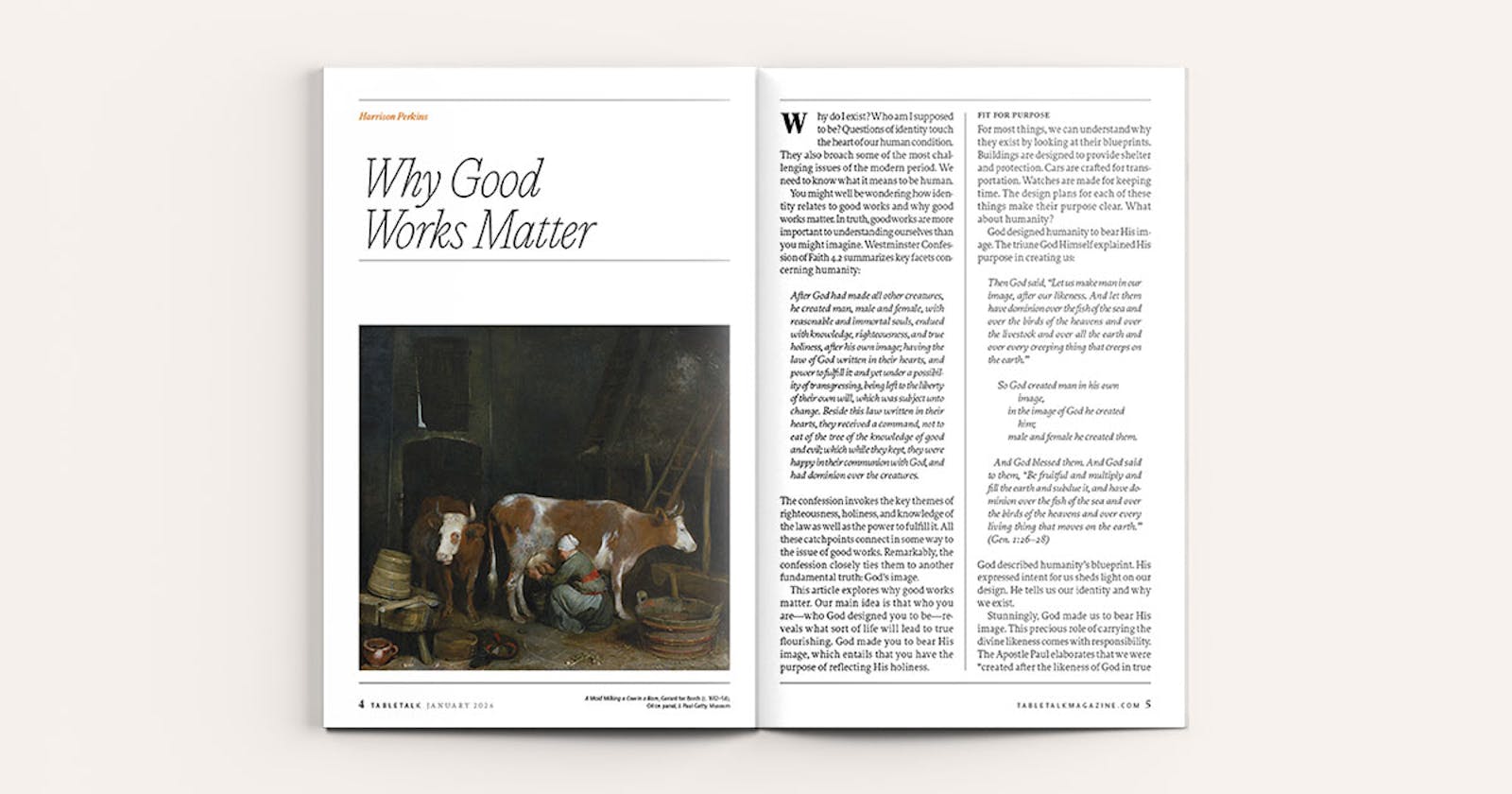
Thus, although the condition was good works, God’s covenant with Adam was a covenant of love. When God gave the law to Adam, as Westminster Confession 19.1 teaches, it was a road map for Adam to know how to show his love for God. Good works were not meant to be a burden for Adam. Rather, they would manifest his love.
Good works matter because they are the fruit growing on the root of love. After all, God created humanity as an act of love toward us. He made us to glorify and enjoy Him. By ruling creation in righteousness, we would have displayed God’s loving character throughout the world. By serving God in the obedience that He created us to perform, we would have reciprocated God’s amazing love to us. Before sin, God’s law was not a miserly imposition. It was a blueprint to show us how best to love God and to love our neighbor. Good works matter as part of the flourishing human life because they demonstrate and display the love in our hearts for God and for others.
an abiding way of love
When Adam broke the covenant of works, sin brought condemnation and corruption on us all. Sin leaves us unable to perform the works that God made us to do (Rom. 3:10–18; Eph. 2:1, 5). One of the saddest aspects of this plight is that our inability to do good works means that we are unable to love well.
Sinners cannot keep the covenant of works. Our good works cannot be perfect, so we cannot earn the reward of glorified, incorruptible life that this covenant held out to Adam if he had obeyed. Sin’s corruption, unmitigated, means that we are unable in ourselves to perform truly good works at all—at least so far as God would assess their quality. Left in our sin’s consequences, our works are never good.
God’s grace is magnificent, though. In justification, Christ’s righteousness is imputed to us, for He rendered that perfect obedience that we need to enter into everlasting, glorified life. In sanctification, Christ frees us from the power of sin and starts to roll back the misery it causes. He enables us anew to perform imperfect, but nevertheless truly good, works. We cannot earn justification by them. We can, however, really express genuine love for God and others by them. After all, God created us to manifest love by our good deeds. He renews us by grace that we might again walk in the good works that He has prepared for us (Eph. 2:10). As we do, we flourish in finding what it means to be truly human as we shine God’s goodness into the world around us.