
Request your free, three-month trial to Tabletalk magazine. You’ll receive the print issue monthly and gain immediate digital access to decades of archives. This trial is risk-free. No credit card required.
Try Tabletalk NowAlready receive Tabletalk magazine every month?
Verify your email address to gain unlimited access.
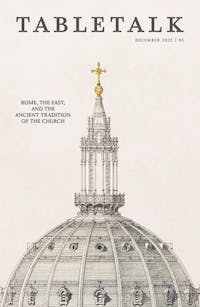
“I really liked that the Catholic Church was just really old,” said one recent Roman Catholic convert. The comment is unassuming, but it reveals something deeper: In a world marked by change and uncertainty, the human heart longs for stability—for something that feels enduring and grounded. The notion that the old is better than the new is, in fact, quite old. In the modern West, especially in America, we tend to prize the new: updated phones, faster cars, smarter devices. But for much of history, people instinctively believed the opposite. Antiquity implied wisdom, authority, and credibility. In the early centuries, Christianity was derided precisely because it was seen as novel. The Roman historian Tacitus called it a “new and mischievous superstition.” The faith was suspect because it seemed new and therefore untrustworthy.
Christians countered that theirs was not a novel religion at all. Rather, the gospel was the fulfillment of what had been promised from the beginning of human history (Gen. 3:15). The New Testament did not replace the Old Testament but fulfilled it. Christianity, they argued, was not a departure from the ancient faith; rather, it was its consummation. It built on what God had already said in the Old Testament. The Protestant Reformers took a similar stance. When Protestantism emerged in the sixteenth century, its leaders were accused of innovation. In response, they asserted the principle of sola Scriptura, that God’s Word alone is the supreme authority in matters of faith. This is what the people of God had believed for thousands of years—from Abraham to David to Jesus. They recognized that this could be messy in practice, but the principle is sound. Yet they were not dismissive of the church’s history. They looked to the early creeds and cited church fathers, not to construct something new but to recover something old: the gospel.
Today, many young people are drawn to what seems ancient not out of mere nostalgia but because they’re searching for permanence. Some are drawn into Roman Catholicism or Eastern Orthodoxy by those communions’ traditional liturgies and claims of historical continuity. But the root issue of the Reformation remains: What is the ancient tradition? And the answer remains unchanged: the Word of God. Wherever Scripture is followed as the final authority, there is the truly ancient faith. The temptation today is to forget what we’ve been given. But Protestantism’s great gift was to place the Bible in the hands of God’s people, to proclaim the simplicity of the gospel, and to secure freedom of conscience before the Lord. Our calling is not novelty but faithful recovery. May we hold fast to the ancient truths so that future generations might walk in the old paths (Jer. 6:16).