
Request your free, three-month trial to Tabletalk magazine. You’ll receive the print issue monthly and gain immediate digital access to decades of archives. This trial is risk-free. No credit card required.
Try Tabletalk NowAlready receive Tabletalk magazine every month?
Verify your email address to gain unlimited access.
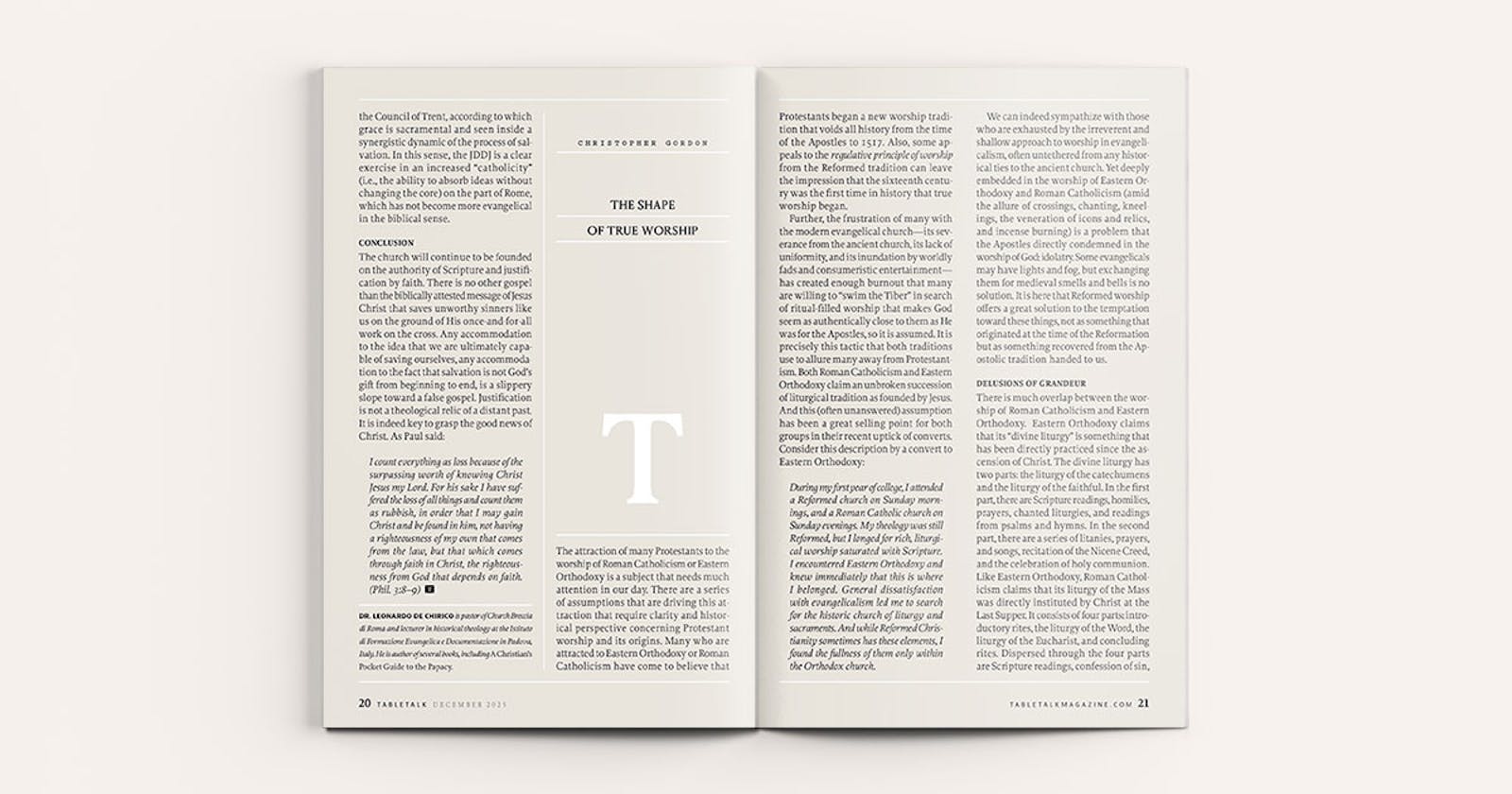
The attraction of many Protestants to the worship of Roman Catholicism or Eastern Orthodoxy is a subject that needs much attention in our day. There are a series of assumptions that are driving this attraction that require clarity and historical perspective concerning Protestant worship and its origins. Many who are attracted to Eastern Orthodoxy or Roman Catholicism have come to believe that Protestants began a new worship tradition that voids all history from the time of the Apostles to 1517. Also, some appeals to the regulative principle of worship from the Reformed tradition can leave the impression that the sixteenth century was the first time in history that true worship began.
Further, the frustration of many with the modern evangelical church—its severance from the ancient church, its lack of uniformity, and its inundation by worldly fads and consumeristic entertainment—has created enough burnout that many are willing to “swim the Tiber” in search of ritual-filled worship that makes God seem as authentically close to them as He was for the Apostles, so it is assumed. It is precisely this tactic that both traditions use to allure many away from Protestantism. Both Roman Catholicism and Eastern Orthodoxy claim an unbroken succession of liturgical tradition as founded by Jesus. And this (often unanswered) assumption has been a great selling point for both groups in their recent uptick of converts. Consider this description by a convert to Eastern Orthodoxy:
During my first year of college, I attended a Reformed church on Sunday mornings, and a Roman Catholic church on Sunday evenings. My theology was still Reformed, but I longed for rich, liturgical worship saturated with Scripture. I encountered Eastern Orthodoxy and knew immediately that this is where I belonged. General dissatisfaction with evangelicalism led me to search for the historic church of liturgy and sacraments. And while Reformed Christianity sometimes has these elements, I found the fullness of them only within the Orthodox church.
We can indeed sympathize with those who are exhausted by the irreverent and shallow approach to worship in evangelicalism, often untethered from any historical ties to the ancient church. Yet deeply embedded in the worship of Eastern Orthodoxy and Roman Catholicism (amid the allure of crossings, chanting, kneelings, the veneration of icons and relics, and incense burning) is a problem that the Apostles directly condemned in the worship of God: idolatry. Some evangelicals may have lights and fog, but exchanging them for medieval smells and bells is no solution. It is here that Reformed worship offers a great solution to the temptation toward these things, not as something that originated at the time of the Reformation but as something recovered from the Apostolic tradition handed to us.
delusions of grandeur
There is much overlap between the worship of Roman Catholicism and Eastern Orthodoxy. Eastern Orthodoxy claims that its “divine liturgy” is something that has been directly practiced since the ascension of Christ. The divine liturgy has two parts: the liturgy of the catechumens and the liturgy of the faithful. In the first part, there are Scripture readings, homilies, prayers, chanted liturgies, and readings from psalms and hymns. In the second part, there are a series of litanies, prayers, and songs, recitation of the Nicene Creed, and the celebration of holy communion. Like Eastern Orthodoxy, Roman Catholicism claims that its liturgy of the Mass was directly instituted by Christ at the Last Supper. It consists of four parts: introductory rites, the liturgy of the Word, the liturgy of the Eucharist, and concluding rites. Dispersed through the four parts are Scripture readings, confession of sin, a homily, the celebration of the Eucharist, and concluding charges and blessings.
Many of the basic elements of Protestant worship are present in both of these liturgical traditions. The crucial differences, however, are far from elusive. Since the Second Vatican Council in the 1960s, Roman Catholicism has gone through something of a liturgical reform. There has been greater emphasis on what is known as mystagogy, an adapting of the Mass to encourage a more full and conscious participation of the worshiper into the mysteries of the faith. Similarly, what is known as apophaticism in Eastern Orthodoxy encourages a closer communion with God through mystical contemplation as a way of obtaining union with the triune God. To encourage this communion with God, both traditions incorporate the veneration of icons and employ images of Mary, angels, and saints to inspire this closeness with God. Both traditions believe that the bread and wine are in some way transformed into the actual body and blood of Christ. Both traditions use outward beauty as a means to achieve a deeper union with Christ.
Roman Catholicism has re-created the temple structure of the old covenant with an altar, a place set apart like a Holy of Holies, and incense, all to reenact the sacrifice of Christ as the “Word made flesh” before worshipers in the Eucharist. Similarly, Eastern Orthodoxy capitalizes on the beauty of Byzantine art and the distinctive appearance of the priests, among other things, to give a sensory experience in worship that inspires achieving deification with the divine. Such practices are not Apostolic; rather, they supply us in our times with a direct application of the warning of the biblical writers that such a return to the old covenant types and shadows in worship denies Christ’s once-for-all sacrifice, and that attempting to pull Christ down to us through mere beauty so that He is worshiped through icons constitutes the very invented worship that the Apostles condemned (Rom. 10:5–13; Col. 2:23; Heb. 10:29). It is for this reason that the Heidelberg Catechism condemns the Roman Catholic Mass as idolatry (Q&A 80).
the beauty of reformed worship
For too long, Protestants have engaged the worship wars with only an eye toward evangelicals who struggle to appreciate the rich liturgical traditions throughout the history of the church. Our current challenges present a unique opportunity for Protestants to recapture the beauty of their own rich liturgical tradition. We have one, and it is indeed ancient. It is of crucial importance to appreciate that the Reformers never viewed themselves as starting a new tradition with regard to liturgy. Foremost, they sought to recover the biblical and Apostolic traditions that were corrupted in the periods leading up to the Reformation. They were well versed in the early church fathers, and they viewed the Reformation as reinstating those biblical practices that promoted the simplicity of a Word-and-sacrament ministry, something that they believed wholeheartedly was at the heart of early church worship. The untethering that occurred at the Reformation was not from those crucial, ancient elements of worship that supported the Word and the sacrament but rather from the idolatry that became intertwined with those elements. The Reformers did not reject beauty; they rejected it as something that directly mediates the presence of Christ. They appreciated beauty in simplicity. Icons, relics, veneration of saints, worship of Mary and angels, and even the view of Christ transubstantiated in the supper they viewed as a denial of the risen Christ who is to be worshiped in heaven. Both traditions pull down heaven to earth in their own way, undermining the call to live by faith until it is made sight in glory. The Reformers emphasized the work of the Spirit, who lifts the Lord’s people up to commune by faith with the risen Christ, who is seated in heaven, at the right hand of God.
The Word and the sacraments, faithfully administered, supply all that is needed to minister the forgiveness of sins and satisfy the needs of true worshipers. Christ, the Reformers believed, has come near to us in the Word and sacrament. The long biblical tradition of idolatry was sufficient warning to them that the use of other means contrary to God’s appointing would promote idolatry in worship. The Reformers, therefore, gave great attention to the second commandment, which condemns all worship that is not according to His Word.
Reformed worship has always been patterned after the earliest liturgies of the ancient church. The liturgies produced at the Reformation are far more in alignment with the church fathers than those of Roman Catholicism and Eastern Orthodoxy. We have direct evidence from early church fathers and councils that images were expressly forbidden in the early church. The earliest post–New Testament Christian writings that discuss worship, such as the Didache and Justin Martyr’s First Apology, speak of the elements of Scripture readings, prayer, preaching, singing, and the Lord’s Supper, with little difference from a common Reformational liturgy. Horton Davies provides some of the early Reformed liturgies in his work The Worship of the English Puritans. Consider Calvin’s La Forme, in Geneva, 1542: Scripture sentences, confession of sins, metrical psalm, prayer for illumination, Scripture reading (NT), sermon, Lord’s Prayer, Apostles’ Creed, metrical psalm, and the Aaronic blessing. One is struck by the simplicity of the liturgy and also by the direct correlation to the elements of worship practiced by the early church.
Those who are attracted to Roman Catholic or Eastern Orthodox worship will find little support for the notion that these traditions offer a more biblical and ancient authenticity in worship than what the Reformation recovered. Psalm 115:8 reminds us that those who make idols and trust in them “become like them.” Our worship shapes our beliefs about who God is and who we are. Reformed worship is beautiful and satisfying. Through the ministry of the Word and sacrament, Christ is near to us, as we are lifted to Him by the work of the Spirit.
Reformed worship provides for us everything necessary to commune with the risen Christ. Perhaps what is needed most for Reformed churches in the face of these challenges is to simply hold fast to the principles that we have been handed and not adapt our own liturgical tradition in the face of evangelical pressure. This may just be one of the most effective witnesses to people who are searching for ancient, Apostolic worship.