December 2025
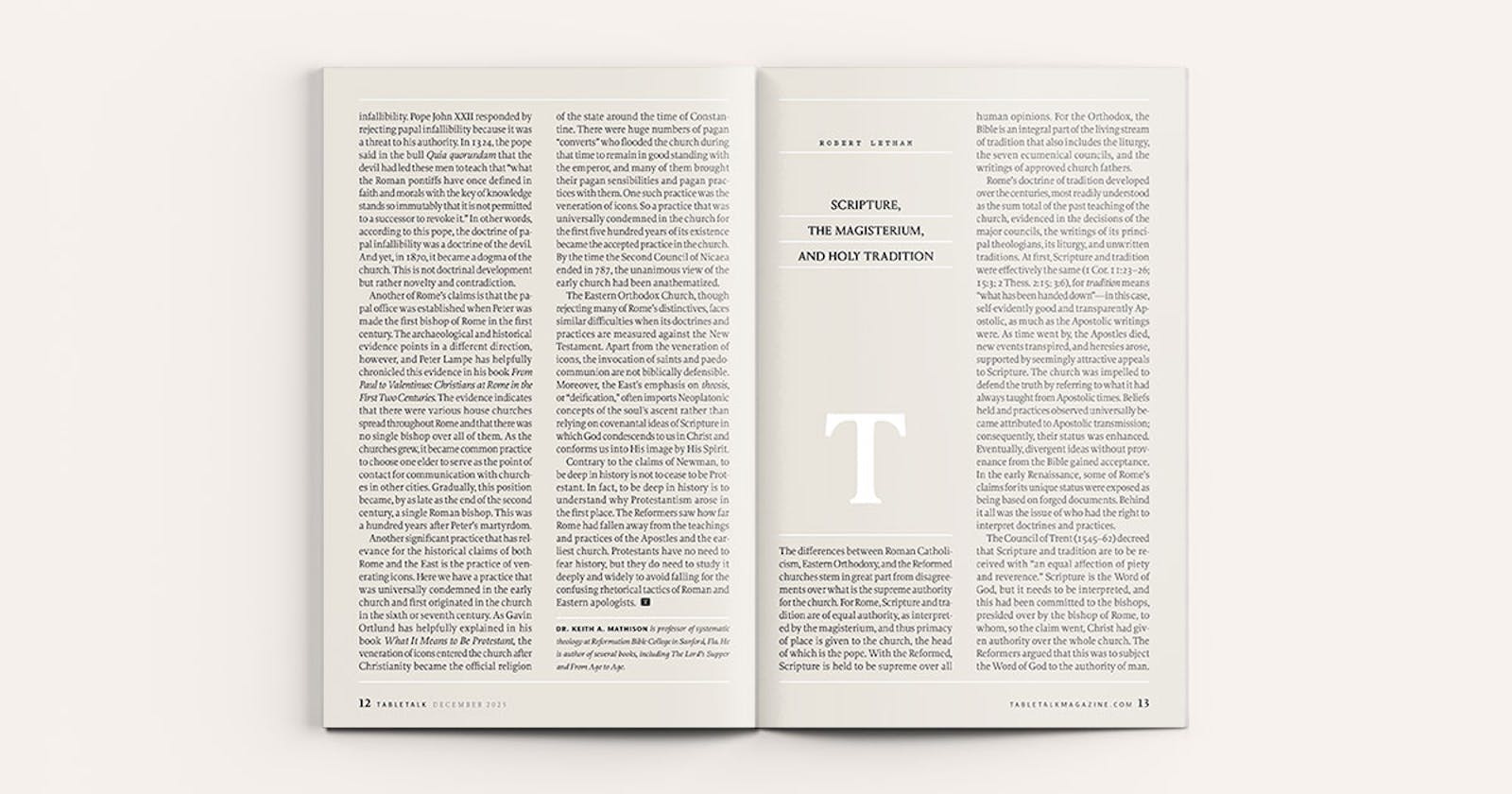
Scripture, the Magisterium, and Holy Tradition
Feature Article
December 2025

Request your free, three-month trial to Tabletalk magazine. You’ll receive the print issue monthly and gain immediate digital access to decades of archives. This trial is risk-free. No credit card required.
Try Tabletalk NowAlready receive Tabletalk magazine every month?
Verify your email address to gain unlimited access.
The differences between Roman Catholicism, Eastern Orthodoxy, and the Reformed churches stem in great part from disagreements over what is the supreme authority for the church. For Rome, Scripture and tradition are of equal authority, as interpreted by the magisterium, and thus primacy of place is given to the church, the head of which is the pope. With the Reformed, Scripture is held to be supreme over all human opinions. For the Orthodox, the Bible is an integral part of the living stream of tradition that also includes the liturgy, the seven ecumenical councils, and the writings of approved church fathers.
Rome’s doctrine of tradition developed over the centuries, most readily understood as the sum total of the past teaching of the church, evidenced in the decisions of the major councils, the writings of its principal theologians, its liturgy, and unwritten traditions. At first, Scripture and tradition were effectively the same (1 Cor. 11:23–26; 15:3; 2 Thess. 2:15; 3:6), for tradition means “what has been handed down”—in this case, self-evidently good and transparently Apostolic, as much as the Apostolic writings were. As time went by, the Apostles died, new events transpired, and heresies arose, supported by seemingly attractive appeals to Scripture. The church was impelled to defend the truth by referring to what it had always taught from Apostolic times. Beliefs held and practices observed universally became attributed to Apostolic transmission; consequently, their status was enhanced. Eventually, divergent ideas without provenance from the Bible gained acceptance. In the early Renaissance, some of Rome’s claims for its unique status were exposed as being based on forged documents. Behind it all was the issue of who had the right to interpret doctrines and practices.
The Council of Trent (1545–62) decreed that Scripture and tradition are to be received with “an equal affection of piety and reverence.” Scripture is the Word of God, but it needs to be interpreted, and this had been committed to the bishops, presided over by the bishop of Rome, to whom, so the claim went, Christ had given authority over the whole church. The Reformers argued that this was to subject the Word of God to the authority of man. Later councils, right up to and including the Second Vatican Council (1962–65), reaffirmed the decrees of Trent.
Protestants did not reject tradition as such. Lutherans, the Reformed, and Anglicans each drew up their own confessions, which duly attained the status of received tradition within their own communions. All such creeds, however, were seen as under the supreme authority of Scripture. Perhaps nowhere is this relationship better expressed than in Article 8 of the Thirty-Nine Articles of Religion of the Church of England:
The three Creeds, Nicene Creed, Athanasius’ Creed, and that which is commonly called the Apostles’ Creed, ought thoroughly to be received and believed; for they may be proved by most certain warrants of Holy Scripture.
Why are the three creeds thoroughly to be received and believed? Because they can be proved by Scripture. Since they conform to Scripture, we believe them and most thoroughly receive them. They have an authority; they express the concerted and continuous result of the biblical exegesis of the Christian church. It is a subordinate authority, however, derived from Scripture, which is “the only rule of faith and practice,” since it is breathed out by the Holy Spirit. That is the meaning of the post-Reformation slogan sola Scriptura, or “Scripture alone.”
That this was not a blanket rejection of tradition is evident from the response to the emergence of Socinianism in the seventeenth century. This radical movement rejected virtually all doctrines of the faith on the ground that they were man-made and not found explicitly in the Bible. Theirs was an attack on the ecumenical councils of the church and on all church tradition. The Reformed, such as Johann Cloppenburg and John Owen, opposed them strenuously. In affirming the supreme authority of Scripture, they recognized that it is to be understood in harmony with the way that Christians have understood it down through the centuries.
The Eastern Orthodox had a different history, with a gradual break with Rome, due in part to their increasing mutual isolation after the collapse of the Roman Empire in the West and the depredations that followed. For them, then and now, Scripture is an integral part of an unbroken, living, and dynamic stream that includes the liturgy, the seven ecumenical councils, and the writings of leading church fathers. The Bible is the Word of God; the Greek and Russian churches, in their missionary activities, customarily translated the Scriptures into the vernacular languages. The extensive divine liturgy is packed with Scripture; in comparison, the practice of wider evangelicalism and even of some Reformed churches is often lacking. But the Bible is regarded as merely a part of tradition and, even if preeminent, not inherently supreme. There was no clear distinction between Scripture and tradition as there was and is in the West. Since Orthodox communions are not hierarchical in the Western sense, with neither pope nor magisterium, legal categories stemming from Rome are not prominent, and different paradigms are at play. There are fewer dogmas and there is greater flexibility, the history of the Middle Ages, Renaissance, Reformation, and Enlightenment having passed them by. But at root a similar, but not identical, problem is evident.
From my own experience on both sides of the Atlantic, if one were to enter a service of many evangelical churches, one would have no idea at all of the position that is claimed for Scripture. The profession may be that Scripture is supreme, but the practice too often says otherwise. On the other hand, the practice in other communions may sometimes be better than the theory.
As the Thirty-Nine Articles state, however, we accept or reject tradition on the basis of how far it may be proved by most certain warrants of Holy Scripture. The Bible is the judge since its primary Author is God. Tradition, at its best, is an interpreter of Scripture, proclaiming it and testifying through it to the glory of God and His saving work in Christ. Tradition can never sit in judgment over Scripture but is judged by it. We do not accept the Bible because it can be proved by most certain warrants of the Nicene Creed; we accept the Nicene Creed because it is proved by the Bible.
Therefore, in the words of the Westminster Confession of Faith:
Synods and councils are to handle, or conclude nothing, but that which is ecclesiastical: and are not to intermeddle with civil affairs which concern the commonwealth, unless by way of humble petition in cases extraordinary; or, by way of advice, for satisfaction of conscience, if they be thereunto required by the civil magistrate. (31.4)
Councils are not a rule of faith and practice since they are capable of error. Conversely:
The supreme judge by which all controversies of religion are to be determined, and all decrees of councils, opinions of ancient writers, doctrines of men, and private spirits, are to be examined, and in whose sentence we are to rest, can be no other but the Holy Spirit speaking in the Scripture. (WCF 1.10)
The Scriptures are the supreme rule, and entailed in this is the point that they are incapable of error.