December 2025
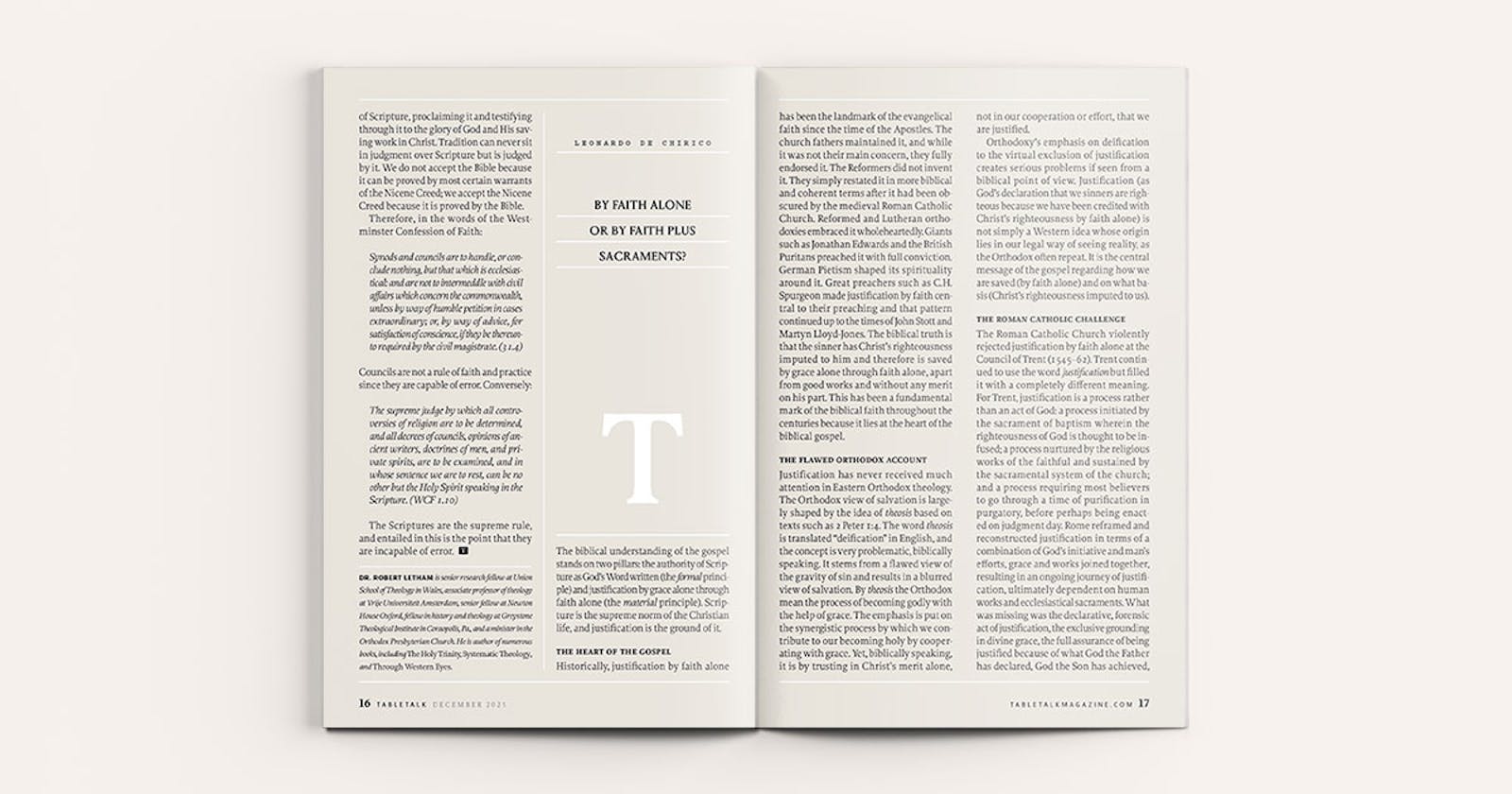
By Faith Alone or by Faith Plus Sacraments?
Feature Article
December 2025

Request your free, three-month trial to Tabletalk magazine. You’ll receive the print issue monthly and gain immediate digital access to decades of archives. This trial is risk-free. No credit card required.
Try Tabletalk NowAlready receive Tabletalk magazine every month?
Verify your email address to gain unlimited access.
The biblical understanding of the gospel stands on two pillars: the authority of Scripture as God’s Word written (the formal principle) and justification by grace alone through faith alone (the material principle). Scripture is the supreme norm of the Christian life, and justification is the ground of it.
the heart of the gospel
Historically, justification by faith alone has been the landmark of the evangelical faith since the time of the Apostles. The church fathers maintained it, and while it was not their main concern, they fully endorsed it. The Reformers did not invent it. They simply restated it in more biblical and coherent terms after it had been obscured by the medieval Roman Catholic Church. Reformed and Lutheran orthodoxies embraced it wholeheartedly. Giants such as Jonathan Edwards and the British Puritans preached it with full conviction. German Pietism shaped its spirituality around it. Great preachers such as C.H. Spurgeon made justification by faith central to their preaching and that pattern continued up to the times of John Stott and Martyn Lloyd-Jones. The biblical truth is that the sinner has Christ’s righteousness imputed to him and therefore is saved by grace alone through faith alone, apart from good works and without any merit on his part. This has been a fundamental mark of the biblical faith throughout the centuries because it lies at the heart of the biblical gospel.
the flawed orthodox account
Justification has never received much attention in Eastern Orthodox theology. The Orthodox view of salvation is largely shaped by the idea of theosis based on texts such as 2 Peter 1:4. The word theosis is translated “deification” in English, and the concept is very problematic, biblically speaking. It stems from a flawed view of the gravity of sin and results in a blurred view of salvation. By theosis the Orthodox mean the process of becoming godly with the help of grace. The emphasis is put on the synergistic process by which we contribute to our becoming holy by cooperating with grace. Yet, biblically speaking, it is by trusting in Christ’s merit alone, not in our cooperation or effort, that we are justified.
Orthodoxy’s emphasis on deification to the virtual exclusion of justification creates serious problems if seen from a biblical point of view. Justification (as God’s declaration that we sinners are righteous because we have been credited with Christ’s righteousness by faith alone) is not simply a Western idea whose origin lies in our legal way of seeing reality, as the Orthodox often repeat. It is the central message of the gospel regarding how we are saved (by faith alone) and on what basis (Christ’s righteousness imputed to us).
the roman catholic challenge
The Roman Catholic Church violently rejected justification by faith alone at the Council of Trent (1545–62). Trent continued to use the word justification but filled it with a completely different meaning. For Trent, justification is a process rather than an act of God: a process initiated by the sacrament of baptism wherein the righteousness of God is thought to be infused; a process nurtured by the religious works of the faithful and sustained by the sacramental system of the church; and a process requiring most believers to go through a time of purification in purgatory, before perhaps being enacted on judgment day. Rome reframed and reconstructed justification in terms of a combination of God’s initiative and man’s efforts, grace and works joined together, resulting in an ongoing journey of justification, ultimately dependent on human works and ecclesiastical sacraments. What was missing was the declarative, forensic act of justification, the exclusive grounding in divine grace, the full assurance of being justified because of what God the Father has declared, God the Son has achieved, and God the Spirit has worked out. Trent came up with a confused and confusing teaching on justification that has been misleading people ever since.
has rome changed?
Many commentators with good intentions, even on the evangelical side, have rightly given attention to what seems to be the heart of the 1999 Joint Declaration on the Doctrine of Justification (JDDJ) signed by representatives from the Roman Catholic Church and the World Lutheran Federation. Paragraph 15 solemnly says:
By grace alone, in faith in Christ’s saving work and not because of any merit on our part, we are accepted by God and receive the Holy Spirit, who renews our hearts while equipping and calling us to good works.
If read out of context and in a theologically naive way, this sentence could be a relevant and pointed summary of the biblical message concerning the mode of justification (by grace alone and not based on merits), the means of justification (by faith alone), the grounds of justification (the saving work of Christ), and the consequences of justification (divine adoption and the gift of the Holy Spirit, the renewal of the heart, and the activation of the Christian life). Yet every sound exercise in theological hermeneutics, including reading documents of ecumenical dialogue, must take into account the immediate and more general context, the meaning of the words used, and the consequences of what is being claimed.
stretching trent rather than reforming rome
Later, in paragraph 28, the JDDJ states that “in baptism the Holy Spirit unites one with Christ, justifies, and truly renews the person.” It is not surprising, however, that the Roman Catholic clarification on this point forcefully underlines that “persons are justified through baptism as hearers of the word and believers in it” (paragraph 27). On the one hand, then, the JDDJ wants to affirm the importance of the declaration of the righteousness of God received by faith. On the other, though, it reiterates the need for sacramental action through the mediation of the church as essential for justification and, therefore, for salvation.
The Roman Catholic point is further reinforced through the claim that the grace of Jesus Christ is “imparted” in baptism (paragraph 30). According to this view, grace is not received by faith alone but is granted by God through the church that administers it in baptism. This statement cannot be reconciled with the view according to which salvation is by grace alone apart from works, even sacramental ones. In contemporary Roman Catholicism we see a total consistency with respect to the traditional doctrine—that is, that justification occurs at baptism by a sacramental act.
For the Roman Catholic Church, the “by grace alone” of paragraph 15 means that grace is intrinsically, constitutionally, and necessarily linked to the sacrament and thus to the church that administers it and the works implemented by it. In this view, salvation cannot be by grace alone, unless “by grace alone” is understood as the same grace being organically incorporated into the sacrament of the church. We are evidently in the presence of a different concept of grace. This view does not change the theology of the Council of Trent, according to which grace is sacramental and seen inside a synergistic dynamic of the process of salvation. In this sense, the JDDJ is a clear exercise in an increased “catholicity” (i.e., the ability to absorb ideas without changing the core) on the part of Rome, which has not become more evangelical in the biblical sense.
conclusion
The church will continue to be founded on the authority of Scripture and justification by faith. There is no other gospel than the biblically attested message of Jesus Christ that saves unworthy sinners like us on the ground of His once-and-for-all work on the cross. Any accommodation to the idea that we are ultimately capable of saving ourselves, any accommodation to the fact that salvation is not God’s gift from beginning to end, is a slippery slope toward a false gospel. Justification is not a theological relic of a distant past. It is indeed key to grasp the good news of Christ. As Paul said:
I count everything as loss because of the surpassing worth of knowing Christ Jesus my Lord. For his sake I have suffered the loss of all things and count them as rubbish, in order that I may gain Christ and be found in him, not having a righteousness of my own that comes from the law, but that which comes through faith in Christ, the righteousness from God that depends on faith. (Phil. 3:8–9)