

Request your free, three-month trial to Tabletalk magazine. You’ll receive the print issue monthly and gain immediate digital access to decades of archives. This trial is risk-free. No credit card required.
Try Tabletalk NowAlready receive Tabletalk magazine every month?
Verify your email address to gain unlimited access.
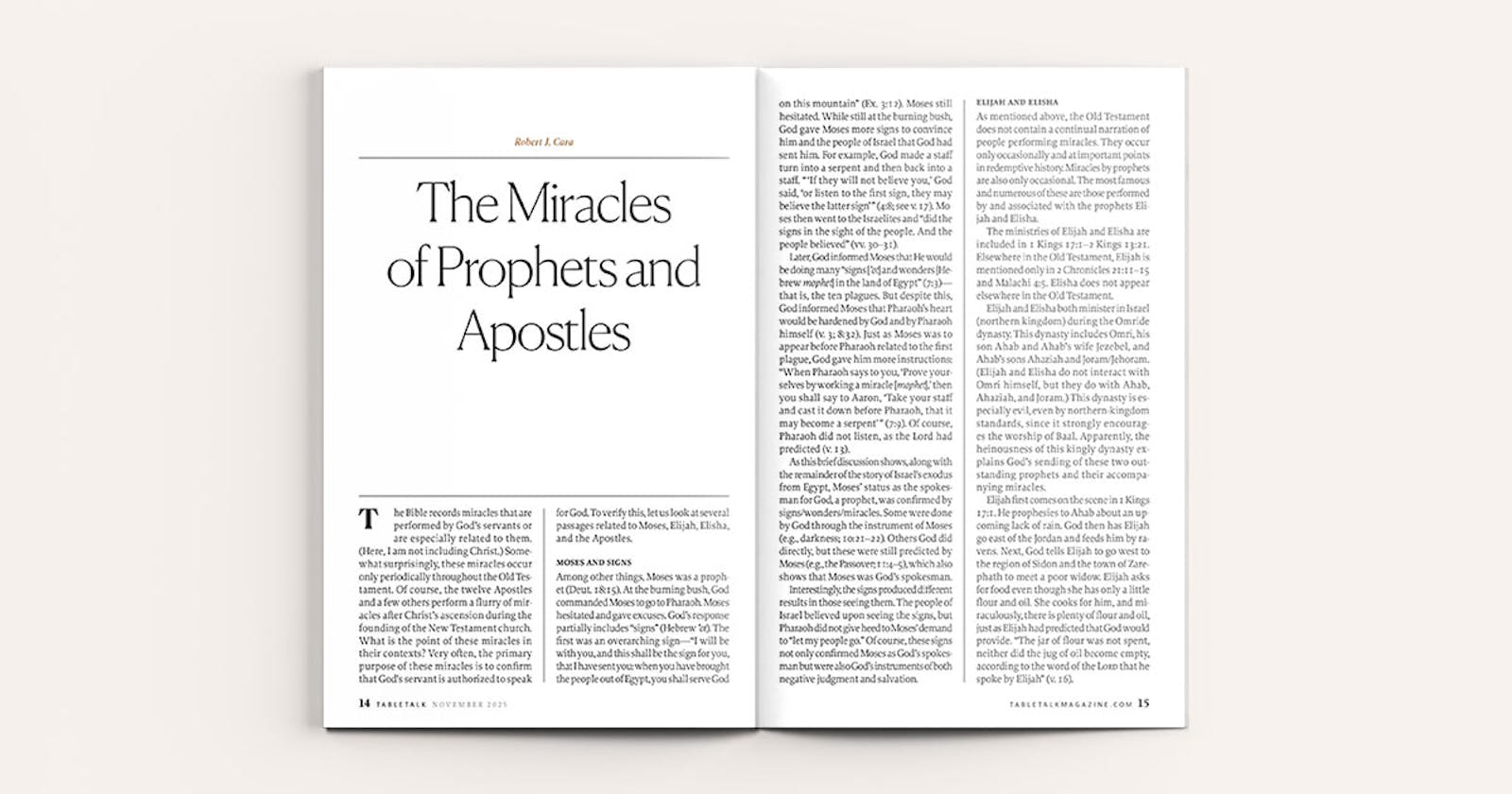
The Bible records miracles that are performed by God’s servants or are especially related to them. (Here, I am not including Christ.) Somewhat surprisingly, these miracles occur only periodically throughout the Old Testament. Of course, the twelve Apostles and a few others perform a flurry of miracles after Christ’s ascension during the founding of the New Testament church. What is the point of these miracles in their contexts? Very often, the primary purpose of these miracles is to confirm that God’s servant is authorized to speak for God. To verify this, let us look at several passages related to Moses, Elijah, Elisha, and the Apostles.
moses and signs
Among other things, Moses was a prophet (Deut. 18:15). At the burning bush, God commanded Moses to go to Pharaoh. Moses hesitated and gave excuses. God’s response partially includes “signs” (Hebrew ’ot). The first was an overarching sign—“I will be with you, and this shall be the sign for you, that I have sent you: when you have brought the people out of Egypt, you shall serve God on this mountain” (Ex. 3:12). Moses still hesitated. While still at the burning bush, God gave Moses more signs to convince him and the people of Israel that God had sent him. For example, God made a staff turn into a serpent and then back into a staff. “‘If they will not believe you,’ God said, ‘or listen to the first sign, they may believe the latter sign’” (4:8; see v. 17). Moses then went to the Israelites and “did the signs in the sight of the people. And the people believed” (vv. 30–31).
Later, God informed Moses that He would be doing many “signs [’ot] and wonders [Hebrew mophet] in the land of Egypt” (7:3)—that is, the ten plagues. But despite this, God informed Moses that Pharaoh’s heart would be hardened by God and by Pharaoh himself (v. 3; 8:32). Just as Moses was to appear before Pharaoh related to the first plague, God gave him more instructions: “When Pharaoh says to you, ‘Prove yourselves by working a miracle [mophet],’ then you shall say to Aaron, ‘Take your staff and cast it down before Pharaoh, that it may become a serpent’ ” (7:9). Of course, Pharaoh did not listen, as the Lord had predicted (v. 13).
As this brief discussion shows, along with the remainder of the story of Israel’s exodus from Egypt, Moses’ status as the spokesman for God, a prophet, was confirmed by signs/wonders/miracles. Some were done by God through the instrument of Moses (e.g., darkness; 10:21–22). Others God did directly, but these were still predicted by Moses (e.g., the Passover; 11:4–5), which also shows that Moses was God’s spokesman.
Interestingly, the signs produced different results in those seeing them. The people of Israel believed upon seeing the signs, but Pharaoh did not give heed to Moses’ demand to “let my people go.” Of course, these signs not only confirmed Moses as God’s spokesman but were also God’s instruments of both negative judgment and salvation.
elijah and elisha
As mentioned above, the Old Testament does not contain a continual narration of people performing miracles. They occur only occasionally and at important points in redemptive history. Miracles by prophets are also only occasional. The most famous and numerous of these are those performed by and associated with the prophets Elijah and Elisha.
The ministries of Elijah and Elisha are included in 1 Kings 17:1–2 Kings 13:21. Elsewhere in the Old Testament, Elijah is mentioned only in 2 Chronicles 21:11–15 and Malachi 4:5. Elisha does not appear elsewhere in the Old Testament.
Elijah and Elisha both minister in Israel (northern kingdom) during the Omride dynasty. This dynasty includes Omri, his son Ahab and Ahab’s wife Jezebel, and Ahab’s sons Ahaziah and Joram/Jehoram. (Elijah and Elisha do not interact with Omri himself, but they do with Ahab, Ahaziah, and Joram.) This dynasty is especially evil, even by northern-kingdom standards, since it strongly encourages the worship of Baal. Apparently, the heinousness of this kingly dynasty explains God’s sending of these two outstanding prophets and their accompanying miracles.
Elijah first comes on the scene in 1 Kings 17:1. He prophesies to Ahab about an upcoming lack of rain. God then has Elijah go east of the Jordan and feeds him by ravens. Next, God tells Elijah to go west to the region of Sidon and the town of Zarephath to meet a poor widow. Elijah asks for food even though she has only a little flour and oil. She cooks for him, and miraculously, there is plenty of flour and oil, just as Elijah had predicted that God would provide. “The jar of flour was not spent, neither did the jug of oil become empty, according to the word of the Lord that he spoke by Elijah” (v. 16).
Subsequently, the widow’s son dies, and she blames Elijah. He takes the son and lies upon him, praying. The son revives. The widow exclaims, “Now I know that you are a man of God, and that the word of the Lord in your mouth is truth” (v. 24). These two opening miracles related to the widow confirm that Elijah speaks for God. Further, they set the pattern for all the Elijah and Elisha miracles.
Picking back up on the prophecy of no rain, it is now three years later and there has been no rain. In this context, Elijah has his famous showdown with Ahab’s 450 prophets of Baal. As part of the climactic scene in which God sends down the fire to consume the sacrifice, Elijah prays out loud, “Let it be known this day that you are God in Israel, and that I am your servant, and that I have done all these things at your word” (18:36). After this, Elijah tells Ahab that rain will be coming, and then it does come (vv. 41–46). These fire and rain miracles again confirm that Elijah speaks for God.
Fleeing from Jezebel, Elijah is at Mount Horeb (Mount Sinai) in a cave (see Moses in the cleft of the rock; Ex. 33:22). To destroy the Omride dynasty, God tells Elijah to anoint the Syrian king Hazael, anoint the future Israelite king Jehu, and anoint Elisha the prophet (1 Kings 19:9–18). Together, these three eventually do destroy the Omride dynasty and its Baal worship, and Jehu becomes king of Israel (2 Kings 10:28–31). All this was done “according to the word of the Lord that he spoke to Elijah” (v. 17). Even though this is not an example of Elijah’s speaking per se, it does prove that God truly spoke to Elijah, which would be a prerequisite of his speaking for God.
Next are several examples of Elijah’s hearing the word of the Lord and conveying the message. Ahab and Jezebel will die, with dogs being involved (1 Kings 21:19–21). Ahaziah’s death is predicted (2 Kings 1:3–4). All these prophecies come true. For example, related to Ahaziah’s death, “He died according to the word of the Lord that Elijah had spoken” (v. 17). All these examples again demonstrate that God speaks through His servant Elijah.
Second Kings 2:1–14 recounts the story of the transfer of the prophetic role from Elijah to Elisha. God takes Elijah to heaven in a whirlwind by the chariots and horses of fire. Both Elijah and Elisha part the Jordan, recalling Moses’ parting the Red Sea (Ex. 14:21). Elisha’s next miracle is his “healing” of the polluted water near Jericho by throwing salt in it. He proclaims: “Thus says the Lord, I have healed this water. . . . So the water has been healed to this day, according to the word that Elisha spoke” (2 Kings 2:21–22). Again, Elisha’s words match God’s words.
Israel and Judah are fighting Moab. They seek help from Elisha. He gives two prophecies that both begin, “Thus says the Lord” (3:16–20). Both come true, and Moab is defeated. Yes, when Elisha says that he is speaking for the Lord, it is proved true.
Five miracles are recorded in 2 Kings 4. One of them relates to a wealthy Shunammite woman who shows hospitality to Elisha. She has no son, and her husband is old. Elisha predicts that she will bear a son, and it comes to pass. Later, her son, now an adult, dies. Elisha, in a scene similar to that of Elijah (1 Kings 17:17–24), lies on the son, and he revives (2 Kings 4:8–37). This scene is also similar to Christ’s raising of the widow’s son at Nain (Luke 7:11–17). Another relates to a man who brings twenty loaves of bread and corn to the prophets’ camp. Elisha asks him to feed all one hundred men. The man objects that there is not enough. Elisha says, “Give them to the men, that they may eat, for thus says the Lord, ‘They shall eat and have some left.’” The men do eat and have “some left, according to the word of the Lord” (2 Kings 4:43–44). This fifth of the five miracles is the only one that explicitly connects Elisha’s word to God’s words. The obvious implication for the other four, however, is that God gave a word to Elisha about each miracle. Also, note how the twenty loaves of bread and corn miracle is similar to Christ’s feeding the five thousand and the four thousand.
Naaman is a military officer in the Syrian army who has leprosy. He hears about Elisha’s healing abilities. He sends a letter to the king of Israel, asking to be healed. The king is in a panic (he tears his clothes) because he thinks this is an excuse for a quarrel. Elisha sends a message to the king: “Why have you torn your clothes? Let him come now to me, that he may know that there is a prophet in Israel” (2 Kings 5:8). Eventually, Elisha facilitates Naaman’s healing.
There are several incidents related to Syrian invasions into Israel (6:8–7:20). In sum, the mysterious horses and chariots of fire defeat the Syrian plans. At one point, Elisha proclaims during a siege of Samaria just before God saves the city, “Hear the word of the Lord: thus says the Lord, Tomorrow about this time a seah of fine flour shall be sold for a shekel” (7:1). To summarize the miracles associated with the prophets Elijah and Elisha, there is a very strong emphasis on their being the authorized spokesmen for God. When they proclaim, “Thus says the Lord,” their statements are true. This is a validation that they are true prophets. In addition, to state the obvious, these miracles are a validation that the Lord is truly God. Another implication is that these miracles are a foreshadowing of some of the miracles that Christ and His Apostles will perform.
apostles in acts
Given the Old Testament pattern of miracles occurring at important points in the history of redemption, one would expect the Apostles to perform miracles because the New Testament church is being founded. This is indeed what we find, and it is clear that these miracles demonstrate, among other things, that the Apostles are authorized to speak for God. For example, in his defense, Paul notes that “the signs [Greek sēmeion] of a true apostle were performed among you . . . with signs [sēmeion] and wonders [teras] and mighty works [dynamis]” (2 Cor. 12:12; see Ex. 7:3; Rom. 15:18–19).
For the purposes of this article, a brief look at the Apostles and other authorized speakers in Acts is presented. To begin with, Acts has a significant emphasis on the preached Word of God. In fact, some scholars, probably overstating the case, see this as the emphasis in Acts. Why? The Word is the primary human means by which the church grows (e.g., Acts 6:7; 8:25; 11:1; 12:24; 13:49; 18:11; 19:10, 20). Acts 6:1–6 is one place that shows its importance. The Apostles choose deacons because they do not want to “give up preaching the word of God” and want to devote themselves “to prayer and to the ministry of the word.” This preaching emphasis in Acts then dovetails with the miracles in Acts. The miracles primarily confirm that the preachers of the word of God are actually speaking for God. Consider Luke’s comment about Paul and Barnabas’ ministry in Iconium: “They remained for a long time, speaking boldly for the Lord, who bore witness to the word of his grace, granting signs [sēmeion] and wonders [teras] to be done by their hands” (14:3). This text confirms that the preaching is from the Lord, but further, the Lord “bore witness” or confirmed this by having Paul and Barnabas perform “signs and wonders.”
Numerous times in Acts, the words “signs” (sēmeion), “wonders” (teras), and “mighty works” (dynamis) are used to confirm the legitimacy of an authorized spokesman for God. First there is the connection to Christ. Peter’s Pentecost sermon includes his stating that God attested to Christ by “mighty works and wonders and signs” (Acts 2:22; see 10:38). Second, there is a connection to Moses and Christ. In his defense, Stephen notes that Moses “perform[ed] wonders and signs in Egypt and at the Red Sea and in the wilderness for forty years” (7:36). Stephen then connects this to Moses’ prediction of a future prophet who would be like Moses, who is Christ (v. 37; see Deut. 18:15). These attesting miracles of Christ and Moses are then a paradigm for the Apostles. Related to the Apostles and a few others, the expressions “signs,” “wonders,” and “mighty works” are also explicitly mentioned. They may be categorized as follows: the Apostles as a group (Acts 2:43; 4:30; 5:12), Peter (4:16), Stephen (6:8), Philip (8:6, 13), Paul and Barnabas (14:3; 15:12), and Paul specifically (19:11). Here is just one example: “Many signs and wonders were regularly done among the people by the hands of the apostles” (5:12).
Specifically, what miracles were done by the Apostles or directly associated with them? There were many healings (3:6; 5:15–16; 8:7; 9:34; 14:8–10; 19:12; 28:8–9) and two raisings from the dead (9:36–40; 20:8–10). There were also miracles related to prison escapes (5:19–20; 12:7–8; 16:26; cf. 7:10) and righteous punishment (5:1–11; 8:13–24; 13:11; 16:18; see 12:23). Although there is no space to expand on it here, there are several Peter/Paul parallels to these miracles—for example, both raised someone from the dead and both escaped from prison.
To summarize, Acts significantly emphasizes the church’s growing through the means of preaching the Word of God. God uses signs, wonders, and mighty works—that is, miracles—performed by the Apostles and a few others to confirm that those preaching the Word of God are authorized by God to do so. There are additional secondary purposes of miracles that include a glimpse of the future eschatological state (e.g., healings) and the continuity between Old Testament prophets and New Testament Apostles with Christ.
conclusion
At important points in the history of redemption, miracles are associated with those who speak directly for God. This article has looked at miracles associated with Moses, Elijah, Elisha, and the New Testament Apostles. Certainly, there are a variety of implications, but the primary purpose of these miracles is to confirm that God’s servant is authorized to speak for God.