
November 2025
Miracles, Signs, Wonders, and the Word
Feature Article
November 2025

Request your free, three-month trial to Tabletalk magazine. You’ll receive the print issue monthly and gain immediate digital access to decades of archives. This trial is risk-free. No credit card required.
Try Tabletalk NowAlready receive Tabletalk magazine every month?
Verify your email address to gain unlimited access.
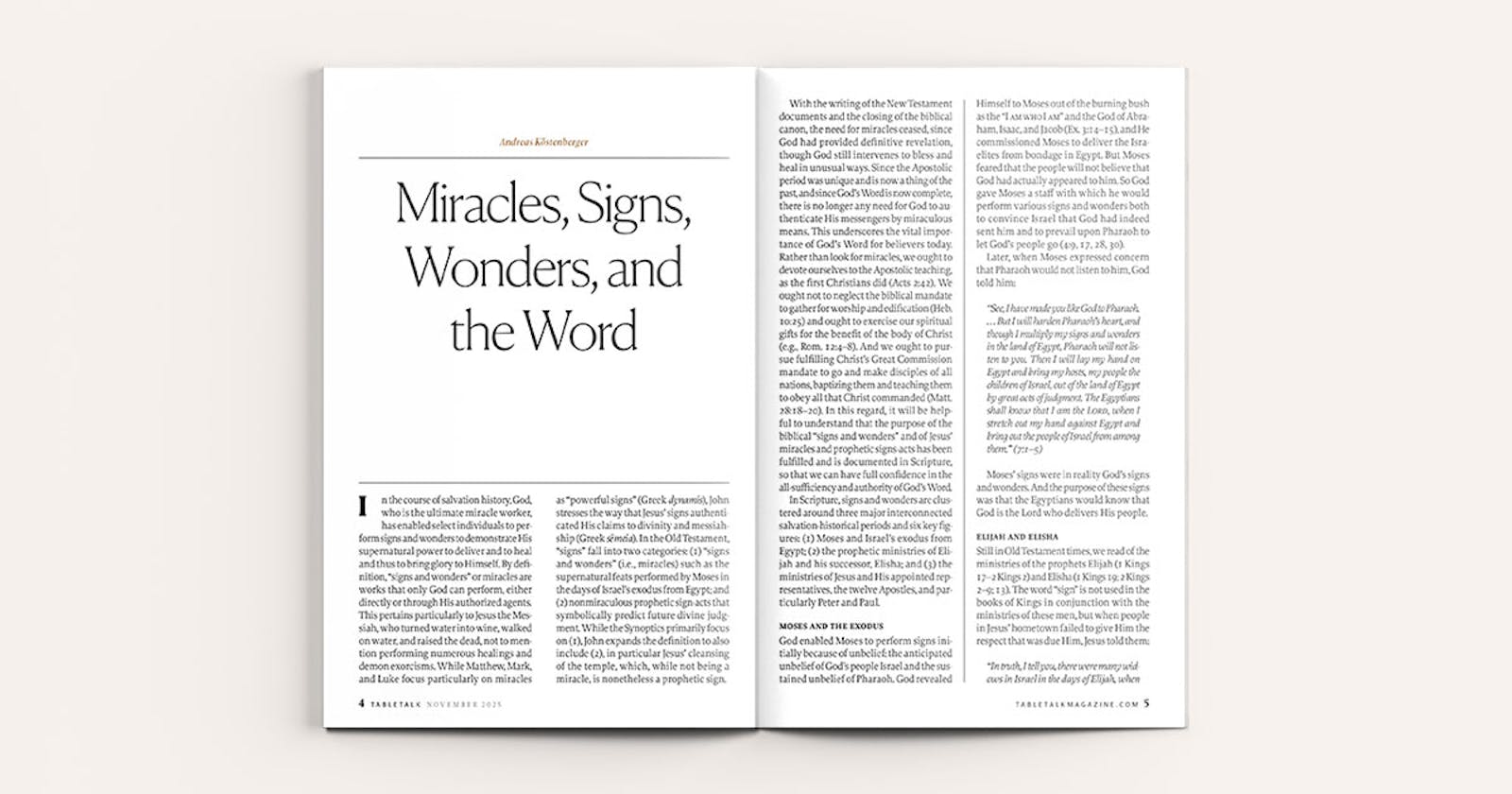
In the course of salvation history, God, who is the ultimate miracle worker, has enabled select individuals to perform signs and wonders to demonstrate His supernatural power to deliver and to heal and thus to bring glory to Himself. By definition, “signs and wonders” or miracles are works that only God can perform, either directly or through His authorized agents. This pertains particularly to Jesus the Messiah, who turned water into wine, walked on water, and raised the dead, not to mention performing numerous healings and demon exorcisms. While Matthew, Mark, and Luke focus particularly on miracles as “powerful signs” (Greek dynamis), John stresses the way that Jesus’ signs authenticated His claims to divinity and messiahship (Greek sēmeia). In the Old Testament, “signs” fall into two categories: (1) “signs and wonders” (i.e., miracles) such as the supernatural feats performed by Moses in the days of Israel’s exodus from Egypt; and (2) nonmiraculous prophetic sign-acts that symbolically predict future divine judgment. While the Synoptics primarily focus on (1), John expands the definition to also include (2), in particular Jesus’ cleansing of the temple, which, while not being a miracle, is nonetheless a prophetic sign.
With the writing of the New Testament documents and the closing of the biblical canon, the need for miracles ceased, since God had provided definitive revelation, though God still intervenes to bless and heal in unusual ways. Since the Apostolic period was unique and is now a thing of the past, and since God’s Word is now complete, there is no longer any need for God to authenticate His messengers by miraculous means. This underscores the vital importance of God’s Word for believers today. Rather than look for miracles, we ought to devote ourselves to the Apostolic teaching, as the first Christians did (Acts 2:42). We ought not to neglect the biblical mandate to gather for worship and edification (Heb. 10:25) and ought to exercise our spiritual gifts for the benefit of the body of Christ (e.g., Rom. 12:4–8). And we ought to pursue fulfilling Christ’s Great Commission mandate to go and make disciples of all nations, baptizing them and teaching them to obey all that Christ commanded (Matt. 28:18–20). In this regard, it will be helpful to understand that the purpose of the biblical “signs and wonders” and of Jesus’ miracles and prophetic signs-acts has been fulfilled and is documented in Scripture, so that we can have full confidence in the all-sufficiency and authority of God’s Word.
In Scripture, signs and wonders are clustered around three major interconnected salvation-historical periods and six key figures: (1) Moses and Israel’s exodus from Egypt; (2) the prophetic ministries of Elijah and his successor, Elisha; and (3) the ministries of Jesus and His appointed representatives, the twelve Apostles, and particularly Peter and Paul.
moses and the exodus
God enabled Moses to perform signs initially because of unbelief: the anticipated unbelief of God’s people Israel and the sustained unbelief of Pharaoh. God revealed Himself to Moses out of the burning bush as the “I am who I am” and the God of Abraham, Isaac, and Jacob (Ex. 3:14–15), and He commissioned Moses to deliver the Israelites from bondage in Egypt. But Moses feared that the people will not believe that God had actually appeared to him. So God gave Moses a staff with which he would perform various signs and wonders both to convince Israel that God had indeed sent him and to prevail upon Pharaoh to let God’s people go (4:9, 17, 28, 30).
Later, when Moses expressed concern that Pharaoh would not listen to him, God told him:
“See, I have made you like God to Pharaoh. . . . But I will harden Pharaoh’s heart, and though I multiply my signs and wonders in the land of Egypt, Pharaoh will not listen to you. Then I will lay my hand on Egypt and bring my hosts, my people the children of Israel, out of the land of Egypt by great acts of judgment. The Egyptians shall know that I am the Lord, when I stretch out my hand against Egypt and bring out the people of Israel from among them.” (7:1–5)
Moses’ signs were in reality God’s signs and wonders. And the purpose of these signs was that the Egyptians would know that God is the Lord who delivers His people.
elijah and elisha
Still in Old Testament times, we read of the ministries of the prophets Elijah (1 Kings 17–2 Kings 2) and Elisha (1 Kings 19; 2 Kings 2–9; 13). The word “sign” is not used in the books of Kings in conjunction with the ministries of these men, but when people in Jesus’ hometown failed to give Him the respect that was due Him, Jesus told them:
“In truth, I tell you, there were many widows in Israel in the days of Elijah, when the heavens were shut up three years and six months, and a great famine came over all the land, and Elijah was sent to none of them but only to Zarephath, in the land of Sidon, to a woman who was a widow. And there were many lepers in Israel in the time of the prophet Elisha, and none of them was cleansed, but only Naaman the Syrian.” (Luke 4:25–27)
Thus Elijah and Elisha continued to manifest God’s miracle-working power in their day. In fact, both raised people from the dead, Elijah a Phoenician boy in Zarephath (1 Kings 17) and Elisha the son of a Shunammite woman (2 Kings 4). Elisha also miraculously fed the hungry, foreshadowing Jesus’ feeding of the multitudes (2 Kings 4:38–44; see John 6:1–15).
nonmiraculous signs in the ot
The Old Testament also refers to nonmiraculous prophetic signs symbolizing impending divine judgment. A classic example is the prophet Isaiah, whom the Lord told, “Go, and loose the sackcloth from your waist and take off your sandals from your feet” (Isa. 20:2). When the prophet complied and walked around naked and barefoot, the Lord declared:
“As my servant Isaiah has walked naked and barefoot for three years as a sign and a portent against Egypt and Cush, so shall the king of Assyria lead away the Egyptian captives and the Cushite exiles, both the young and the old, naked and barefoot, with buttocks uncovered, the nakedness of Egypt. Then they shall be dismayed and ashamed because of Cush their hope and of Egypt their boast. And the inhabitants of this coastland will say in that day, ‘Behold, this is what has happened to those in whom we hoped and to whom we fled for help to be delivered from the king of Assyria! And we, how shall we escape?’” (vv. 3–6)
Isaiah’s walking about naked and barefoot served as a sign of God’s judgment on the people’s misplaced trust in Egypt and Cush. Later, Ezekiel performed a series of three nonmiraculous prophetic signs symbolizing the siege of Jerusalem involving taking a brick, lying on his left side, and making and eating bread (Ezek. 4). Similarly, Jeremiah was told to break a piece of pottery and make himself straps and yoke-bars to visually convey God’s impending judgment in a series of prophetic signs (Jer. 19; 27–28).
These examples show that while signs in Old Testament times were often miraculous (“signs and wonders”), they sometimes were not but rather involved symbolic actions that served as prophetic portents of divine judgment. Thus, signs in the Old Testament served to convey both God’s authority to judge and His power to deliver.
jesus and the apostles
Synoptic Gospels. Moving into the New Testament period, the Synoptic Gospels indicate that Jesus, when challenged to provide a sign of His authority, replied:
“An evil and adulterous generation seeks for a sign, but no sign will be given to it except the sign of the prophet Jonah. For just as Jonah was three days and three nights in the belly of the great fish, so will the Son of Man be three days and three nights in the heart of the earth.” (Matt. 12:39–40)
Jesus didn’t perform signs on demand. Those who persisted in unbelief would be given no sign other than Jonah’s three-day ordeal of “burial” and “resurrection,” which pointed to Jesus’ burial and resurrection.
John. John, doubtless aware of the earlier gospels, centers the first half of his gospel on seven messianic signs of Jesus. In this, he likely seeks to provide a counterpoint to the Synoptics by stressing that, rightly understood, all of Jesus’ miracles were in fact signs pointing beyond themselves to Jesus’ messianic identity. To make this point, John frequently couples a striking act of Jesus with a lengthy discourse and/or an “I am” saying. For example, while the feeding of the five thousand is featured in all four Gospels, only John follows up with the Bread of Life Discourse, identifying Jesus as the “bread from heaven,” the antitype of the manna that God sent to feed the Israelites in the wilderness (John 6).
Jesus’ seven messianic signs in John reveal His fulfillment of messianic expectations: He healed the sick (4:46–54; 5:1–15), fed the hungry (6:1–15), opened the eyes of the blind (9:1–41), and even raised the dead (11:1–44). He is also the heavenly Bridegroom (2:1–11; 3:29). In addition, in an instance of a nonmiraculous, prophetic sign of divine judgment, Jesus cleared the temple, a portent of the destruction of the “temple” of His body—the crucifixion—and His rising from the dead (2:13–22). While not everyone agrees that the temple clearing is a Johannine sign—more commonly, scholars include Jesus’ walking on the water (6:16–21)—the temple clearing fits the profile of Old Testament prophetic signs conveying God’s impending judgment.
By focusing on the significant nature of Jesus’ works and deemphasizing their miraculous character, John stresses that many in Jesus’ day were wowed by the striking feats that Jesus performed while missing their true significance: These powerful manifestations pointed to Jesus as the Messiah and Son of God (see especially 20:30–31).
It is possible to see, or even be the recipient of, Jesus’ miracles and yet to miss their true God-intended purpose. Case in point: the thirty-eight-year invalid who was healed by Jesus yet tragically failed to recognize Him as the God-sent Messiah (5:1–15). By contrast, the man born blind moved from receiving physical sight to spiritual seeing, and even to worship of Jesus (9:38).
Pointedly, in John’s gospel, the only person performing any signs is Jesus. While John the Baptist’s witness was true, he didn’t perform any signs (10:41); neither did the disciples or anyone else. Jesus’ signs are in a category of their own. They identify Him, and Him alone, as the Messiah and God-sent one-of-a-kind Son (1:14, 18; 3:16, 18).
the signs’ christocentrism
In the Bible’s Christ-focused forward movement, the signs performed by Moses and Elijah/Elisha point ahead to those of Jesus, while the signs wrought by the Apostles point backward to Him. Jesus’ signs authenticate Him as the One whom God sent. Jesus is the climax of salvation history anticipated by both Moses and the prophets (1:45; see also 5:45–46).
In Luke’s gospel, Jesus, speaking to Moses and Elijah, even refers to His impending death as His “departure” or “exodus” (Greek exodos; Luke 9:31). Luke also depicts Jesus as the new and greater Elijah/Elisha and includes numerous parallels between their respective ministries, such as Jesus’ healing of the widow’s son in 7:11–17, which mirrors Elijah’s raising of a widow’s son (1 Kings 17:17–24). In this way, Jesus marks the fulfillment of God’s previous performance of powerful signs through His appointed prophetic representatives.
the apostles in acts
The book of Acts, the sequel to Luke’s gospel, chronicles what Jesus continued to do through the agency of the Apostles (Acts 1:1). This was needed because the New Testament was yet to be written. In the meantime, God authenticated the Apostles’ preaching of the gospel by striking signs. The Apostles proclaimed that while the Jewish authorities, along with the Roman governor, had put Jesus on the cross, God vindicated Him and raised Him from the dead. The Apostles’ proclamation of Jesus’ resurrection dominates the entire book of Acts, and thousands responded to the gospel in repentance and faith (2:41; 4:4).
God, for His part, underscored the veracity of the Apostles’ message by performing countless signs and wonders through them. In the early days of the church, Peter healed a lame man, just as Jesus had done before him, and people were struck by wonder and amazement (3:1–10). Later, Peter even raised a woman from the dead (9:40–41).
Later, Luke reports that “God was doing extraordinary miracles by the hands of Paul, so that even handkerchiefs or aprons that had touched his skin were carried away to the sick, and their diseases left them and the evil spirits came out of them” (19:11–12). In the ensuing narrative, Paul raised a young man to life after a fatal fall (20:9–12). There is no doubt that God performed numerous miracles through the Apostles to authenticate their preaching of the resurrected Jesus.
the apostolic and postapostolic eras
The Apostolic era marks the period after Jesus’ resurrection and ascension until the completion of the New Testament canon. The signs and wonders performed by the Apostles, similar to those wrought by Jesus, marked the Apostles as God’s chosen representatives and spokesmen. They also identified them as Jesus’ true successors who were authorized to carry on His redemptive mission. The Apostolic ministry also included the production of inspired holy Scriptures, new covenant documents that recounted the story of Jesus and laid out the implications of His work for believers individually and for communities of believers, the church, corporately. Once the canon was closed, the Scriptures became the abiding authoritative norm for all believers. The need for further signs and wonders ceased, because any such additional miracles would only detract from the uniqueness of the person and work of Jesus and the uniqueness of the Apostles’ role as the foundation of the church along with the prophets (Eph. 2:20).
conclusion
In the end, as we’ve seen was the case throughout biblical times, it is not humans but God who performs miraculous signs and wonders, though God sometimes uses humans as means. This God is eternal, unchanging, and all-powerful. He can work in extraordinary ways today as He did in the past, though He no longer uses miracles to authenticate His messengers. Yet we shouldn’t get sidetracked by an undue focus on the miraculous and miss that which alone matters in the final analysis: our glorious redemption in and through the Lord Jesus Christ and the definitive revelation of God’s power and truth in Him. Jesus is the incarnate Word and the one-of-a-kind Son who made the Father known (John 1:18). The incarnate Word and the written Word are forever linked in providing a way to the Father and revealing His glory effectively to those who become His spiritual sons and daughters in Christ by faith.